Nutrient Dynamics in Mangroves: From Biogeochemical Cycling to Ecosystem Function
 and Pullaikodi Sreeja
Department of Botany, Sir Syed College, Kannur University, Taliparamba, Kerala, India
Corresponding Author’s E-mail: haripriyababurajphd@gmail.com
Download this article as:
ABSTRACT:Mangrove ecosystems are critical to coastal protection, nutrient cycling, and carbon sequestration, playing an essential role in environmental stability and biodiversity. Their occurrence under challenging conditions, including high salinity, waterlogging, and low oxygen availability, is supported by diverse physiological and ecological mechanisms that regulate nutrient acquisition, storage, and utilization. This review synthesizes published literature on macro and micronutrients in mangrove ecosystems, focusing on nutrient cycling, plant physiological responses, and ecosystem functioning. Relevant literature was reviewed using major scientific databases, including Web of Science, Scopus, and Google Scholar, with emphasis on studies addressing nutrient dynamics, plant–nutrient interactions, and ecosystem processes. Nutrient availability varies substantially among mangrove ecosystems and is influenced by sediment characteristics, tidal and riverine inflows, organic matter accumulation, and anthropogenic nutrient enrichment. The synthesis indicates that nitrogen and phosphorus are frequently limiting nutrients, while nutrient availability strongly influences species-specific nutrient acquisition, retranslocation, storage, productivity, and ecosystem processes. Various mangrove species exhibit specialized nutrient strategies, such as nutrient retranslocation and storage in leaves and roots, which allow them to thrive in nutrient-poor environments. These species-specific strategies influence plant productivity, litter production, nutrient cycling, and carbon storage, thereby contributing to broader ecosystem processes and trophic interactions. The reviewed evidence also indicates that changes in nutrient inputs can modify biogeochemical processes and ecosystem functioning, highlighting the importance of understanding nutrient–plant interactions in mangrove conservation and restoration. This paper provides an integrated understanding of nutrient dynamics and species-specific physiological responses, which is essential for assessing mangrove ecosystem functioning and developing effective management strategies.
KEYWORDS:Ecophysiology; Ecosystem functioning; Macronutrients; Mangrove ecosystems; Micronutrients; Nutrient cycling
Introduction
Mangrove ecosystems are among the most productive and ecologically important coastal habitats, occurring where land meets the sea. Bunting et al.,1 reported that, these distinctive intertidal woodlands are essential buffers between marine and terrestrial environments, offering a wide range of ecological functions such as shoreline stabilization, nursery habitats for fish and crustaceans, carbon sequestration, and biodiversity conservation. The total global coverage of mangroves is estimated to be approximately 137,600 square kilometers (13.76 million hectares) as reported by Bunting et al.1 Their growth and productivity depend on their ability to acquire and use nutrients because of their special adaptations, which enable them to tolerate high salinity, waterlogged soils, and low oxygen levels.
One of the most important complex processes governing the health and functioning of mangrove ecosystems is nutrient cycling.2 Nutrients such as nitrogen, phosphorus, potassium, calcium, magnesium, and sulfur are essential elements required for plant growth and ecosystem productivity, whereas biogeochemical cycling refers to the processes through which these elements are transformed, transported, retained, and recycled within mangrove ecosystems.2 Liu et al.,3 reported that in coastal systems, nutrient dynamics are influenced by factors such as tidal inundation, sediment composition, salinity, and anthropogenic inputs. Mangroves, with their dense root systems and unique physiology, are crucial in capturing, converting, and recycling these nutrients, making them key regulators of biogeochemical processes in tropical and subtropical coastlines. Mangroves contribute significantly to the cycling of nutrients by effectively absorbing and utilizing essential macro and micronutrients.4-6
The present review provides a comprehensive overview of nutrient dynamics in mangrove ecosystems, with a focus on key nutrient cycles, their sources, transformations, and functional roles in ecosystem processes. The review also aims to highlight the role of mangroves in cycling and retention of nutrients, the impact of anthropogenic disturbances, emerging research needs and potential directions for future research and conservation strategies. Although nutrient dynamics in mangroves have been widely investigated, knowledge remains fragmented across studies addressing nutrient cycling, plant physiological responses, productivity, and ecosystem functioning. In particular, the linkages between nutrient availability and plant-level responses and their consequences for broader ecosystem processes have not been sufficiently integrated. The present review identifies and synthesizes these interconnected aspects to provide an integrated understanding of how nutrient dynamics influence plant processes and ecosystem functioning. It further examines the role of mangroves in nutrient cycling and retention, the effects of anthropogenic disturbances, and emerging research needs, with implications for mangrove conservation, restoration, and management.
Literature Search Strategy
This paper presents a narrative critical review of nutrient dynamics in mangrove ecosystems and evaluates their functional characteristics in relation to nutrient availability. The review examines nutrient sources, cycling and transformations, plant nutrient utilization, productivity, biodiversity, nutrient losses, and the effects of environmental and anthropogenic factors, including climate change. Relevant literature was identified through searches of Web of Science, Scopus, and Google Scholar, supplemented by relevant books and peer-reviewed publications. The literature search covered publications from 1940 to 2025, was conducted from April to September 2025, and was updated in April 2026. The search was conducted using combinations of following keywords including: “nutrient cycling” AND “mangrove ecosystem”; “nutrient dynamics” AND mangrove; “nutrient availability” AND mangrove; “mangrove” AND “plant–nutrient interactions”; “mangrove” AND “carbon sequestration”; and “mangrove” AND “biodiversity”. Additional combinations involving nutrient cycling, plant physiology, ecosystem functioning, productivity, and food-chain interactions were used to identify relevant studies.
Following the initial search, records were screened based on their title, abstract, and relevance to the objectives of the review. Studies focusing on mangrove nutrient dynamics, plant physiological responses, nutrient transformations, productivity, and related ecosystem processes were considered for detailed examination. Studies unrelated to mangrove nutrient processes or ecosystem functioning, as well as publications without sufficient relevance to the review objectives, were excluded. Relevant full-text studies were subsequently examined and synthesized thematically to identify major patterns, relationships, research gaps, and emerging research needs concerning nutrient dynamics and their links with plant processes and ecosystem functioning. As this study is a narrative critical review rather than a systematic review, the literature was synthesized thematically rather than through a formal systematic-review protocol or quantitative meta-analysis.
Results and Discussion
The results were discussed under two major thematic areas; nutrient dynamics and their ecophysiological implications, followed by temporal distribution of research on mangrove nutrient dynamics.
Nutrient dynamics
Mangroves are important coastal ecosystems that are significant for protecting the coast and cycling of nutrients. Their occurrence under challenging environmental conditions, including high salinity, waterlogging, and low oxygen availability, requires specialized mechanisms for nutrient acquisition and utilization. Mangroves nutritional dynamics are influenced by the uptake and use of essential macronutrients including nitrogen, phosphorus, and potassium and also micronutrients like iron, manganese, zinc, copper, and boron.7 According to Huxham et al.,8 these nutrients are supplied through sedimentary and tidal inputs and are influenced by organic matter and detritus deposition.
Sahoo & Dhal9 reported that mangrove habitats support diverse microbial communities that play central roles in nutrient transformations. Microbial decomposition of mangrove litter and other organic matter releases mineral nutrients into sediments and porewater, while subsequent microbial processes can transform these nutrients into forms available for plant uptake. Bacteria may also utilize plant-derived root exudates as carbon substrates, thereby contributing to nutrient transformation processes. Alongi et al.,10 reported that mangrove soils are characterized by low pH, high salinity, variable redox conditions, and relatively low nutrient availability, although these characteristics differ among sites. Mangrove species have developed mechanisms for efficient nutrient uptake and utilization under nutrient-limited conditions as demonstrated by Reef et al.11 Nutrient resorption from senescent leaves is an important mechanism for nutrient conservation.12
Mangroves have evolved specialized adaptations that facilitate survival and nutrient acquisition under waterlogged and saline conditions. Specialized root structures, including prop roots and pneumatophores, primarily facilitate aeration and gas exchange and modify oxygen availability and redox conditions within the rhizosphere. These localized redox gradients can influence microbial activity and nutrient transformations in adjacent sediment microsites.13 Furthermore, Holguin et al.,14 reported that, in nutrient-poor soils, several mangrove species have symbiotic interactions with bacteria that fix nitrogen, which improves the mangrove’s ability to acquire nitrogen. In addition, leaf-level adaptations such as salt excretion, water storage, and osmotic regulation contribute to the maintenance of physiological function under saline conditions.15
The distribution of specific mangrove species and the functional characteristics of mangrove ecosystems are strongly influenced by the availability of essential nutrients in combination with other environmental factors such as salinity, hydrology, sediment characteristics, and redox conditions. The availability of nutrients and the water body’s productivity are strongly correlated, discussed by Rahaman et al.16 Primary productivity, biomass buildup, and the general health of mangrove forests are all directly impacted by nutrient availability, especially that of nitrogen and phosphorus as previously reported by Feller and Mckee.17 However, the degree of nutrient limitation varies among sites and depends on environmental conditions and nutrient inputs. For example, Lovelock et al.,18 reported distinct zonation patterns and distributions of Rhizophora and Avicennia, reflecting differences in their physiological traits and responses to environmental gradients, including nutrient availability.
Mangrove Ecosystems and their Role in Nutrient Cycling
Nutrient cycling in mangroves is characterized by dynamic exchanges among vegetation, sediments, porewater, and adjacent coastal waters, reported by Kristensen et al.19 It’s the initial entire ecological unit, which serves as a metaphor for the forest trees. These exchanges regulate the availability and transformation of carbon, nitrogen, phosphorus, sulfur, and other mineral elements and contribute to ecosystem functioning. From this angle, the mangrove ecosystems’ carbon balance and the Nitrogen cycling and mineral element growth in connection to ecosystem development are revealed, along with that how the fragile human disruption changes maintain the balance of these cycles.20
Mangrove sediments are essential to the nutrient biogeochemical cycles because they act as both a source and sink for nutrients, as previously reported by Prasad and Ramanathan.21 As the foundation of benthic food webs, sedimentary bacteria are well acknowledged as a necessary food source for protists and invertebrates.22 The cycling of macronutrients and micronutrients is interconnected through microbial activity, mineralization, redox reactions, plant uptake, and sediment–water exchange. Gerona et al.,23 reported that mangrove ecosystems experiences site-specific limitations of nutrients such as N, P, Fe, and Cu-limited; while the availability of trace elements such as Zn and Mo can influence plant growth within suitable concentration ranges.
Mangrove ecosystems have a complex nitrogen cycle involving nitrogen fixation, mineralization, nitrification, denitrification, and other microbial transformations. Dissolved inorganic nitrogen can undergo rapid turnover, whereas particulate and sediment-associated nitrogen may have longer residence times. Mangrove sediments can therefore function as important reservoirs for nitrogen, while tidal exchange, organic matter decomposition, microbial activity, and plant uptake regulate its availability. In addition to nitrification and denitrification, dissimilatory nitrate reduction to ammonium (DNRA) and anaerobic ammonium oxidation (anammox) represent important pathways in coastal nitrogen cycling. DNRA converts nitrate to ammonium, thereby retaining nitrogen in a biologically available form, whereas anammox couples ammonium oxidation with nitrite reduction to produce dinitrogen gas and contributes to nitrogen removal. The relative contribution of these pathways varies with environmental conditions such as organic carbon availability, redox status, nitrate availability, and sediment characteristics.24 Due to a number of secondary effects, including pH and salinity, sulfur cycling in mangrove sediments can have a substantial impact on the benthic population.25 Lovelock et al.,18 reported that Potassium and Magnesium are essential macronutrients; both are critical for enzyme activation and chlorophyll synthesis.
Numerous factors, including as primary productivity, nutrient-use efficiency, nutrient resorption, sclerophylly, decomposition, nutritional quality of plant tissue, and allocation to defense, affect within-stand nutrient cycling. Feller et al.,26 discussed that, the effectiveness of these plant-mediated mechanisms depends on both environmental nutrient availability and species-specific functional traits.
Productivity
Mangrove productivity depends on efficient nutrient cycling, particularly soil processes like ammonification and nitrification that provide available nitrogen. These ecosystems are often nutrient-limited, with photosynthesis closely linked to nutrient availability. However, the degree and type of nutrient limitation vary among mangrove ecosystems according to nutrient inputs, sediment characteristics, salinity, hydrology, and other environmental conditions. Photosynthetic activity and primary production may therefore respond differently to nutrient availability across sites.27
Precipitation has a positive correlation with both gross (GPP) and aboveground forest net primary production (ANPP). Additionally, ANPP and porewater salinity have an inverse correlation. Porewater salinity, rainfall, tidal inundation frequency, light intensity, humidity, species age and composition, temperature, nutrient availability, disturbance history, and geomorphological context are the principal factors influencing forest primary production.28
Trophic Linkages and Nutrient Transfer in Mangrove Habitats
Mangrove Biodiversity and Trophic Structure
Mangrove environments are home to a diverse array of species, such as fungi, bacteria, crustaceans, mollusks, fish, birds, and mammals. These organisms occupy different trophic levels and form intricate food chains and food webs. Nagelkerken and Van der29 reported that detritivores like crabs and polychaetes feed on decaying plant material, while higher trophic levels include fish and birds that consume invertebrates and smaller fish. Through these interactions, nutrients released during decomposition are transferred across trophic levels and contribute to nutrient recycling within mangrove-associated food webs.
Primary Producers and Microbial Communities
Mangrove vegetation, particularly species like Rhizophora, Avicennia, and Sonneratia, are key primary producers that fix carbon through photosynthesis and contribute large amounts of organic matter to the system. This organic matter supports diverse microbial communities—bacteria, fungi, and archaea—that drive nutrient transformations such as nitrogen fixation, nitrification, and denitrification.30
Autochthonous sources are the main source of detritus in mangrove sediments. The main sources of the benthic detritus pool are mangrove tree leaves, branches, and wood that fall onto the substrate.31 Benthic microalgae on the sediment surface, epiphytes on branches, lower trunks, and prop roots, as well as deposited phytoplankton and seagrass transported from adjacent coastal areas, may also contribute to the organic matter pool and influence nutrient availability.
Mangrove-Associated Organisms in the Food Chain
Numerous species rely directly or indirectly on mangrove-derived nutrients. For example, fiddler crabs feed on surface detritus, while mudskippers consume both algae and detritus. Mumby et al.,32 reported that juvenile stages of commercially important piscine species find food and shelter in mangrove creeks. Leaf litter and other plant parts that fall into the water are broken down by microbes and detritivores. This detritus-based food chain is central to mangrove ecosystems. Robertson et al.,33 discussed that bacteria and fungi decompose the organic material, facilitating the transfer of nutrients to primary consumers like crabs, amphipods, and juvenile fish.
Food web
Mangroves contributed to food webs, but species in the inner bay region also relied heavily on a combination of macroalgae and plankton as a source of carbon reported by Thimdee et al.34 However, in the inner bay regions, the dominant carbon sources sustaining aquatic food webs were not mangrove-derived but rather originated from macroalgae and planktonic production. This finding demonstrates spatial variation in organic matter sources and indicates that nutrient and energy flows within coastal food webs depend on multiple primary producers. Mangrove-derived detritus may be particularly important near the mangrove fringe, whereas algal and planktonic inputs may become more influential in adjacent waters.
Nutrient Cycling and Energy Flow
Mangrove ecosystems function as biogeochemical hotspots that actively mediate nutrient cycling and energy transfer across terrestrial and marine interfaces. Through microbial mineralization, sediment–water interactions, and tidal flushing, mangroves efficiently recycle nutrients and maintaining their internal productivity while supporting adjacent ecosystems.20 The decomposition of leaf litter and root exudates provides organic substrates that support microbial and detritivore activity, resulting in the release and transformation of nutrients within sediments and waters.
Bouillon et al.,35 reported that these recycled nutrients are exported to adjacent seagrass meadows and coral reefs, stimulating primary productivity and enhancing coastal food web connectivity. The energy flow within mangroves begins with detritus and microbial biomass, which form the base of the food web. This energy is transferred sequentially to deposit-feeding invertebrates, meiofauna, crustaceans, and fish, ultimately sustaining higher trophic levels, including migratory and commercial fish species Robertson et al.33
Moreover, tidal hydrodynamics play a key role in nutrient transport—enhancing sediment oxygenation and nutrient exchange between mangrove sediments and coastal waters. The balance between nutrient retention and export varies with hydrology, nutrient loading, sediment characteristics, and biological activity. In nutrient-rich systems, mangroves act as nutrient transformers and buffers, reducing eutrophication by trapping excess inputs and promoting denitrification.30
Recent studies also emphasize the coupling of carbon and nutrient cycles, where microbial processes regulate both organic matter decomposition and carbon sequestration efficiency in sediments, explained by Hu et al.36 Thus, nutrient and energy flows link mangrove vegetation, sediments, microbial communities, and adjacent coastal ecosystems.
Microbial Regulation of Nutrient Cycling in Mangrove Sediments
Microbial communities are central to nutrient cycling in mangrove sediments because they regulate the transformation of organic and inorganic forms of carbon, nitrogen, sulfur, and phosphorus. Organic matter decomposition and mineralization release nutrients from mangrove litter and other organic substrates, while microbial oxidation–reduction processes determine the chemical forms and availability of these nutrients. Nitrifying microorganisms oxidize ammonium under relatively oxygenated conditions, whereas denitrifying microorganisms reduce nitrate under low-oxygen conditions and can contribute to nitrogen removal.22
Mangrove roots can generate steep spatial gradients in oxygen availability and redox potential within otherwise reducing sediments. Consequently, aerobic and anaerobic microbial processes may occur in closely adjacent sediment microsites rather than being uniformly distributed throughout the sediment.22 Nitrification occurs primarily under oxygenated conditions, whereas denitrification, dissimilatory nitrate reduction to ammonium (DNRA), anammox, and sulfate reduction are generally favoured under low-oxygen or anaerobic conditions, depending on substrate availability and redox status. Thus, the influence of mangrove roots on nutrient cycling is mediated largely through changes in rhizosphere oxygenation, organic-carbon availability, and redox conditions rather than through direct nutrient uptake by aerial roots.23 DNRA converts nitrate to ammonium and can conserve bioavailable nitrogen within sediments, whereas anammox converts ammonium and nitrite to dinitrogen gas. Gerona et al.,23 specifically examined the relative contribution of these pathways depends on factors such as redox conditions, organic carbon availability, nitrate and ammonium concentrations, salinity, and sediment characteristics.
Mangrove-Specific Adaptations
Mangroves possess specialized physiological and structural adaptations that influence nutrient acquisition, conservation, and utilization under saline and waterlogged conditions. For example, Reef et al.,11 detailed about Avicennia marina, which can absorb nutrients directly from the sediment through pneumatophores, enhancing nutrient turnover in anaerobic mud. Aerial roots, including pneumatophores and prop roots, primarily facilitate gas exchange and modify rhizosphere oxygen and redox conditions rather than functioning as specialized structures for direct nutrient uptake.11 These adaptations make mangroves efficient in nutrient retention and recycling, even under harsh conditions like salinity, low oxygen, and tidal inundation.
Mangroves also possess diverse salt-regulation mechanisms. Species such as Avicennia marina use salt-excreting glands, whereas Rhizophora and Bruguiera restrict salt entry at the root level. The accumulation of compatible solutes and osmolytes, including proline, glycine betaine, and mannitol, further contributes to osmotic adjustment under salinity stress.15 The reproductive strategy known as vivipary, where seeds germinate while still attached to the parent tree and ensures rapid establishment of seedlings in unstable and saline sediments.13 Leaf traits such as thick cuticles, sunken stomata, and succulent tissues help reduce water loss and maintain physiological activity under salt and heat stress.13
At the physiological and biochemical level, mangroves display antioxidant enzyme systems (e.g., peroxidase, catalase, superoxide dismutase) that mitigate oxidative stress under salinity and flooding. These mechanisms, together with nutrient resorption and storage, contribute to the maintenance of physiological function under variable nutrient and environmental conditions.7,11
Nutrients in Restoration
He et al.,37 reported that the restoration of mangroves resulted in a significant increase in microbial diversity and a change in the makeup of the microbial community, which raised the relative abundance of dominating phyla like Fusobacteria, Deferribacteres, and Nitrospirae. Such microbial changes may influence nutrient transformation and biogeochemical functioning during ecosystem recovery.
Mckee and Faulkner38 reported that structural development and biogeochemical functioning of restored mangrove forests, but site-specific, regional, or local variations in hydrology and related factors like salinity and soil waterlogging. The efficacy of restoration can be evaluated using soil organic carbon (SOC), total nitrogen (TN), and total phosphorus (TP). However, Jiang et al.,39 discussed that, the relative effectiveness of passive and active restoration in recovering soil nutrient pools may vary according to site conditions and restoration history.
Dharmayasa et al.,40 reported that changes in biogeochemical cycles and nutrient availability indicate that rehabilitated mangrove ecosystems have not yet attained the same stability as natural ecosystems, as indicated by changes in organic matter content and C:N ratios. Long-term monitoring of nutrient pools, microbial processes, and sediment characteristics is therefore important for evaluating the recovery of biogeochemical functioning. These results emphasize the necessity of focused interventions in mangrove rehabilitation efforts to guaranty long-term restoration of nutrient balance, which is crucial for maximizing carbon storage and climate change resilience in tropical coastal ecosystems. An essential step in maintaining soil fertility and regenerating nutrients is the breakdown of organic waste discussed by Twilley et al.41 Frank et al.,42 studies have observed hourly variations in suspended particulate matter (SPM) in tidal streams, reflecting nutrient fluxes during tidal exchange. Da Silva et al.,43 reported that mangrove replanting and restoration efforts also affect soil nutrient dynamics, especially phosphorus accumulation, and providing indicators of ecosystem recovery.
Nutrient Cycling and Greenhouse Gas Emissions
Nutrient cycling in mangrove sediments is also linked to greenhouse-gas production and consumption. In addition to carbon storage and carbon dioxide (CO₂) dynamics, mangrove sediments can act as sources or sinks of methane (CH₄) and nitrous oxide (N₂O), depending on hydrology, salinity, organic matter availability, redox conditions, and microbial activity, reported by Prasad and Ramanathan.21 Robertson et al.,33 reported that nitrogen transformations such as nitrification and denitrification can influence N₂O production, while anaerobic decomposition and methanogenic processes contribute to CH₄ production.33 Therefore, assessment of mangrove biogeochemical functioning should consider both carbon storage and greenhouse-gas fluxes when evaluating ecosystem responses to environmental change.
Eco – Physiological Implications
Mangroves exhibit a range of ecophysiological responses to nutrient dynamics, which govern their growth, distribution, interspecific interactions, and overall ecosystem functioning in saline, waterlogged habitat. Nutrient availability can significantly influence the functional characteristics of mangrove ecosystems, including their carbon storage, faunal diversity, and coastal protection roles. High nutrient inputs from tidal waters, rivers, and runoff may enhance litter production and support detritus-based food webs.20 Dittmar et al.,44 reported that nutrient availability can influence biomass production and associated ecosystem processes, although responses vary with environmental conditions and nutrient status. Experimental evidence from Lovelock et al.,18 indicates that nitrogen and phosphorus inputs disrupt mangrove growth dynamics, nutrient cycling with differing impacts depending on the nutrient type. Twilley et al.,45 reported that Mangrove wetlands also contribute to carbon sequestration through biomass production and soil carbon accumulation, linking net primary productivity with carbon storage potential.
Physiological Responses to Nutrient Availability
Mangrove productivity is influenced by efficient nutrient uptake, retention, and recycling mechanisms.4 Where nutrient availability is limited, mangroves can maintain physiological function through mechanisms such as nutrient retranslocation, nutrient storage, long-lived leaves, and efficient internal nutrient cycling. Feller and McKee17 and Holguin et al.,14 highlighted the importance of these mechanisms in mangrove nutrient utilization.
Recent studies by Mack et al.,46 emphasized that micronutrient and macronutrient cycles are interconnected, with geochemical transformations and microbial activity contributing to nutrient mineralization and influencing nutrient availability to plants. These processes may contribute to the ability of mangroves to respond to spatial and temporal variation in nutrient availability. However, the magnitude of these responses varies among sites depending on salinity, hydrology, sediment characteristics, and the availability of individual nutrients.
Species-Specific Nutrient Strategies
Nutrient dynamics can influence interspecific interactions and forest structure, but species responses to nutrient availability are influenced by multiple interacting factors, including salinity, hydrology, sediment characteristics, and species-specific physiological traits. Avicennia species may exhibit high nutrient uptake capacity under certain environmental conditions, whereas Rhizophora species possess mechanisms such as nutrient storage and retranslocation that can contribute to nutrient conservation, reported by Feller et al.47 These differences indicate species-specific strategies for nutrient acquisition and conservation rather than a universal separation of Avicennia into nutrient-rich habitats and Rhizophora into nutrient-poor habitats. Thus, species distribution and zonation should be interpreted as outcomes of interacting physiological and environmental gradients rather than nutrient availability alone. Such physiological differences may contribute to variation in species composition and zonation along environmental gradients, as reported by previous studies of Simpson et al.,49 Cannicci et al.,50 Zhu et al.,51 and others.48
Role in sediment accretion and habitat formation
According to Thorn,52 mangroves act as land builders, contributing to sediment trapping and stabilization. Root systems reduce sediment resuspension and promote the retention of organic and inorganic particles, thereby influencing sediment development and nutrient accumulation. This process can contribute to gradual elevation gain and changes in coastal habitat structure.53 The extent of sediment trapping and nutrient accumulation, however, depends on hydrodynamic conditions, sediment supply, root structure, and rates of organic-matter deposition. The trapping of both organic and inorganic particles therefore reinforces the role of mangroves in shaping coastal geomorphology and influencing sediment biogeochemical processes.
Trophic Linkages and Biotic Interactions
Mangroves support complex trophic interactions, serving as nursery habitats for fish and supporting diverse benthic and planktonic communities as reported by Kathiresan & Bingham.54 Spatio-temporal changes in community structure may reflect changes in multiple environmental variables, including nutrient fluxes, as discussed by Bhutia et al.55 Through decomposition and consumption of mangrove-derived organic matter, these biotic interactions contribute to the transfer and recycling of nutrients across trophic levels.
Litter decomposition contributes significantly to the carbon budget and microbial food chain, with the relative contribution of microbial and particulate food pathways varying among mangrove systems, as reported by Wafer et al.56 Microbial decomposition of mangrove litter releases nutrients that can subsequently be incorporated into microbial biomass and transferred to detritivores and higher trophic levels. Iara et al.,57 examined metal contamination and trophic transfer across six trophic levels, demonstrating the interaction between biogeochemical processes and contaminant transfer within mangrove-associated food webs.
Interplay of Biotic and Abiotic Drivers
A complex interaction of biotic (plants, microbes, fauna) and abiotic (salinity, sediment type, hydrology) factors controls the nutrient regime of mangrove ecosystems. These interactions influence individual plant physiology as well as broader ecosystem processes.
Abiotic factors like salinity gradients and sediment redox conditions regulate the chemical speciation and mobility of nutrients such as nitrogen, phosphorus, and sulfur. Holguin et al.,14 discussed that high salinity and anaerobic sediment conditions can constrain nitrification and favour alternative anaerobic nitrogen transformation pathways, thereby altering nitrogen fluxes. Similarly, Lovelock et al.,18 examined how sediment texture and organic matter content influence the retention and release of macro- and micronutrients, affecting plant nutrient acquisition. Mangrove roots create localized oxygenated zones that facilitate microbial processes such as nitrification, while adjacent low-oxygen or anaerobic microsites support processes such as denitrification and sulfate reduction.4 The microbial community structure, in turn, responds dynamically to environmental drivers and organic matter input, reinforcing feedbacks in nutrient turnover reported by previous studies of researchers.19,58
Furthermore, the interplay between plant physiological traits and abiotic stresses determines the adaptive nutrient utilization strategies of different mangrove species. Species-specific variations in root morphology, aerenchyma formation, and ion exclusion mechanisms contribute to their capacity to thrive under fluctuating nutrient and salinity regimes reported by Feller et al.47 These coordinated plant–environment interactions can influence nutrient acquisition, nutrient conservation, and physiological performance under changing environmental conditions, although the relative importance of individual mechanisms varies among species and habitats.
Year wise details of mangrove research findings
Table 1 summarizes the chronological evolution of mangrove nutrient- and ecosystem-related research from 1940 to 2025. The research trajectory can be broadly divided into three periods: the Foundational Research Period (1940–2000), the Modern Research Period (2001–2015), and the Contemporary Research Period (2016–2025). Early studies primarily focused on ecosystem ecology, mangrove anatomy and ecophysiology, nutrient cycling, sediment ecology, and microbial processes. During the modern period, research expanded toward nutrient dynamics, biochemistry, nutrient limitation, anthropogenic impacts, and blue-carbon processes. More recent studies have increasingly integrated nutrient cycling with carbon sequestration, climate change, restoration, contaminant interactions, and ecosystem-scale biogeochemical processes. In addition, this illustrates a progressive shift from descriptive and process-oriented studies toward integrated, multidisciplinary investigations of mangrove nutrient dynamics, carbon storage, anthropogenic pressures, restoration, and climate change.
Table 1: Year wise details of mangrove research findings, focus area and its references.
|
Period |
Year | Research focus | Major findings with references |
| Foundational Research | 1940–1985 | Ecosystem ecology |
Early understanding of mangrove ecology, geomorphology and sediment trapping.52,53 |
|
1986–1990 |
Anatomy & ecophysiology | Structural adaptations, salt regulation and nutrient cycling.13, 31 | |
| 1991–1995 | Nutrient-microbe ecology |
Carbon sequestration, litter decomposition, nutrient responses reported by Twilley et al.,41 and others.23,48 |
|
|
1996–2000 |
Nutrient cycling & sediment ecology | Nutrient fluxes, detrital production, P dynamics reported by McKinnon and Klumpp59 Chen and Twilley,60 Fabre et al.,61 and others.62 | |
| Modern Research | 2001–2005 | Nutrient dynamics & physiology |
Microbial processes, trophic structure, and nutrient-use efficiency reported by Alonso and Paez.63 |
|
2006–2010 |
Biochemistry & nutrient limitation | DOC dynamics, nutrient limitation, microbial controls and productivity reported by Imai et al.,64 Lin et al., 67 Polidoro et al.65 | |
| 2011–2015 | Nutrient & anthro pogenic impacts |
Nutrient loading, heavy metals and blue-carbon dynamics reported by Fry & Cormier,66 Behera et al.68 |
|
|
Contemporary Research |
2016–2020 |
Nutrient cycling, carbon & global change | Links succession, sediment microbes, carbon storage and global change reported by Chen et al.,69 Rovai et al.,70 Fries et al.71 |
| 2021–2025 | Nutrient cycling, restoration & climate change |
Macro/micronutrient cycling, nutrient–contaminant interactions, restoration and anthropogenic pressures reported by Singh et al.,72 De Lacerda and Ferreira.,73 Akbar et al.,75 Gautami and Patil,77 Ariyanto et al.,78 Ishfaq et al.,80 Rachman et al.,76 and others.74,79 |
Literature Search and Temporal Distribution Analysis
A total of 150 publications related to mangrove nutrient research were initially identified. Following screening for relevance to the central theme of the review, 80 publications were selected for detailed analysis. The selected publications were grouped according to their year of publication into five periods: 1940–1960, 1961–1980, 1981–2000, 2001–2020, and 2021–2025. The proportion of publications in each period was calculated as a percentage of the total number of selected publications (n = 80). The temporal distribution of the selected literature is presented in Fig. 1.
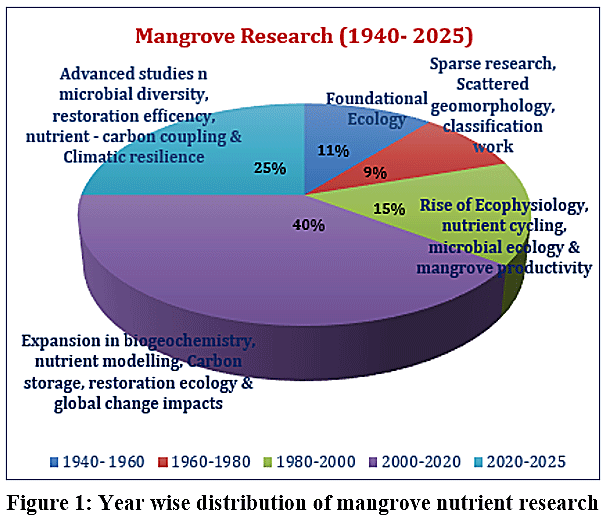 |
Figure 1: Year wise distribution of mangrove nutrient research Click here to View Figure |
(Temporal distribution of selected publications on mangrove nutrient research during 1940–2025. Percentages represent the proportion of publications in each period among the 80 publications selected for analysis.)
Figure 1 illustrates the temporal distribution of publications on mangrove nutrient research from 1940 to 2025. The proportion of publications increased progressively across the study periods, with the highest proportion recorded during 2000–2020 (40%), followed by 2020–2025 (25%). Earlier periods accounted for 11%, 9%, and 15% of publications during 1940–1960, 1960–1980, and 1980–2000, respectively. This temporal pattern reflects the increasing research attention toward mangrove nutrient dynamics and associated ecological processes.
Future Directions
Future research should adopt an integrated, technology-enabled framework that links nutrient dynamics with broader ecological and climatic processes. The use of remote sensing and AI tools can provide real-time mapping of nutrient fluxes and sediment interactions, while microbial genomics and isotopic tracing will help reveal the hidden biochemical pathways that regulate nitrogen and phosphorus cycling. Restoration ecology should focus on comparing active versus passive rehabilitation strategies to understand their long-term nutrient recovery efficiencies. Incorporating bioindicators such as mangrove-associated algae, fungi, and microbial assemblages can improve monitoring accuracy. Moreover, coupling nutrient studies with blue-carbon assessments will allow better quantification of carbon sequestration potential in restored and degraded mangroves. Collectively, these approaches will strengthen predictive ecosystem models, improve adaptive management, and enhance mangrove resilience under global climate-change scenarios.
Conclusion
The reviewed literature demonstrates that nutrient dynamics in mangroves, shaped by nutrient availability, recycling, and transformation processes, influence productivity, biodiversity, and ecosystem functioning. These dynamics are driven by complex interactions between the mangroves’ biological processes, the physical environment, and microbial transformations. However, the magnitude and direction of these effects vary among sites and depend on factors such as salinity, hydrology, sediment characteristics, nutrient inputs, and species composition.
Modern research emphasizes the vulnerability of mangrove nutrient dynamics to human activities, including deforestation, aquaculture, and agricultural runoff, which can alter nutrient loading and sedimentation patterns. Furthermore, mangroves contribute to carbon storage by accumulating organic matter in above- and belowground biomass and sediments. Nutrient cycling supports detrital food-web processes, including litter production, decomposition, nutrient exchange, and trophic transfer, although the relative importance of these processes varies among mangrove ecosystems. Advances in molecular and isotopic techniques have provided greater insights into microbial activity in mangrove sediments and their roles in processes such as denitrification and nitrogen fixation, thereby improving understanding of nutrient transformations within mangrove ecosystems.
Future studies should focus on the effects of restoration on nutrient dynamics, long-term responses to climate change, and the development of comprehensive models linking nutrient dynamics with ecosystem processes and services. These approaches may contribute to improved restoration and management strategies. Technological approaches such as remote sensing and artificial intelligence (AI) also have potential for assessing and monitoring ecosystem conditions and nutrient-related patterns across different regions; however, their application to mangrove nutrient assessment requires further validation and integration with field-based measurements. Mangroves may serve as indicators of environmental change because their nutrient dynamics respond to interacting environmental and anthropogenic drivers, although their effectiveness as indicators depends on site-specific conditions and appropriate monitoring frameworks. Maintaining their ecological integrity requires continued investigation of nutrient dynamics and their responses to environmental change. Adaptive, site specific and multidisciplinary approaches are crucial for bridging knowledge gaps and ensuring the protection of these vital ecosystems for future generations.
Acknowledgement
The authors gratefully acknowledge the support and facilities provided by the Department of Botany and Sir Syed College, Taliparamba, affiliated to Kannur university, Kerala for carrying out this research.
Funding Sources
The author(s) received no financial support for the research, authorship, and/or publication of this article.
Conflict of Interest
The authors do not have any conflict of interest.
Data Availability Statement
This statement does not apply to this article.
Ethics Statement
This research did not involve human participants, animal subjects, or any material that requires ethical approval.
Informed Consent Statement
This study did not involve human participants, and therefore, informed consent was not required.
Clinical Trial Registration
This research does not involve any clinical trials.
Permission to Reproduce Material from other Sources
Not Applicable.
Author Contributions
- Baburaj Haripriya: Conceptualization and study design; field sampling and laboratory analysis; data curation and statistical analysis; interpretation of results; drafting of the original manuscript.
- Pullaikodi Sreeja: Supervision of the study; methodological guidance; critical review and editing of the manuscript; validation of results and overall scientific oversight.
References
- Bunting P, Rosenqvist A, Lucas RM. The Global Mangrove Watch—a new 2010 global baseline of mangrove extent. Remote Sens. 2018;10(10):1669. https://doi.org/10.3390/rs10101669
CrossRef - Alongi DM. Macro- and micronutrient cycling and crucial linkages to geochemical processes in mangrove ecosystems. J Mar Sci Eng. 2021;9(5):456. https://doi.org/10.3390/jmse9050456
CrossRef - Liu SM, Li RH, Zhang GL, Wang DR, Du JZ, Herbeck LS. The impact of anthropogenic activities on nutrient dynamics in the tropical Wenchanghe and Wenjiaohe Estuary. Mar Chem. 2011;125(1-4):49-68. https://doi.org/10.1016/j.marchem.2011.02.003
CrossRef - Alongi DM. Nitrogen cycling and mass balance in the world’s mangrove forests. Nitrogen. 2020;1(2):167-189. doi:10.3390/nitrogen1020012
CrossRef - Dookie S, Sirpaul J, Ansari AA. The influence of soil-water relations in mangrove forests in ecosystem balance. J Environ Sci. 2023;13(1):9-28. https://doi.org/10.9734/AJEE/2023
- Duarte CM, Geertz-Hansen O, Thampanya U, Terrados J, Fortes MD, Kamp-Nielsen L. Relationship between sediment conditions and mangrove Rhizophora apiculata seedling growth and nutrient status. Mar Ecol Prog Ser. 1998;175:277-283. https://doi.org/10.3354/meps
CrossRef - Alongi DM. Present state and future of the world’s mangrove forests. Environ Conserv. 2002;29(3):331-349. doi:10.1017/S0376892902000231
CrossRef - Huxham M, Whitlock D, Githaiga M, Dencer-Brown A. Carbon in the coastal seascape: how interactions between mangrove forests, seagrass meadows and tidal marshes influence carbon storage. Curr For Rep. 2018;4(2):101-110.
CrossRef - Sahoo K, Dhal NK. Potential microbial diversity in mangrove ecosystems: a review. Indian J Mar Sci. 2009;38(2):249-256. https://nopr.niscpr.res.in/handle/123456789/4368
- Alongi DM, Clough BF, Robertson AI. Nutrient use efficiency in arid zone forests of the mangroves Rhizophora stylosa and Avicennia marina. Aquat Bot. 2005;82(2):121-131. doi:10.1016/j.aquabot.2005.04.005
CrossRef - Reef R, Feller IC, Lovelock CE. Nutrition of mangroves. Tree Physiol. 2010;30(9):1148-1160. https://doi.org/10.1093/treephys/tpq048
CrossRef - Lovelock CE. Nutrient resorption and nutrient use efficiency in mangrove species. Oecologia. 2006;148(3):432-441. https://doi.org/10.1007/s00442-006-0381-7
- Tomlinson PB. The Botany of Mangroves. Cambridge, England: Cambridge University Press; 1986. https://doi.org/10.1017/CBO9780511526748
- Holguin G, Vazquez P, Bashan Y. The role of sediment microorganisms in the productivity, conservation, and rehabilitation of mangrove ecosystems. Biol Fertil Soils. 2001;33(4):265-278. https://doi.org/10.1007/s003740000319
CrossRef - Ball MC. Ecophysiology of mangroves. Trees. 1988;2:129-142. https://doi.org/10.1007/BF01816820
CrossRef - Rahaman SMB, Sarder L, Rahaman MS, Ghosh AK, Biswas SK, Siraj SS. Nutrient dynamics in the Sundarbans mangrove estuarine system. Ecol Processes. 2013; 2:1-13. https://doi.org/10.1186/2192-1709-2-21
CrossRef - Feller IC, McKee KL. Nutrient limitation of primary production in Florida Everglades: an experimental test in the field. Ecosystems. 2007;10(6):1054-1070. https://doi.org/10.1007/s10021-007-9073-2
- Lovelock CE, Ball MC, Martin KC, Feller IC. Nutrient enrichment increases mortality of mangroves. PLoS One. 2009;4(5):e5600. doi: 10.1371/journal.pone.0005600.
CrossRef - Kristensen E, Bouillon S, Dittmar T, Marchand C. Organic carbon dynamics in mangrove ecosystems: a review. Aquat Bot. 2008;89(2):201-219. https://doi.org/10.1016/j.aquabot.2007.12.005
CrossRef - Alongi DM. The Energetics of Mangrove Forests. Dordrecht, Netherlands: Springer; 2009. doi:10.1007/978-1-4020-4271-3
CrossRef - Prasad MBK, Ramanathan AL. Sedimentary nutrient dynamics in a tropical estuarine mangrove ecosystem. Estuar Coast Shelf Sci. 2008;80(1):60-66. https://doi.org/10.1016/j.ecss.2008.07.004
CrossRef - Alongi DM. The role of bacteria in nutrient recycling in tropical mangrove and other coastal benthic ecosystems. Hydrobiologia. 1994;285(1-3):19-32. doi:10.1007/BF00005650
CrossRef - Gerona-Daga MEB, MacKenzie RA, Sumabat-Dacones LG, Naputo CFP, Salmo SG III. The role of nutrient availability and resorption efficiency and their impact on nutrient conservation in mangroves. Glob J Environ Sci Manag. 2024;10(Special Issue):37-52. doi:10.22034/gjesm.2024.10.SI.03
- Alongi DM. Carbon balance in salt marsh and mangrove ecosystems: a global synthesis. J Mar Sci Eng. 2020;8(10):767. doi:10.3390/jmse8100767.
CrossRef - Singh G, Ramanathan AL, Prasad MBK. Nutrient cycling in mangrove ecosystem: a brief overview. Int J Ecol Environ Sci. 2005;30:231-244.
- Feller IC, Whigham DF, O’Neill JP, McKee KL. Effects of nutrient enrichment on within-stand cycling in a mangrove forest. Ecology. 1999;80(7):2193-2205. https://doi.org/10.1890/0012-9658(1999)080[2193:EONEOW]2.0.CO;2
CrossRef - Alongi DM. Impact of global change on nutrient dynamics in mangrove forests. Forests. 2018;9(10):596. doi:10.3390/f9100596.
CrossRef - Alongi DM. Global meta-analysis of mangrove primary production: implications for carbon cycling in mangrove and other coastal ecosystems. Forests. 2025;16(5):747. https://doi.org/10.3390/f16050747
CrossRef - Nagelkerken I, van der Velde G. Are Caribbean mangroves important feeding grounds for juvenile reef fish? Mar Ecol Prog Ser. 2004;274:143-151. https://doi.org/10.3354/meps274143
CrossRef - Alongi DM. Carbon cycling and storage in mangrove forests. Annu Rev Mar Sci. 2014; 6:195-219. doi:10.1146/annurev-marine-010213-135020
CrossRef - Alongi DM. The role of soft-bottom benthic communities in tropical mangrove and coral reef ecosystems. Rev Aquat Sci. 1989; 1:243-280.
- Mumby PJ, Edwards AJ, Arias-González JE. Mangroves enhance the biomass of coral reef fish communities in the Caribbean. Nature. 2004;427(6974):533-536. https://doi.org/10.1038/nature02286.
CrossRef - Robertson AI, Alongi DM, Boto KG. Food chains and carbon fluxes. In: Mangrove Ecosystems in Australia. Australian Institute of Marine Science; 1992;41;293-326.
CrossRef - Thimdee W, Deein G, Sangrungruang C, Matsunaga K. Analysis of primary food sources and trophic relationships in a mangrove-fringed estuary. Wetl Ecol Manag. 2004;12:135-144. https://doi.org/10.1023/B:WETL.0000021677.61881.74
CrossRef - Bouillon S, Connolly RM, Lee SY. Organic matter exchange and cycling in mangrove ecosystems: recent insights from stable isotope studies. J Sea Res. 2008;59(1-2):44-58. https://doi.org/10.1016/j.seares.2007.05.001
CrossRef - Hu M, Sardans J, Sun D, Yan R, Wu H, Ni R. Microbial diversity and keystone species drive soil nutrient cycling and multifunctionality following mangrove restoration. Environ Res. 2024;251:118715. https://doi.org/10.1016/j.envres.2024.118715
CrossRef - He Q, Li ZA, Elphick CS, et al. Making restoration effective for dynamic coastal wetlands. Glob Change Biol. 2025;31(9): e70455. https://doi.org/10.1111/gcb.70455.
CrossRef - McKee KL, Faulkner PL. Restoration of biogeochemical function in mangrove forests. Restor Ecol. 2000;8(3):247-259. https://doi.org/10.1046/j.1526-100x.2000.80035.x
CrossRef - Jiang D, Nie T, Yan J et al. Restoration type determines synchronic recovery of soil carbon, nitrogen, and phosphorus in mangrove wetlands. J Environ Manage. 2025; https://doi.org/10.1016/j.jenvman.2025.125658
CrossRef - Dharmayasa IGNP, Sugiana IP, Prapaspongsa T. Soil organic matter in natural and rehabilitated mangroves: implications for environmental restoration and climate resilience. J Ecol Eng. 2025;26(1).
CrossRef - Twilley RR, Chen RH, Hargis T. Carbon sinks in mangroves and their implications. Water Air Soil Pollut. 1992;64(1-2):265-288. https://doi.org/10.1007/BF00477106
CrossRef - Frank D, Meziane T, Tran T et al. Carbon biogeochemistry and carbon dioxide emissions in a human impacted and mangrove dominated tropical estuary. Mar Chem. 2018; 207:261-275. https://doi.org/10.1016/j.marchem.2018.07.002
CrossRef - da Silva, G. R., Lázaro et al. (2024). How do replanted mangroves affect phosphorus dynamics in their soils?. Journal of Environmental Management, 366, 121915. https://doi.org/10.1016/j.jenvman.2024.121915
CrossRef - Dittmar T, Hertkorn N, Kattner G, Lara RJ. Mangroves, a major source of dissolved organic carbon to the oceans. Glob Biogeochem Cycles. 2006;20(1):GB1012.
CrossRef - Twilley RR, Castañeda-Moya E, Rivera-Monroy VH, Rovai A. Productivity and carbon dynamics in mangrove wetlands. In: Rivera-Monroy VH, Lee SY, Kristensen DK, Twilley RR, eds. Mangrove Ecosystems: A Global Biogeographic Perspective: Structure, Function, and Services. Springer International Publishing; 2017:113-162.
CrossRef - Mack RM, Langley JA, Feller IC, Chapman SK. The ecological consequences of nutrient enrichment in mangroves. 2024; 300:108690. https://doi.org/10.1016/j.ecss.2024.108690
CrossRef - Feller IC, Lovelock CE, Berger U, McKee KL, Joye SB, Ball MC. Biocomplexity in mangrove ecosystems. Annu Rev Mar Sci. 2010;2:395-417. https://doi.org/10.1146/annurev.marine.010908.163809
CrossRef - McKee KL. Interspecific variation in growth, biomass partitioning, and defensive characteristics of neotropical mangrove seedlings. Am J Bot. 1995;82(3):299-307. https://doi.org/10.1002/j.1537-2197.1995.tb12634.x
CrossRef - Simpson TL, Feller IC, Chapman SK. Effects of competition and nutrient enrichment on Avicennia germinans. 2013; 104:55-59. doi:10.1016/j.aquabot.2012.09.006
CrossRef - Cannicci S, Fusi M, Cimò F, Dahdouh-Guebas F, Fratini S. Interference competition as a key determinant for spatial distribution of mangrove crabs. Hydrobiologia. 2018;18(8):1-12. doi:10.1186/s12898-018-0164-1
CrossRef - Zhu D, Hui D, Wong M, Yang Q, Yu S. Light and competition alter leaf stoichiometry of introduced and native mangrove species. Sci Total Environ. 2020;738:140301. https://doi.org/10.1016/j.scitotenv.2020.140301
CrossRef - Thorn BG. Coastal landforms and geomorphic processes. In: Snedaker SC, Snedaker JG, editors. The Mangrove Ecosystem: Research Methods. UNESCO;1984:3-17.
CrossRef - Davis JH. The ecology and geological role of mangroves in Florida. Pap Tortugas Lab. 1940; 32:303-412.
- Kathiresan K, Bingham BL. Biology of mangroves and mangrove ecosystems. Adv Mar Biol. 2001;40:81-251. https://doi.org/10.1016/S0065-2881(01)40003-4
CrossRef - Bhutia RN, Abhilashwodeyar K, Devadas D, Mandal UK, Sreekanth GB, Landge AT. Dynamics of phytoplankton community in relation to environmental variables tropical mangrove estuary, Sundarbans, India. J Environ Biol. 2024;45(6):654-665. http://doi.org/10.22438/jeb/45/6/MRN-5369
CrossRef - Wafar S, Untawale AG, Wafar M. Litter fall and energy flux in a mangrove ecosystem. Estuar Coast Shelf Sci. 1997;44(1):111-124. https://doi.org/10.1006/ecss.1996.0120
CrossRef - Iara CS, Morozesk M, Azevedo VC. Trophic transfer of emerging metallic contaminants in a neotropical mangrove ecosystem food web. J Hazard Mater. 2021;408:124424. https://doi.org/10.1016/j.jhazmat.2020.124424
CrossRef - Sengupta A, Chaudhuri S. Arbuscular mycorrhizal relations of mangrove plant community at the Ganges River estuary in India. Mycorrhiza. 2002;12(4):169-174. doi:10.1007/s00572-002-0164-2
CrossRef - McKinnon AD, Klumpp DW. Mangrove zooplankton of north Queensland, Australia. Hydrobiologia. 1997;362(1):145-160. https://doi.org/10.1023/A:1003191702281
CrossRef - Chen R, Twilley RR. Patterns of mangrove forest structure and soil nutrient dynamics along the Shark River Estuary, Florida. Estuaries. 1999;22(4):955-970. doi:10.2307/1353075
CrossRef - Fabre A, Fromard FR, Trichon V. Fractionation of phosphate in sediments of four representative mangrove stages (French Guiana). Hydrobiologia. 1999;392(1):13-19. https://doi.org/10.1023/A:1003514121475.
CrossRef - Fortes M. The effects of siltation on tropical coastal ecosystems. In: Oceanographic Processes of Coral Reefs. Boca Raton, FL: CRC Press; 2000:113-132.
CrossRef - Alonso-Rodriguez R, Páez-Osuna F. Nutrients, phytoplankton and harmful algal blooms in shrimp ponds: a review with special reference to the Gulf of California. Aquaculture.2003;219(1-4):317-336. https://www.biodiversitylibrary.org/item/28508
CrossRef - Imai N, Takyu M, Nakamura Y. Growth, crown architecture and leaf dynamics of saplings of five mangrove tree species in Ranong, Thailand. Mar Ecol Prog Ser. 2009;377:139-148. https://doi.org/10.3354/meps07825
CrossRef - Polidoro BA, Carpenter KE, Collins L, et al. The loss of species: mangrove extinction risk and geographic areas of global concern. PLoS One. 2010;5(4):e10095. https://doi.org/10.1371/journal.pone.0010095
CrossRef - Fry B, Cormier N. Chemical ecology of red mangroves (Rhizophora mangle) in the Hawaiian Islands. Pac Sci. 2011;65(2):219-234.
CrossRef - Lin YM, Liu JW, Xiang P, Lin P, Ye GF, Sternberg LSL. Tannin dynamics of propagules and leaves of Kandelia candel and Bruguiera gymnorrhiza. Biogeochemistry. 2006;78(3):343-359. https://doi.org/10.1007/s10533-005-4422-2
CrossRef - Behera BC, Mishra RR, Patra JK, Sarangi K, Dutta SK, Thatoi HN. Impact of heavy metals on bacterial communities from mangrove soils of the Mahanadi Delta (India). Chem Ecol. 2013;29(7):604-619. https://doi.org/10.1080/02757540.2013.810719
CrossRef - Chen Q, Zhao Q, Li J, Jian S, Ren H. Mangrove succession enriches the sediment microbial community in South China. Sci Rep. 2016; 6:27468. https://doi.org/10.1038/srep27468
CrossRef - Rovai AS, Twilley RR, Castaneda-Moya E, et al. Global controls on carbon storage in mangrove soils. Nat Clim Change. 2018;8(11):534-538. https://doi.org/10.1038/s41558-018-0162-5
CrossRef - Friess DA, Aung TT, Huxham M, Lovelock C, Mukherjee N, Sasmito S. SDG 14: life below water—impacts on mangroves. In: Sustainable Development Goals. Springer; 2019:445-481. https://doi.org/10.1007/978-3-319-71064-8_28-1
CrossRef - Singh N, Yadav N, Srivastava S. Nutrient cycles, protection and management of mangroves ecosystem. Singapore: Springer Nature; 2025:379-396.https://doi.org/10.1007/978-981-96-3993-9_19
CrossRef - de Lacerda LD. Mangroves mitigate pollutant transfer through estuaries. In: Mangroves in the Anthropocene. 2025:37.
- de Lacerda LD, Ferreira AC. Mangrove responses to challenges of the Anthropocene. In: Mangroves in the Anthropocene. 2025:107.
- Akbar N, Marus I, Ismail F et al. Nutrients in mangrove sediment as a growth factor in coastal rehabilitation areas in East Halmahera, North Maluku, Indonesia. Egypt J Aquat Biol Fish. 2025;29(5):285-294. https://doi.org/10.21608/ejabf.2025.415886.6442
CrossRef - Rachman HA, Hidayah Z, As-syakur AR, Wardhani MK. Long-term dynamics of mangrove vegetation coverages in Indonesia’s national parks derived from remote sensing data. Research Square. Published 2025. https://doi.org/10.21203/rs.3.rs-7554686/v1
CrossRef - Goutami B, Patil VV. Understanding dynamics of water quality of coastal wetlands in a changing global landscape: a systematic review. Wetl Ecol Manag. 2025;33(5):1-32.
CrossRef - Ariyanto D, Pringgenies D, Natalia Br Ginting D. Nutrient dynamic in sediment and organs of the mangrove Avicennia marina. BIO Web Conf. 2025; 156:02012. https://doi.org/10.1051/bioconf/202515602012
CrossRef - Gu YG. Comment on nutrient enrichment by high aquaculture effluent input exacerbates imbalances between methane production and oxidation in mangrove sediments. Water Res. 2025:124360. https://doi.org/10.1016/j.watres.2025.124360
CrossRef - Ishfaq M, Tam NFY, Lang T, Hussain M, Zhou H. Nitrogen-phosphorus conservation and trade-offs in mangroves. Plant Soil. 2025:1-20.
CrossRef
Accepted on: 30-09-2026
Second Review by: Dr. Mohammed Faisal
Final Approval by: Dr. Muhammad Hamayun