Formulation and Acceptability of Broth Powders Based on Fermented Zamné (Senegalia macrostachya) Seeds
 , Henri Sidabéwindin Ouédraogo1, Kénan Yidia Kinda2, Charles Parkouda2 and Aly Savadogo1*
1Department of Biochemistry and Microbiology, Laboratory of Applied Biochemistry and Immunology, Joseph KI-ZERBO University, Ouagadougou, Burkina Faso
2Department of Food Technology, Institute for Research in Applied Sciences and Technologies, Ouagadougou, Burkina Faso
Corresponding author’s E-mail: alysavadogo@gmail.com
Download this article as:
ABSTRACT:Fermented zamné is a nutritionally valuable condiment, rich in protein, lipids, and minerals. However, its strong odor and alkaline taste negatively affect its consumer acceptability. To improve its acceptability, dehulling and formulation into broth powder products were investigated. Preference test, hedonic profile and ranking test were used to evaluate sensory parameters of samples. Moisture, pH, ash content, fat content, protein and carbohydrate were then determined. Sensory test indicated that dehulling significantly improved its sensory acceptability, likely by improving the color and reducing undesirable flavor attributes. Based on this result, dry broths were formulated by blending dehulled fermented Zamné with selected ingredients (Onion leaves, black pepper, garlic, ginger and salt). Hedonic test showed that the taste, aftertaste, smell and color of all the broths were appreciated. Among the formulations, F5 containing 60% of dehulled fermented Zamné and 40% of added ingredients received the highest overall acceptance score. Biochemical analysis revealed that dehulled fermented Zamné had higher protein (38.98 ± 0.24 g/100g DM) and lipids contents (28.15 ± 0.68 g/100g DM) compared to the formulated broths (from 30.23 to 35.18 g/100g DM and from 15.91 to 23.81 g/100g DM, respectively). In contrast, the formulated broths showed higher ash content (6.47- 9.50 g/100g DM). Overall, dehulling combined with ingredient incorporation significantly improved the sensory properties and acceptability of fermented Zamné.
KEYWORDS:Broths; Condiment; Fermented Zamné; Hedonic test; Senegalia macrostachya
Introduction
Fermentation has been used worldwide as a means of preserving food and increasing its nutritional value. In Africa and worldwide, alkaline fermented foods constitute an important component of the daily diet of many people.1 These products are commonly used as condiments and serve as a tasty, low-cost protein source. In Africa, these foods have a large impact on the nutrition, health and socioeconomy of people. In Burkina Faso, soumbala produced through the fermentation of Parkia biglobosa seeds is the most widely known and consumed condiment.2 This alkaline fermented product is particularly valued for its high protein content, typically ranging from 39.91 to 41.19%.3,4 In addition to soumbala, several other local seeds are traditionally fermented and used as condiments in Burkina Faso. Among them, fermented Zamné, derived from Senegalia macrostachya seeds, represents a lesser-known but nutritionally promising product. The seeds are typically boiled and subjected to alkaline fermentation for approximately 48 hours.5 Fermented Zamné is mainly produced and consumed in the central region of Burkina Faso.6 With a high protein content (48.91 ± 0.74 g/100 g DM) and significant amounts of important minerals like potassium, magnesium, and iron, it is nutritionally similar to soumbala.4
Despite these nutritional attributes, the adoption of fermented Zamné remains limited. Previous studies have reported that its sensory attributes, particularly its strong odor, dark color, and pronounced taste, are less appreciated compared to soumbala.7 These characteristics negatively influence consumer acceptance and hinder its integration into people regular dietary habits. Improving the sensory quality and acceptability of fermented Zamné is therefore essential to promote its consumption.8 Processing strategies such as dehulling may reduce undesirable sensory attributes, while product reformulation could enhance its consumer appeal.5 In this regard, the current study sought to assess how dehulling and new product formulation affected the fermented Zamné sensory quality. Specifically, dry broth powders were developed using dehulled fermented Zamné combined with selected ingredients, and their acceptability was assessed through sensory evaluation. Proximate composition was assessed to evaluate their nutritional composition.
Materials and Methods
Zamné and ingredients Samples collection
Zamné (Senegalia macrostachya seeds) was purchased from a local market in Ouagadougou, Burkina Faso. The additional ingredients used for broth formulation, including garlic, onion leaves, black pepper, ginger and salt were purchased from the same local market.
Production of fermented zamné
The Department of Food Technologies of the Research Institute in Applied Science of Burkina Faso’s (IRSAT/DTA) pilot food processing unit produced the fermented seeds. Non-dehulled fermented Zamné was produced after cooking cleaned seeds in water for 30 minutes, then draining and washing. After adding potash (1%, w/w), a second cooking step was carried out. The cooked seeds were drained, inoculated with previously prepared soumbala (2%, w/w) as a starter culture, and fermented at room temperature (25-30 °C) in a fermentation vessel for 48 h. The fermented product was subsequently sun-dried for 72 h. For the dehulled fermented Zamné, the seeds were dehulled after the initial cooking step. The dehulled seeds were then subjected to a similar processing as described above: second cooking process (30 min with 1% potash), inoculation (2% Soumbala), and fermented at room temperature in a fermentation vessel for 48 h. The final product was also sun-dried for 72 h.
Preparation of ingredients
Garlic, onion leaves, black pepper, and ginger were washed and dried in a dryer at 55 °C for 8 h. The dried materials were then milled using a hammer mill equipped with a 600 µm sieve to obtain fine powders.
Formulation of dry broths
A preliminary preference test was conducted to compare dehulled and non-dehulled fermented Zamné. The most preferred product was found to be dehulled fermented Zamné, and was selected as the base ingredient for broth formulation. Dry broths were formulated by varying the proportion of fermented Zamné, which was considered the main factor influencing sensory acceptability.4 Six formulations were prepared, with fermented Zamné levels ranging from 50% to 100%, mixed with the powdered ingredients (garlic, onion leaves, black pepper, ginger, and salt). The composition of the different formulations is presented in Table 1.
Table 1: Composition of broth formulations
|
Composition |
Fermented Zamné powder (%) | Onion leaves (%) | Black pepper (%) | Garlic (%) | Ginger (%) |
Salt (%) |
|
F1 |
100 | 0 | 0 | 0 | 0 | 0 |
| F2 | 90 | 2 | 2 | 2 | 2 |
2 |
|
F3 |
80 | 4 | 4 | 4 | 4 | 4 |
| F4 | 70 | 10 | 5 | 5 | 5 |
5 |
|
F5 |
60 | 15 | 5 | 10 | 5 | 5 |
| F6 | 50 | 15 | 5 | 15 | 10 |
5 |
Beef broth production
For the culinary test, the beef broth was prepared according to the method described by Sawadogo-Lingani et al.9 In fact, in many West African countries, fermented condiments are widely used for preparing soups and stews.10 Beef broth was prepared by cooking 2 kg of meat (beef) in water (5 L) with onions and salt as condiments. The meat was removed at the end of cooking. This broth was then divided and mixed with dehulled fermented Zamné and non-dehulled fermented Zamné (100 g in 1 L of beef broth) and cooked for 5 minutes. Beef broth was used only for the preference test between dehulled fermented Zamné and non-dehulled fermented Zamné.
Analysis methods
Ethical Clearance and recruitment of participants
This study was approved by the Health Research Ethics Committee of the Ministry of Health of Burkina Faso on December 3, 2025, authorization number: 2025-12-541. The participants constituted an untrained consumer panel composed of students from Ouagadougou universities and personnel from the Department of Food Technology. The study was presented to the volunteers, who were familiar with the consumption of fermented condiments, as a sensory analysis of fermented Zamné. All methods were carried out in accordance with the sensory analysis methods according to test type. Informed consent was obtained from all the participants (age > 18 years) involved in the study.
Sensory analyses
Three (03) tests were selected for the sensory evaluations of the samples.
Preference test
The preference test allows consumers to express a choice between samples. One sample is preferred and chosen over another, or there is no preference. Panelists are asked which of two coded samples they prefer.11 The aim was to determine which condiment between dehulled fermented Zamné and non-dehulled fermented Zamné was most appreciated. Fresh samples, powders of dry samples, and beef broth containing the powders (culinary test) were evaluated. The six samples were presented together and evaluated in pairs. The most liked was used for the formulation of broth powders.
Ranking tests
Ranking tests require panelists to order samples according to the perceived intensity of a sensory characteristic order from the most acceptable to the least acceptable.11 For the ranking test, the six formulations of broth were divided into two groups of three. The two best formulations from each group were selected and submitted to a final ranking test.
Hedonic tests
Hedonic tests are designed to measure the degree of liking for a product by choosing the appropriate category.12 The selected formulations (04) and dehulling fermented Zamné were subjected to this test. The participants were asked to appreciate the color, smell, taste, aftertaste, and overall acceptability of the products using a labeled 5-point hedonic scale.
Biochemical analysis
The measurement of pH was carried out according to AOAC 981.12.13 Moisture was estimated by desiccation with the drying oven at 105°C. The ash content was estimated by incineration at 550°C. Protein was determined using the Kjeldahl method. The determination of the fat content is made according to the method of extraction by Soxhlet using hexane as solvent. Carbohydrate was determined by the differential method.
Statistical analysis
Data were collected using Microsoft Excel 2019. An analysis of variance (ANOVA) was performed with XLSTAT (version 2016.02.27444) to investigate differences between percent-composition variables. SPSS Statistics (version 27) was used to assess differences between sensory parameters. For the preference test, a chi-square goodness-of-fit test was applied to each product category. Ordinal data from the rankings were analyzed using Friedman’s nonparametric test. In cases of significant differences, the Newell and MacFarlane multiple comparisons post-hoc test and the Nemenyi test were applied to identify distinct samples. For all analyses, differences were considered statistically significant for a p-value < 0.05.
Results
Panel Composition
The composition of the panel is summarized in Table 2. The sensory panel consisted of 29 and 33 tasters (women and men) for the preference test and 30 tasters for the first ranking test. 28 tasters, females and males, aged from 18 to over 40, made the second ranking and hedonic tests. The 18- to 30-year-old age group represented 76% to 96% of the participants across the panel.
Table 2; Panel composition
|
Total participants |
Information on the Participants | Sensory analysis |
samples evaluated | ||||
| Age (%) |
Gender (%) |
||||||
|
18-30 |
31-40 | over 40 | Female |
Male |
|||
|
29 |
96.6 | 0 | 3.4 | 58.6 | 41.4 | Preference test (fresh samples) | (No dehulled and dehulled fermented Zamné |
| 33 | 87.9 | 9.1 | 3 | 66.6 | 33.3 |
Preference test (dry samples (powder) and in broths) |
|
|
30 |
76.66 | 6.66 | 16.66 | 53.33 | 46.66 | 1st ranking tests | All formulated broths |
| 28 | 89.29 | 3.57 | 7.14 | 42.86 | 57.14 | 2nd ranking test and hedonic tests |
Selected formulated broths and dehulled fermented Zamné |
Sensory characteristics
Preference test
Figure 1 presents the results of the preference test. The powder of fermented dehulled Zamné and beef broth with fermented dehulled Zamné showed a statistically significant preference, receiving 78.8% and 69.7% of the votes, respectively (chi-square test, p < 0.05). Conversely, for the fresh samples, although the non dehulled fermented Zamné obtained a higher score (55.2% versus 44.8%), this difference was not statistically significant (p > 0.05), indicating similar sensory acceptability between the two fresh variants.
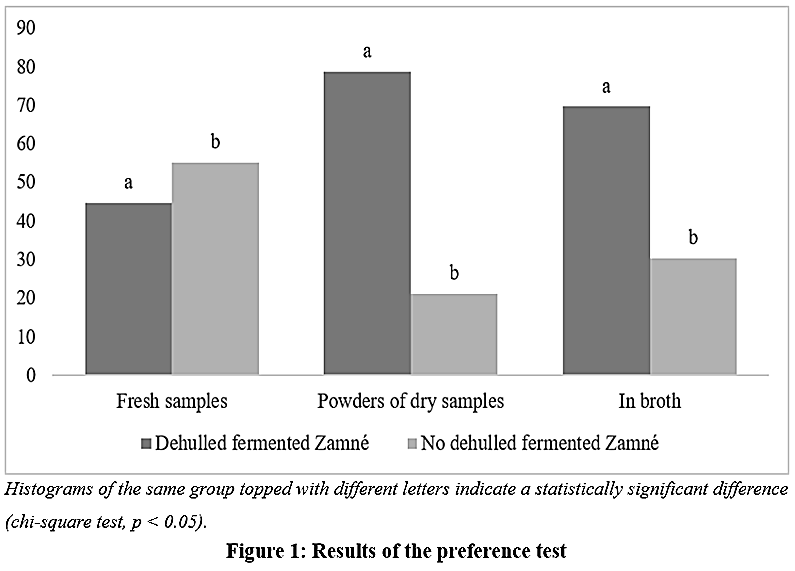 |
Figure 1: Results of the preference test Click here to View Figure |
Ranking test
Statistical analysis of the two ranking tests (Friedman test, alpha = 0.05) revealed significant differences between the samples (Figure 2). In the first group, formulation F4 ranked first (chosen by 43.3% of judges), followed by F6 (33.3%). Their sums of ranks were significantly lower (p < 0.05) than those of the other products, indicating a clear preference. In the second group, F3 obtained first place (50% of judges) and F5 second place (53,3% of judges). Multiple comparison tests confirmed that the performance of F4, F6, F3, and F5 was statistically superior to that of the control F1 (Zamné 100% fermented) and F2.
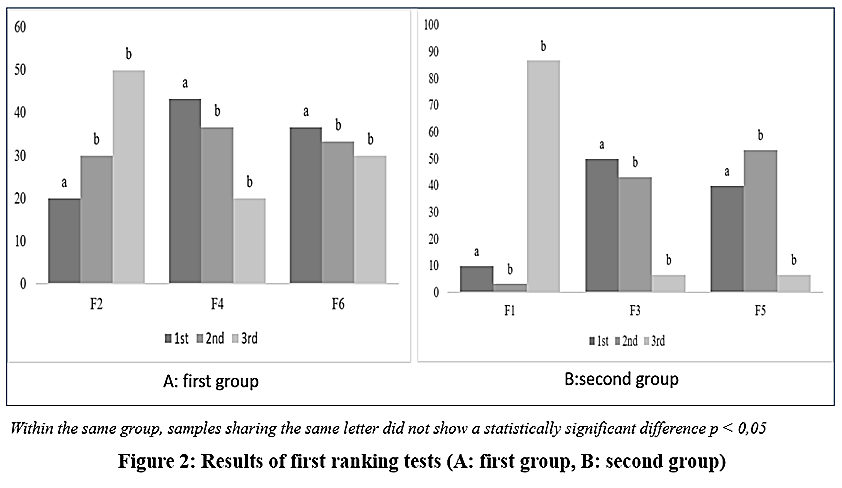 |
Figure 2: Results of first ranking tests (A: first group, B: second group). Click here to View Figure |
The ranking test results reveal highly significant differences in appreciation among the four formulas (Friedman test, p = 0.0014). These results (Figure 3) show that sample F5 is the most appreciated, having been ranked first by 46.2% of panel members. Sample F4 comes in second place (34.6%). Samples F3 and F6 share the majority of the lower rankings, both coming in third place with 34.6% of the votes; F6 also receives 34.6% of the votes for fourth place. The Nemenyi post-hoc test indicates that formula F5 stands out significantly from formulas F3 and F6 (p < 0.05).
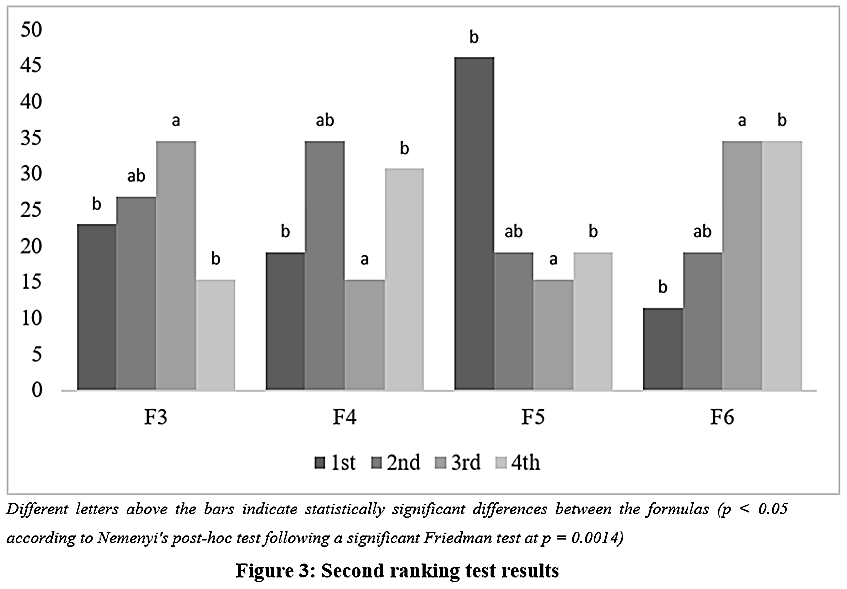 |
Figure 3: Second ranking test results Click here to View Figure |
Hedonic test
According to the panel, the samples evaluated (F3, F4, F5 F6 and F1(control)) have a beautiful color, a good smell and a pleasant taste and aftertaste. The texture of all the samples is appreciated as “fine”. Formulation F1 used as control (100% fermented Zamné) perfomed poorly against the four broth formulations. Concerning the overall assessment of the four formulated broths (F3, F4, F5 and F6), F5 received the highest observed proportion of first-place rankings compared to the other formulations. In fact, the panel (44.4 %) “like very much” this formulation, while formulations F3, F4 and F6 were just “liked” by 33.3%, 48.1%, and 40.7% of the panel, respectively. The aroma of all the samples was liked. The P-values of chi-square test were greater than 0.05, indicating that there are no significant differences between the correlations of the sensory parameters. The results of hedonic tests are illustrated in Figure 4.
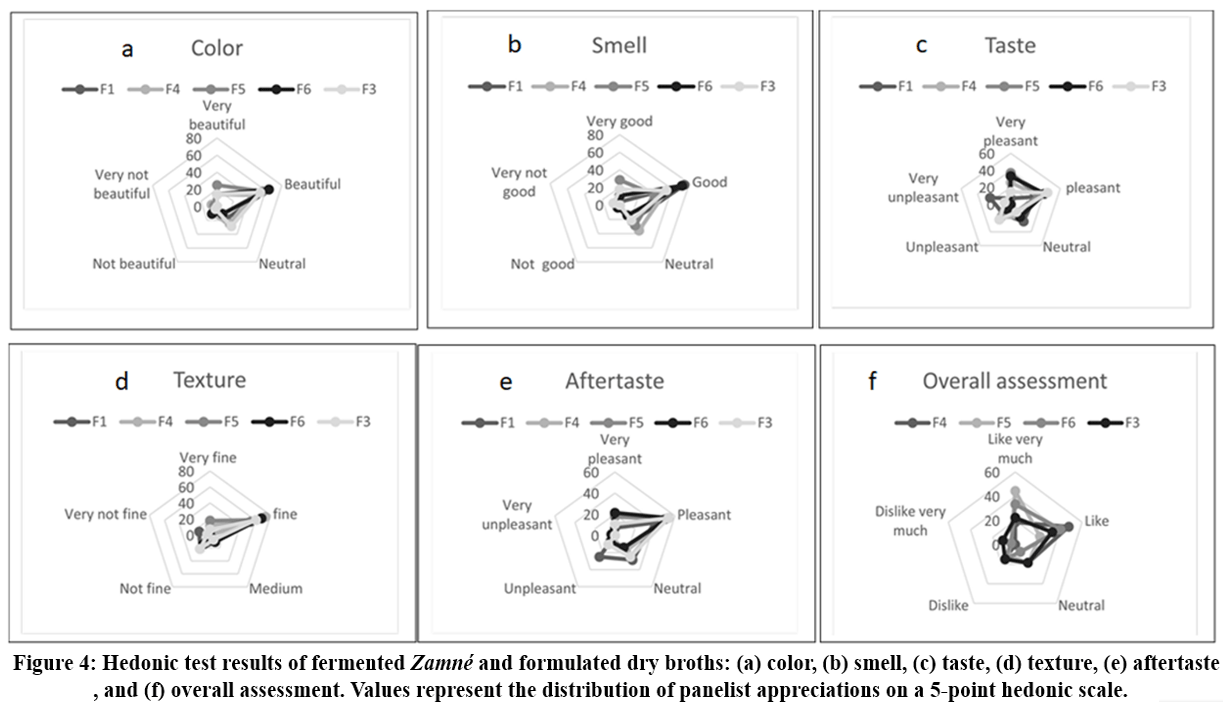 |
Figure 4: Hedonic test results of fermented Zamné and formulated dry broths: (a) color, (b) smell, (c) taste, (d) texture, (e) aftertaste, and (f) overall assessment. Values represent the distribution of panelist appreciations on a 5-point hedonic scale. |
Proximate composition
As seen from Table 3, pH values of non-dehulled fermented Zamné (6.2) and dehulled fermented Zamné (6.23) are higher than those of formulated broths (from 5.80 to 6.14). The protein content of formulated broths varies from 30.23 to 35.18% of dried matter. These values are lower than those of non-dehulled fermented Zamné and dehulled fermented Zamné, 36.61 and 38.98% respectively. However, formulated broths showed a higher content of ash (6.47-9.5). Water content, fat and carbohydrate contents of all the samples were within the same range. Statistical analyses showed a significant difference between ash, lipids, protein and carbohydrate contents of no dehulled fermented Zamné and those of dehulled fermented Zamné. Some differences were observed between fermented seeds and formulated broths for pH, ash and protein contents.
Table 3: Proximate composition of fermented Zamné, dehulled fermented Zamné and formulated broths
|
Samples |
Moisture (%) | pH | Ash
(g/100g DM) |
Lipids
(g/100g DM) |
Proteins
(g/100g DM) |
Carbohydrates (g/100g DM) |
|
Non-dehuled fermented Zamné |
4.78 ± 0.15b | 6.2 ± 0.04c | 3.02 ± 0.04b | 23.33 ± 0.34c | 36.61 ± 1.21c | 37.04± 0.97c |
| Dehulled fermented Zamné | 4.19 ± 0.08a | 6.23 ± 0.01c | 2.18 ± 0.04a | 28.15 ± 0.68d | 38.98 ± 0.24d |
30.69± 0.14b |
|
F3 |
4.74 ± 0.08b | 6.14 ± 0.05bc | 6.47 ± 0.13c | 23.81 ± 0.48c | 33.93 ± 0.79b | 35.79± 0.64c |
| F4 | 5.14 ± 0.16c | 5.99 ± 0.06ab | 8.09 ± 0.22d | 20.76 ± 0.93b | 35.18 ± 0.35bc |
35.97± 0.43c |
|
F5 |
5.68 ± 0.10d | 5.80 ± 0.13a | 9.16 ± 0.18e | 18.96 ± 1.25b | 34.18 ± 0.41b | 37.7± 0.83c |
| F6 | 6.31 ± 0.09e | 5.82 ± 0.08a | 9.50 ± 0.25e | 15.91 ± 0.30a | 30.23 ± 0.16a |
44.36± 0.14d |
|
P-value |
<0.001 | <0.001 | <0.001 | <0.001 | <0.001 |
<0.001 |
In the same column for the same product, means with the same superscript letters are not significantly different with P > 0.05.
Discussion
In the present study, we investigated the effect of dehulling on the sensory acceptability and nutritional quality of fermented Zamné, and subsequently developed dry broth formulations with selected seasoning ingredients to enhance its sensory attributes. The age demographics show an overwhelming concentration of young participants (76%-96% in the 18–30 age group). The preference test indicated that dehulled fermented Zamné was more acceptable than the non-dehulled product. This difference can be primarily attributed to variations in sensory attributes, particularly color, aroma, and taste. The darker color observed in non-dehulled fermented Zamné may negatively influence consumer perception. When making food choices, color is important in guiding consumer preferences.14 Moreover, the dehulling likely affected the level of fermentation by reducing the presence of seed coat components, which may contribute to undesirable flavors and odors. Similar effects have been reported for soumbala, where processing methods, including dehulling, significantly influence aroma. Furthermore, the difference in protein content could also affect the flavor. Ouoba et al.,15 reported in their study that the flavour properties of Soumbala, a fermented seeds of Parkia biglobosa, are most likely due to its amino acid content. Based on these findings, dehulled fermented Zamné was selected for broth formulation. Hedonic evaluation showed that the control sample (100% fermented Zamné) was less appreciated than all formulated broth formulations, indicating that incorporation of the seasoning ingredients improves the product’s acceptability. The aroma was generally well appreciated across all formulations, confirming its central role in consumer acceptance of fermented condiments. Among the formulations, F5 (60% fermented Zamné and 40% added ingredients) exhibited a numerical trend towards higher preference, receiving the highest proportion of first-place rankings. However, chi-square analysis revealed no statistically significant differences (p > 0.05) among the core parameters of the four enriched formulations (F3 to F6). This suggests that while F5 presents a favorable sensory balance, it remains statistically comparable to the other broth formulations. Appiah et al.,10 reported that the most important predictive factor for the acceptability of fermented condiments is aroma. Therefore, the improvement of the sensory acceptability observed in the formulated broths can be attributed to the combined effects of dehulling and the addition of flavoring ingredients, which likely reduced off-flavor and enhanced overall sensory balance. So, these condiments could be used to diversify people’s diets. In fact, diets in West Africa often lack variety and consist of large quantities of the staple food.16 Zamné seeds had already demonstrated unique sensory attributes that could facilitate their promotion in human diets.17
Proximate composition revealed an increase in moisture content of formulated broths compared to fermented Zamné, which may be attributed to the processing conditions. Nevertheless, the moisture content of fermented Zamné (dehulled and non-dehulled) remained lower than those reported for similar fermented condiments such as soumbala and other fermented seeds including Parkia biglobosa, Glycine max and Treculia africana (10.23%, 11.41% and 11.40%, respectively). The preservation of foods by drying is a direct consequence of removal or binding of moisture, without which microorganisms do not grow. Shelf‐life can be reduced or lost due to microbial, physical, and chemical changes in food. Although the moisture contents were relatively low, water activity was not measured; therefore, microbial shelf stability can not be established from moisture content alone.
Unlike acidic fermentations, where pH may drop to 2-4 after fermentation due to organic acid production, alkaline fermentation is characterized by relatively high pH values, primarily resulting from the release of ammonia and other basic compounds during microbial proteolysis. Compared to the dehulled and non-dehulled fermented zamné, the formulated dry broths exhibited lower pH values. This decrease can be attributed to the addition of ingredients, which may contribute organic acids or other acidifying compounds. The pH values obtained are similar to those reported by Owusu-Kwarteng et al.,18 for fermented Zamné and kawal (pH 5.87-7.22), respectively. However, the values were lower than those of Soumbala (6.3 to 7.8). Moreover, a higher ash content of the broth powders compared to fermented Zamné (dehulled and non-dehulled) was noticed. This could be due to the added mineral-rich ingredients.
An important part of this mineral content could be due to the salt. The addition of food-grade salt (5% w/w in formulations F4, F5, and F6) directly impacts the mineral profile of the dry broths. For instance, in formulation F5, which exhibited a total ash content of 9.16 g/100g DM, the added salt accounts for approximately 54.6% of the total mineral fraction. While salt enhances palatability and sensory acceptance, a 5% inclusion rate introduces a non-negligible sodium load. From a nutritional and public health perspective, elevated sodium intake is closely linked to arterial hypertension and cardiovascular risks. Therefore, while these fermented Zamné broths represent excellent sources of plant-based protein, future optimization studies should focus on reducing the sodium load potentially through the integration of potassium-based salt substitutes to align the final product with global health guidelines. Food-grade salt consists primarily of sodium chloride, with a minimum content of 97%.19 Additionally, the higher ash content in non-dehulled fermented Zamné compared to the dehulled form is likely due to the presence of the seed coat.3 Ash content is a measure of the total mineral content of food products.6 However, ash is a nonspecific measure of minerals and does not give information about the mineral profile. The ash content of fermented Zamné and the prepared broths suggests that they may contain various minerals. So, the mineral profile of fermented Zamné and formulated broths needs to be investigated. The high protein content of fermented condiments makes them suitable for use in combating protein malnutrition.10 As reported by Guissou et al.,20 Senegalia macrostachya seeds are rich in proteins with values ranging from 37.7% to 40.08%. In our study, a marked decrease in the protein and lipid contents in the formulated broths compared to the fermented Zamné was observed. This result can be attributed to the dilution effect resulting from the addition of other ingredients (Onion leaves, black pepper, garlic, ginger, salt) which have lower protein content. Nevertheless, the protein levels remain relatively high, confirming the nutritional potential of the fermented Zamné and formulated broths. Compared to other fermented condiments, the protein content of fermented Zamné is comparable to that of soumbala but lower than that reported for kinema, a fermented soybean-based products.21 Appiah et al.,10 reported a protein content of 21.28% in fermented seeds of Treculia africana, which is lower to that of fermented Zamné. The fat content of fermented Zamné was also higher than those reported for fermented seeds of Adansonia digitata (Maari), Glycine max and Treculia Africana. Given their fat content, fermented condiments could be a source of fat-soluble vitamins and also be used as flavor enhancers. The fat content could contribute significantly to meeting the daily lipid requirement of consumers. Nutritionally, dehulled fermented Zamné condiment can be considered as a superior source of fat and protein compared to non-dehulled fermented Zamné.
We also noticed a significant decrease in carbohydrate content in the dehulled fermented zamné compared to the non-dehulled sample. This decrease in carbohydrate content can be attributed to the removal of the carbohydrate-rich seed coat. According to Owusu-Kwarteng et al.,22 during the fermentation process, fermentative microorganisms cause the hydrolysis of proteins and oligosaccharides. Interestingly, carbohydrate content increased in the formulated broths compared to the dehulled fermented Zamné, probably due to the contribution of the added ingredients. The carbohydrate content of fermented Zamné and formulated broths was higher than those reported by Azokpota et al.,23 for Afitin (13.2%), Iru (8.1%) and Sonru (9.7%), three different types of condiment produced by fermentation of Parkia biglobosa seeds in Benin. Proximate composition of fermented Zamné and formulated broths showed these condiments as a good source of nutrients. Tankoano et al.,2 reported that the development of taste or aroma during fermentation leads to an improvement in the nutritional value of the condiment.
The study provides an overview of consumers’ perception of fermented Zamné. However, it has limitations. Water activity was not assessed; therefore, microbial shelf stability cannot be established from moisture. Furthermore, the lack of direct profiling of minerals makes it impossible to evaluate Zamné‘s nutritional contribution in terms of mineral micronutrients. It is also important to note shortcomings related to sensory analysis. The panel sizes were small and predominantly composed of young people, and the consumers were untrained. This makes it difficult to generalize the results. A larger panel size with trained consumers is therefore necessary for a comprehensive assessment. The lack of cost analysis makes it impossible to determine whether the product resulting from the optimized formula will be affordable for consumers. It is therefore important to evaluate the cost associated with the optimization.
Conclusion
The present study demonstrated that fermented Zamné (Senegalia macrostachya seeds) is a nutritionally valuable condiment, rich in protein, lipids, and minerals. Dehulling significantly improved its sensory acceptability, likely by improving the color and reducing undesirable flavor attributes. Furthermore, formulation into broth powders enhanced its consumer acceptability. F5 showed the highest observed sensory acceptability among the tested formulations. These findings highlight the potential of combining processing and formulation approaches to valorize underutilized fermented zamné and promote its wider consumption.
Acknowledgemen
The authors would like to thank the Laboratory of Applied Biochemistry and Immunology of the University Joseph KI-ZERBO and IRSAT/DTA for providing reagents and technical platforms.
Funding Sources
The author(s) received no financial support for the research, authorship, and/or publication of this article.
Conflict of Interest
The authors do not have any conflict of interest.
Data Availability Statement
This statement does not apply to this article.
Ethics Statement
This study was approved by the Health Research Ethics Committee of the Ministry of Health of Burkina Faso on December 3, 2025, authorization number: 2025-12-541.
Informed Consent Statement
Informed consent was obtained from all the participants (age > 18 years) involved in the study.
Clinical Trial Registration
This research does not involve any clinical trials.
Permission to Reproduce Material from other Sources
Not Applicable.
Author Contributions
- Anaïs Kady Coulibaly: Conceptualization, Methodology and Original Draft
- Henri Sidabéwindin Ouédraogo: Data collection and analysis
- Kénan Yidia Kinda: Material preparation
- Charles Parkouda: Supervision
- Aly Savadogo: Supervision
References
- Franz C. M. A. P., Huch M., Maina J., et al. African fermented foods and probiotics. Int. J. Food Microbiol. 2014; 190: 84-96.
CrossRef - Tankoano A., Kaboré K., Judith P. M., et al. Characterization of spice ingredients and raw soumbala for the formulation of a highly nutritious seasoning. Cogent Food Agric. 2024; 10(1): 2413387. doi:10.1080/23311932.2024.2413387.
CrossRef - Dhiman S., Kaur S., Thakur B., Singh P., Tripathi M. Nutritional Enhancement of Plant- Based Fermented Foods: Microbial Innovations for a Sustainable Future. Fermentation. 2025; 11(1): 1-45.
CrossRef - Guissou A. W. D. B., Parkouda C., Anaïs C. K., Korotimi T., Oboulbiga E. B., Savadogo A. Fermentation Effect on the Nutrient and Antinutrient Composition of Senegalia macrostachya and Parkia biglobosa Seeds: A Comparative Study. Food Nutr. Sci. 2020; 11(7): 726-740. doi:10.4236/fns.2020.117052.
CrossRef - Dabiré Y., Siourimè N., Compaoré C. S., et al. Molecular screening of bacteriocin-producing Bacillus spp. isolated from Soumbala, a fermented food condiment from Parkia biglobosa seeds. Sci. Afr. 2021; 12: e00836. doi:10.1016/j.sciaf.2021.e00836.
CrossRef - Ouédraogo H., Kabré B., Lykke A. M., et al. Effect of provenance and traits of fruit on the seed germination of Senegalia macrostachya in Burkina Faso, West Africa. Sci. Rep. 2025; 15: 39709. https://doi.org/10.1038/s41598-025-23328-w.
CrossRef - Kumari C., Choudhary N., Sinha J., Rai A. K. Application of fermentation technologies in enhancing food nutrition and flavor profiles. Int. J. Adv. Biol. Res. 2025; 9: 1498-1503.
CrossRef - Kabré E., Bandé M., Karfo R., et al. Quantitative determination of chemical and biochemical parameters during « soumbala » manufacturing process in two communities of Burkina Faso. Int. J. Biol. Chem. Sci. 2020; 14(12): 3001-3017. doi:10.4314/ijbcs.v14i9.4.
CrossRef - Sawadogo-Lingani H., Diawara B., Ganou L., Gouyahali S., Halm M., Amoa-Awua W. J.M. Effet du décorticage mécanique sur la fermentation des graines de néré (Parkia biglobosa) en soumbala. Ann. Sci. Agron. 2003; 41: 67-84.
- Appiah F., Oduro I., Ellis W. O., Adu G. Comparative assessment of the performance of Parkia biglobosa, Glycine max and Treculia africana in the production of a local condiment (dawadawa) in Ghana. African J. Food Sci. 2012; 6(5): 111-116. doi:10.5897/AJFS12.007.
CrossRef - Watts B. M., Ylimaki G. L., Jeffery L. E., Elias L. G. Basic sensory methods for food evaluation. Ottawa: International Development Research Centre (IDRC); 1989. ISBN: 0889365636.
- Lim J., Wood A., Green B. G., John T., Avenue C., Haven N. Derivation and Evaluation of a Labeled Hedonic Scale. Chem. Senses. 2009; 34(9): 739-751. doi:10.1093/chemse/bjp054.
CrossRef - AOAC. Official Methods of Analysis of the AOAC, Method 981.12: pH of Acidified Foods. 14th ed. Arlington, VA: Association of Official Analytical Chemists; 1982.
- Coulibaly A. K., Guissou A. W. D. B., Oboulbiga E. B., et al. Sensory properties of fermented Zamné (Senegalia macrostachya seeds) and their influence on the broth quality and sensory profile. Sci. Rep. 2025; 15: 1-10. doi:10.1038/s41598-025-13819-1.
CrossRef - Ouoba L. I. I., Rechinger K. B., Barkholt V., Diawara B., Traore A. S., Jakobsen M. Degradation of proteins during the fermentation of African locust bean (Parkia biglobosa) by strains of Bacillus subtilis and Bacillus pumilus for production of Soumbala. J. Appl. Microbiol. 2003; 94(3): 396-402.
CrossRef - Masters E. T., Kelly B. A. Protein Quality of African Locust Bean — A High-Value Gathered Tree Food Contributing Protein and Palatability to Plant-Based Diets. Int. J. Food Sci. 2024; 2024: 1596212. doi:10.1155/2024/1596212.
CrossRef - Drabo M. S., Traoré K., Parkouda C., Hama-Ba F., Savadogo A., Raes K. Non-Sensory perception and sensory appeal of Zamnè, PseudoZamnè, traditionally cooked Senegalia erythrocalyx seeds, and tempeh according to burkinabe consumers. Foods. 2023; 12(23): 4268. https://doi.org/10.3390/foods12234268.
CrossRef - Owusu-Kwarteng J., Agyei D., Akabanda F. Plant-Based Alkaline Fermented Foods as Sustainable Sources of Nutrients and Health-Promoting Bioactive Compounds. Front. Sustain. Food Syst. 2022; 6: 885328. doi:10.3389/fsufs.2022.885328.
CrossRef - FAO. Codex Alimentarius Standard for Food Grade Salt (CXS 150-1985). Adopted 1985, Amended 2025. FAO-Codex; 2025: 8p.
- Guissou A. W. D. B., Parkouda C., Ganaba S., Savadogo A. Technological and Biochemical Changes Associated with the Production of Zamne: A Traditional Food of Senegalia macrostachya Seeds from Western Africa. J. Exp. Food Chem. 2017; 3(4): 1-6. doi:10.4172/2472-0542.1000131.
CrossRef - Dakwa S., Sakyi-Dawson E., Diako C., Takyiwa N., Amoa-Awua W. K. Effect of boiling and roasting on the fermentation of soybeans into dawadawa (soy-dawadawa). Int. J. Food Microbiol. 2005; 104(1): 69-82. doi:10.1016/j.ijfoodmicro.2005.02.006.
CrossRef - Owusu-Kwarteng J., Parkouda C., Adewumi G. A., Irène L., Ouoba I., Jespersen L. Technologically relevant Bacillus species and microbial safety of West African traditional alkaline fermented seed condiments. Crit. Rev. Food Sci. Nutr. 2020; 61(18): 1-18. doi:10.1080/10408398.2020.1830026.
CrossRef - Azokpota P., Hounhouigan D. J., Nago M. C. Microbiological and chemical changes during the fermentation of African locust bean (Parkia biglobosa) to produce afitin, iru and sonru, three traditional condiments produced in Benin. Int. J. Food Microbiol. 2006; 107(3): 304-309. doi:10.1016/j.ijfoodmicro.2005.10.026.
CrossRef
Accepted on: 11-09-2026
Second Review by: Dr. Amany Salama
Final Approval by: Dr. Eugene A. Silow