Benzothiophene Derivatives as Multi-Target Kinase Inhibitors and Antimicrobial Agents Against Multidrug-Resistant Pathogens: Advances in Green and Metal-Free Synthetic Methodologies
 and Dinesh Dattatray Rishipathak
Department of Pharmaceutical Chemistry, MET’s Institute of Pharmacy, Savitribai Phule Pune University, Nashik, India
Corresponding Author’s E-mail: sgshant45@gmail.com
Download this article as:
ABSTRACT:Benzothiophene (benzo[b]thiophene, C₈H₆S) is a privileged sulfur-containing heterocyclic scaffold in drug discovery, combining a rigid, near-planar aromatic framework (calculated Log P ≈ 2.78, molecular weight ≈ 134.20 g/mol) with the clinical precedent of approved agents such as raloxifene, zileuton, and sertaconazole. Although individual synthetic and biological studies on benzothiophene continue to accumulate rapidly, no recent review has jointly integrated post-2020 green and metal-free synthetic advances with the emerging biological literature on multidrug-resistant pathogens and multi-target kinase inhibition, while also critically separating experimentally demonstrated activity from in silico predictions. this review synthesises synthetic methodologies (2007–2024, with emphasis on post-2020 reports) alongside biological data on antimicrobial, anticancer, central nervous system, anti-inflammatory, antioxidant, and antidiabetic activity, and evaluates the structure–activity relationships (SAR) and mechanistic evidence reported for each area. Recent metal-free, aqueous, and photochemical cyclisation strategies provide complementary routes to substituted benzothiophenes, while selected derivatives show sub-micromolar in vitro potency against multidrug-resistant Staphylococcus aureus, colistin-resistant Gram-negative pathogens, and kinase targets including DYRK1A/B, VEGFR-2, EGFR, and PLK1-PBD; however, this evidence is derived overwhelmingly from in vitro and in silico studies, with in vivo pharmacokinetic and toxicological data remaining limited for most compound classes. Benzothiophene remains a versatile and pharmacologically tractable scaffold but realising its translational potential will require systematic pharmacokinetic profiling, resistance-mechanism studies, and green-chemistry metrics that are largely absent from the current primary literature.
KEYWORDS:Benzo[b]thiophene; green and metal-free synthesis; multidrug-resistant pathogens; multi-target kinase inhibitors; structure–activity relationship; in silico drug design
Introduction
Heterocyclic compounds are a key part of current medical and synthetic organic chemistry because they have a wide range of structures, can be tuned to have different physicochemical properties, and can interact with many different biological targets. Benzothiophene Fig. 1., a fused bicyclic heteroaromatic structure of a benzene ring fused with a thiophene molecule, has emerged as a prominent scaffold in pharmaceutical research.1 The sulfur atom’s unique electronic distribution and the system’s aromaticity give benzothiophene derivatives a lot of chemical reactivity and biological adaptability, making it easier to include them in a wide range of drug candidates and functional molecules.1,2
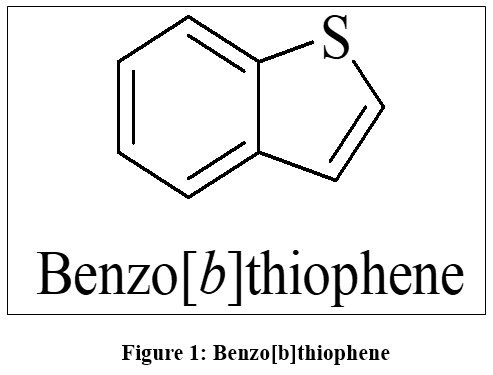 |
Figure 1: Benzo[b]thiophene Click here to View Figure |
Benzothiophene-based compounds have shown a lot of promise as drugs in several areas during the past 20 years. These include anti-inflammatory, anticancer, antibacterial, antiviral, antidiabetic, and neuroprotective uses. Several compounds incorporating benzothiophene have achieved regulatory approval or are now undergoing clinical development, underscoring the scaffold’s drug-likeness, metabolic stability, and binding flexibility. For example, the benzothiophene moiety gives raloxifene,1 a selective estrogen receptor modulator, its receptor selectivity and bioactivity. Likewise, zileuton, a 5-lipoxygenase inhibitor employed in asthma treatment, and sertaconazole, an antifungal drug, further substantiate the clinical efficacy of benzothiophene-based compounds.2 Fig. 2. indicating drugs containing benzo[b]thiophene moiety.
The medicinal relevance of the benzothiophene scaffold is not a recent development: raloxifene, the prototypical benzothiophene-based selective estrogen receptor modulator, was established as an effective agent for postmenopausal osteoporosis in the early 2000s,3 and subsequent structure–activity relationship work through the mid-2000s on raloxifene, arzoxifene, and related benzothiophene-based SERMs helped define how substitution pattern governs estrogen-receptor subtype selectivity and antagonist/agonist balance in this scaffold.4 This early clinical and structural foundation, established more than two decades ago, underlies the more recent synthetic and biological expansion of the benzothiophene scaffold discussed throughout this review.
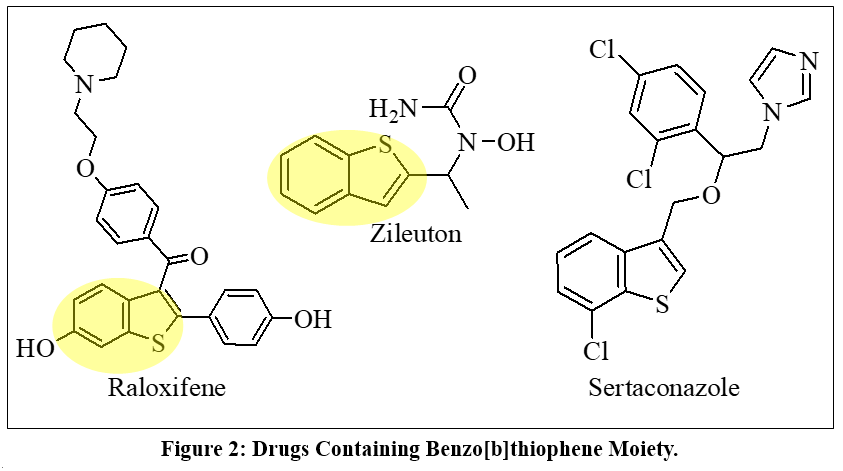 |
Figure 2: Drugs Containing Benzo[b]thiophene Moiety. Click here to View Figure |
The synthetic accessibility of benzothiophenes has undergone considerable advancement, as traditional electrophilic cyclizations and palladium-catalyzed annulation strategies are now enhanced by environmentally friendly and metal-free methodologies. Contemporary techniques including PdI₂/KI-catalyzed aerobic cyclization,7 electrophilic sulfur-mediated cyclization,8 light-induced radical cyclizations,9 and transition-metal-free domino syntheses,10 have facilitated the creation of structurally intricate and functionally varied benzothiophene derivatives under mild and sustainable conditions. These advancements enhance reaction efficiency and atom economy while simultaneously broadening the chemical landscape accessible for biological screening.
Benzothiophene derivatives exhibit significant biological activity, demonstrating marked efficacy against resistant microbial strains,11-13 aggressive tumor cell lines,14-16 and protein targets associated with neurodegenerative disorders.17 Recent investigations into structure–activity relationships (SAR) have underscored the significant influence of substituents at pivotal positions on the benzothiophene core—most notably at the 2- and 3-positions—on the modulation of potency, selectivity, and pharmacokinetic properties.1,2,11 Moreover, computational modeling and Quantitative Structure Activity Relationship (QSAR) analyses have elucidated mechanistic insights into target interactions, thereby informing rational drug design and scaffold optimization.18,19 Given the continuing need for structurally innovative and biologically effective heterocycles, benzothiophene remains a prominent framework in medicinal chemistry and related fields. Recent progress in synthetic methodology, biological evaluation, and computational design has renewed research interest in this scaffold for drug discovery and materials science.20-22
Despite this substantial and rapidly growing body of individual synthetic and biological studies, a specific gap remains in the literature. Existing reviews of benzothiophene chemistry tend to focus narrowly on either synthetic methodology or a single biological activity, and none of the recent reviews have jointly integrated post-2020 green and metal-free synthetic advances with the emerging biological literature on multidrug-resistant pathogens and multi-target kinase inhibition while explicitly distinguishing experimentally demonstrated activity from in silico or computationally predicted activity. This review addresses that gap.
This review therefore provides an integrated, critical examination of: (i) synthetic methodologies for benzothiophene derivatives reported principally between 2007 and 2024, with emphasis on green and metal-free strategies published after 2020 (Section 3); (ii) structure–activity relationships and mechanistic evidence for antimicrobial, anticancer, central nervous system, anti-inflammatory, antioxidant, and antidiabetic activity (Section 4); and (iii) the role of in silico tools (QSAR, molecular docking, ADME prediction) in guiding derivative design. Throughout, experimental (in vitro/in vivo) and computational (in silico) evidence are explicitly distinguished, and translational limitations of the reviewed literature — including sparse in vivo pharmacokinetic data, inconsistently reported green-chemistry metrics, and limited resistance-mechanism studies — are highlighted to guide future research priorities (Section 5).
Structural and Physicochemical Features of Benzothiophene
Benzothiophene, also known as benzo[b]thiophene, has the molecular formula C₈H₆S and a molecular weight of roughly 134.20 g/mol. The configuration consists of a thiophene ring integrated with a benzene ring, providing aromatic stabilization and maintaining a predominantly planar geometry. At ambient temperature, benzothiophene presents itself as a white solid, exuding a distinctive aroma that evokes associations with naphthalene or mothballs. The melting point of benzothiophene is noted to be around 32 °C, while its boiling point is recorded at 221 °C under standard atmospheric conditions. The density is approximately 1.15 g/cm³ under ambient conditions.23 The compound demonstrates significant lipophilicity, as evidenced by a calculated Log P of around 2.78, suggesting favorable membrane permeability while exhibiting limited solubility in aqueous environments.24
Extensive documentation exists regarding thermodynamic evaluations. Chirico et al.,23 and Finke et al.,25 presented comprehensive calorimetric and phase-transition data, encompassing values for heat capacity, entropy, and heat of fusion, obtained through experimental investigations. Vapor pressure data, encompassing Antoine constants and Vogel-type correlations, have been meticulously established for the purpose of gas-phase modelling.26
From a spectroscopic perspective, UV–Visible absorption analyses underscore the prominent π–π transitions inherent to its aromatic framework. Bol’shakov et al.,27 documented absorption maxima within the ultraviolet spectrum, noting that spectral characteristics were influenced by substitution patterns and the fusion of rings in complex structures like benzothieno[3,2-b][1]benzothiophene.
The in silico computed physicochemical descriptors further elucidate its drug-like characteristics: the absence of rotatable bonds, the lack of hydrogen-bond donors or acceptors, and the presence of a rigid fused aromatic system indicate bioisosteric significance for flat, hydrophobic drug-binding sites.24 The integration of these characteristics, along with its electronic configuration, underpins its significance in the realms of medicinal chemistry and material science applications. Table 1. depicts summary of physicochemical properties of Benzo[b]thiophene.
Collectively, the absence of hydrogen-bond donors, the low rotatable-bond count, and the rigid planar aromatic core discussed below are directly relevant to medicinal chemistry: these features favour membrane permeability and binding to flat, hydrophobic pockets typical of kinase ATP sites and enzyme active sites, while the same rigidity and lipophilicity (Log P ≈ 2.78) that aid target engagement also predispose many derivatives toward the aqueous-solubility limitations discussed in the biological-activity and toxicity sections below (Section 4).
Table 1: Summary of the Physicochemical Properties of Benzo[b]thiophene
|
Sr. No. |
Properties | Value |
| 1 | Molecular formula |
C₈H₆S |
|
2 |
Molecular weight | ~134.20 g/mol |
| 3 | Appearance |
White solid, naphthalene-like odor |
|
4 |
Melting point | ~32 °C |
| 5 | Boiling point |
~221 °C |
|
6 |
Density | ~1.15 g/cm³ |
| 7 | Log P |
~2.78 |
|
8 |
UV–Vis absorption | π–π* bands in UV |
| 9 | Hydrogen-bond donors/acceptors |
0 |
|
10 |
Rotatable bonds |
0 |
Crystallographic and Structural Features
Planarity and Ring Geometry
The planar nature of the benzothiophene core is confirmed by crystallographic investigations. The fused thiophene-benzene structure has little torsional distortion. In the crystal structure of 6-(p-tolyl)benzo[b]naphtho[2,3-d]thiophene, the dihedral angle between the benzothiophene system and attached aromatic rings is ≤ 2°, suggesting near-coplanarity.28 In another example, the structure of 3-(4-methoxybenzyl)-1-benzothiophene revealed that the benzothiophene core was flat, with the attached benzyl ring tilted at a dihedral angle of 72.41°, demonstrating that peripheral substituents have little effect on core planarity.29
Bond Lengths, Aromaticity and π-Conjugation:
The benzothiophene ring system adheres to Hückel’s rule, with 10 π-electrons delocalized across the fused rings. The sulfur atom donates one out-of-plane lone pair to the π-system, augmenting aromatic stability.30 X-ray data analysis of bond lengths indicates that C–S and neighboring C–C bonds exhibit partial double-bond character, suggesting π-delocalization throughout the thiophene and benzene rings.31
Intermolecular Interactions and Crystal Packing
In the solid state, benzothiophene derivatives frequently exhibit π···π stacking interactions and weak hydrogen bonds (e.g., C–H···S or C–H···π). Centroid-to-centroid distances of ~3.66 Å between adjacent aromatic systems are common, promoting molecular alignment and crystal stability. In one such derivative, N–H···O, N–H···N, and π-stacking interactions result in head-to-head dimers and zigzag chains, confirming the scaffold’s crystal engineering potential.31
It should be noted that the values reported above (centroid-to-centroid distances, dihedral angles) are crystallographic geometric parameters rather than quantified binding affinities; the cited crystal-structure studies do not report binding affinity scores or interaction-strength values for these contacts, and none should be inferred. Quantitative interaction energies for these packing motifs were not available in the primary literature reviewed here.
Substituent Effects on Conformation
Substituents on the benzothiophene rings impact the conformation and interaction profile, whereas the core often remains unchanged. In 3-(4-methoxybenzyl)-1-benzothiophene, the approximately 72° inclination of the attached ring indicates diminished conjugation while maintaining the planarity of the core.32
Extended Structures and Packing in BTBT Derivatives
More complex systems like benzothieno[3,2-b]benzothiophene (BTBT) exhibit highly organized herringbone or π-stacked configurations, where modifications to substituents play a significant role in determining the solid-state morphology and optoelectronic properties.33 In the case of DBOPBTBT, a dihedral angle of approximately 14.8° between the phenyl rings and the core promotes coplanarity and enables effective π-overlap, supported by S–S contacts measuring 3.4–3.8 Å.34 Investigations into polymorphs demonstrate that temperature-driven transitions among packing configurations have a profound effect on charge mobility and optical characteristics.35 Table 2. shows the structural highlights of Benzo[b]thiophene.
Table 2: Structural Highlights
|
Sr. No. |
Feature | Description |
| 1 | Core planarity |
Benzene–thiophene ring essentially flat (~0–2°) |
|
2 |
π-Electron conjugation | Sulfur lone pair delocalized; aromatic 10 π-electron system |
| 3 | Bond dimensions |
Partial C–S double-bond character; resonance-stabilization |
|
4 |
π···π and C–H···S interactions | Centroid distances ~3.6–3.7 Å; weak hydrogen and stacking contacts |
| 5 | Substituent dihedral angles |
~72° tilt of substituents vs. core, minor impact on core planarity |
|
6 |
Solid-state packing motifs |
Herringbone vs. π-stacked arrangements; S–S contacts ~3.4 Å |
Synthetic Strategies of Benzothiophene Derivatives:
The development of benzothiophene derivatives has progressed significantly, propelled by the demand for effective, sustainable, and adaptable methodologies that embrace structural intricacy and functional variety. Recent advancements highlight the importance of sustainable chemistry principles, metal-free methodologies, and adjustable reactivity, facilitating the exploration of a diverse range of benzothiophene-based frameworks pertinent to pharmaceutical development and materials research. Various synthetic strategies discussed in this section are summarized in Table 3.
Historically, benzothiophene synthesis relied on classical electrophilic and radical-mediated cyclisation chemistry — including Friedel–Crafts-type acylations, Pummerer rearrangements of aryl sulfoxides, and peroxide-promoted radical cyclisation of diaryl disulfides with alkynes — which,5 while robust, often required harsh conditions (strong acid, high temperature, or stoichiometric peroxide) and gave limited regiocontrol. From the late 1990s and 2000s onward, transition-metal (particularly palladium- and copper-catalysed) annulation and cross-coupling strategies, exemplified by the palladium-catalyzed annulation of aryl sulfides with alkynes,6 expanded the accessible substitution patterns and functional-group tolerance considerably. The methods reviewed below, drawn principally from the 2007–2024 literature, represent the most recent phase of this evolution: a shift toward metal-free, aqueous, photochemical, and domino/one-pot strategies that reduce reliance on precious-metal catalysts and organic solvents. For clarity, the fourteen methods discussed in this section are grouped below by mechanistic class — (a) palladium-catalyzed cyclization, (b) metal-free electrophilic/protonative cyclization, (c) photochemical (visible-light-mediated) cyclization, (d) domino/one-pot multicomponent strategies, and (e) cross-coupling-based approaches — with the category indicated in each subsection heading and summarised comparatively in Table 3. As a general guide, metal-free and aqueous domino methods (Sections 3.2, 3.4, 3.6, 3.8–3.9, 3.11) are most attractive when avoiding transition-metal contamination is a priority (e.g., for pharmaceutical intermediates), whereas palladium-catalyzed carbonylative cyclization (Section 3.1) and cross-coupling routes (Sections 3.5, 3.13) offer more direct access to specific substitution patterns (esters, extended π-systems) at the cost of catalyst removal and cost considerations. Quantitative green-chemistry metrics such as E-factor, process mass intensity (PMI), and full atom-economy calculations were not consistently reported across the primary studies cited below; where a method is described as “green” or “sustainable,” this reflects qualitative features stated by the original authors (e.g., catalyst-free conditions, aqueous or solvent-free media, ambient temperature) rather than a quantitative life-cycle assessment.
PdI₂/KI-Catalyzed Oxidative Cyclization–Carbonylation (Palladium-Catalyzed)
Mancuso et al.,7 documented an effective palladium-catalyzed oxidative cyclization–alkoxycarbonylation method for the production of benzothiophene-3-carboxylate esters under aerobic circumstances, employing PdI₂/KI as the catalytic system and air as the exclusive oxidant Scheme 1. The transformation occurs through the coordination of 2-(methylthio)phenylacetylenes to Pd(II), followed by a 5-endo-dig sulfur cyclization, iodide-facilitated demethylation, carbon monoxide insertion, and nucleophilic capture by an alcohol, culminating in the reoxidation of Pd⁰ to PdI₂ by molecular oxygen, thereby completing the catalytic cycle. The approach demonstrates a wide substrate range, tolerating aromatic, heteroaryl, and alkyl substituents, and is compatible with various alcohols to give the appropriate esters in moderate to high yields (57–83%). The incorporation of the ionic liquid BmimBF₄ with methanol facilitates catalyst recycling for a minimum of five cycles with no activity reduction, highlighting the method’s sustainability. This ligand-free, multicomponent methodology provides operational simplicity and atom economy while adhering to green chemistry principles by employing air as an oxidant and enabling the synthesis of pharmacologically pertinent benzothiophene derivatives in a single step.
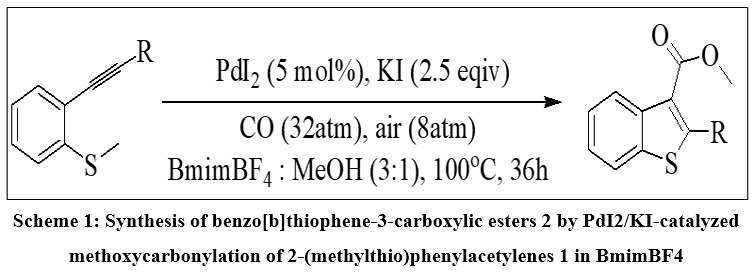 |
Scheme 1: Synthesis of benzo[b]thiophene-3-carboxylic esters 2 by PdI2/KI-catalyzed methoxycarbonylation of 2-(methylthio)phenylacetylenes 1 in BmimBF4 |
Electrophilic Sulfur-Mediated Cyclization of Alkynyl Thioanisoles (Metal-Free)
In their 2022 paper in the Journal of Organic Chemistry, Alikhani et al.,8 described an effective and feasible metal-free method for synthesizing 2,3-disubstituted benzo[b]thiophenes by electrophilic sulfur-mediated cyclization of o-alkynyl thioanisoles as presented in Scheme 2. The transformation employs dimethyl(thiodimethyl)sulfonium tetrafluoroborate as a stable and easily obtainable electrophilic sulfur source, allowing the reaction to occur under mild, ambient-temperature conditions without requiring transition-metal catalysts or harsh reagents. The approach demonstrates extensive functional group tolerance, allowing for diverse aryl and alkyl substituents on both the alkyne and aromatic ring, and produces the target products in excellent to near-quantitative yields. The nucleophilic attack of the alkyne on the electrophilic sulfur initiates intramolecular cyclization, subsequently leading to selective demethylation, resulting in the formation of the benzo[b]thiophene framework with a thiomethyl group at the C-3 position. The technique is operationally straightforward and scalable, while adhering to green chemistry principles by utilizing non-toxic chemicals, producing little wastes, and obviating the necessity for costly or delicate metal catalysts. This study presents a flexible and sustainable alternative to traditional benzo[b]thiophene syntheses, with potential applications in the synthesis of bioactive compounds, materials, and heteroaryl building blocks.
Visible-Light-Induced Radical Cyclization (Photochemical)
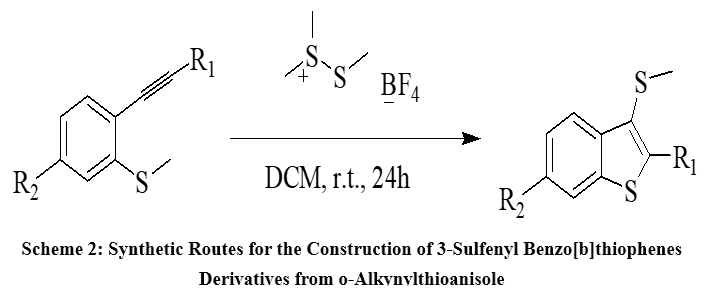 |
Scheme 2: Synthetic Routes for the Construction of 3-Sulfenyl Benzo[b]thiophenes Derivatives from o-Alkynylthioanisole Click here to View Scheme |
In a 2023 article of the European Journal of Organic Chemistry, Sujith K. P. and Anna Lee presented a visible-light-mediated radical cyclization method for the synthesis of 3-arylselanyl benzothiophenes, refer Scheme 3. Their approach utilizes diaryl selenides as the aryl selenium source, subjected to irradiation from a low-power (5 W) white LED at room temperature (about 23 °C). The reaction occurs without catalysts or additives, underscoring its operational simplicity and environmental sustainability. The approach demonstrates a gentle and effective assembly of benzothiophene scaffolds, a crucial structure in chemical synthesis and materials research. This method utilizes visible light to produce selenium-centered radicals that intramolecularly attack alkynyl aryl substrates, facilitating the direct formation of a benzothiophene ring with an arylselanyl substituent at the 3-position, thus providing an environmentally friendly and practical alternative to conventional metal-dependent methods.9
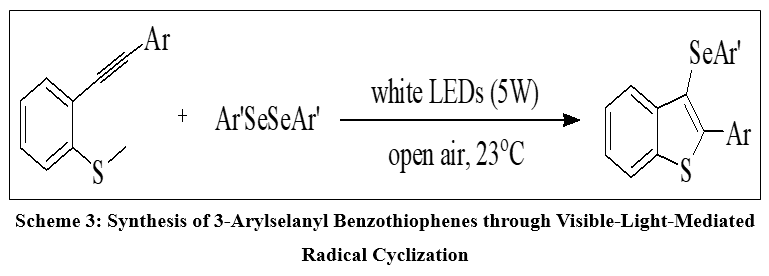 |
Scheme 3: Synthesis of 3-Arylselanyl Benzothiophenes through Visible-Light-Mediated Radical Cyclization Click here to View Scheme |
Transition-Metal-Free Domino Syntheses in Aqueous Media (Domino/One-Pot)
In their 2022 paper in Organic & Biomolecular Chemistry, Deng, Gu, Zhang, Zhang, and Meng described a highly sustainable, catalyst-free, three-component domino reaction in water for synthesizing benzothiophene-fused pyrrolidones containing a trifluoromethyl (CF₃) group, as given in Scheme 4. The transformation occurs seamlessly at ambient temperature, utilizing readily accessible starting materials and water as the exclusive reaction medium, thus obviating the necessity for organic solvents or transition-metal catalysts. This approach is operationally straightforward and demonstrates extensive substrate compatibility, accommodating various functional groups on both the aryl and alkyne components, yielding the required products in moderate to good yields. The reaction sequence exhibits favorable atom economy and environmental benignity, aligning it with the principles of green chemistry. The technique is notably scalable without much efficiency loss, and the CF₃-substituted benzothiophene derivatives shown strong anticancer potential in first CCK-8 cytotoxicity experiments against specific cancer cell lines. This method constitutes a pragmatic, environmentally sustainable, and physiologically pertinent pathway to fluorinated benzothiophene derivatives with prospective applications in pharmaceutical chemistry and materials science.10
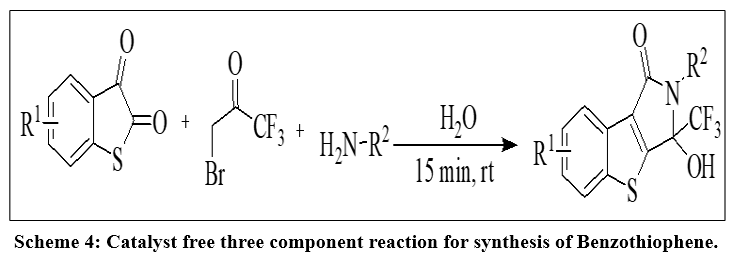 |
Scheme 4: Catalyst free three component reaction for synthesis of Benzothiophene. Click here to View Scheme |
Sustainable Benzo[b]thieno[2,3-d]thiophene Derivatives (Cross-Coupling)
Kim et al.,20 detailed the design, synthesis, and characterization of two innovative solution-processable benzo[b]thieno[2,3-d]thiophene (BTT) derivatives—2-(benzo[b]thiophen-5-yl)benzo[b]thieno[2,3-d]thiophene and 2-(benzo[b]thieno[2,3-d]thiophene-2-yl)dibenzo[b,d]thiophene—intended for use as small-molecule organic semiconductors in organic thin-film transistors (OTFTs). The synthetic approach utilized direct cross-coupling techniques to develop the extended π-conjugated BTT cores, with the objective of achieving an equilibrium among solubility, thermal stability, and charge-transport characteristics. The thermal and optical analyses, including TGA, DSC, and UV–Vis spectroscopy, validated the presence of elevated decomposition temperatures, consistent melting transitions, and advantageous electronic absorption characteristics that suggest effective π–π stacking in the solid state. The authors constructed bottom-gate/top-contact OTFTs through solution shearing, and morphological analyses utilizing X-ray diffraction (XRD) and atomic force microscopy (AFM) demonstrated the presence of well-ordered crystalline domains. Device testing revealed p-type transport characteristics, with the dibenzo[b,d]thiophene-substituted derivative attaining hole mobilities of up to 0.005 cm² V⁻¹ s⁻¹ and on/off current ratios exceeding 10⁶. The findings illustrate the promise of thoughtfully engineered BTT derivatives as viable options for high-performance, printable organic semiconductors, wherein molecular planarity and the strategic design of side groups play a crucial role in influencing film microstructure and device efficiency.
Enantiospecific C2-Alkylation via Benzothiophene S-Oxides (Metal-Free)
Sang et al.,21 documented a transition-metal-free, enantiospecific C2-alkylation of benzothiophene S-oxides using boronate complex intermediates, facilitating the effective synthesis of enantioenriched 2,3-disubstituted benzothiophenes with full stereochemical retention. The approach entails the initial directed lithiation of benzothiophene S-oxide, succeeded by borylation to yield an arylboronate complex. Activation with trifluoromethanesulfonic anhydride (Tf₂O) facilitates S–O bond cleavage and initiates a Pummerer-type 1,2-metalate rearrangement, resulting in the formation of a new C2–C bond in a stereospecific way. The reaction has a wide substrate range, accommodating primary, secondary, and tertiary alkyl boronic esters, along with aryl boronic esters, and effectively incorporates various C3-substituted benzothiophene S-oxide derivatives while maintaining enantioselectivity. The approach notably excludes transition metals, functions under mild circumstances, and produces high yields with exceptional enantiospecificity, rendering it particularly appealing for the late-stage modification of intricate structures. This study emphasizes the efficacy of boronate complex chemistry and Pummerer-type rearrangements in the stereocontrolled functionalization of heteroaromatic frameworks, presenting considerable prospects for drug discovery and materials science applications.
One-Pot Aroylation and Click Chemistry Hybridization (Domino/One-Pot)
Mukhtar et al.,22 describe a straightforward, one-pot approach for the synthesis of substituted 2-aroylbenzo[b]thiophen-3-ols by a base-mediated Sₙ2-type reaction involving 2-mercaptobenzoic acid and aryl bromomethyl ketones, employing triethylamine in DMF at room temperature, achieving yields of up to 87%, Scheme 5 represents the work reported in this article. The suggested mechanism entails a nucleophilic assault by the thiol group on the bromomethyl ketone, resulting in the formation of a sulfanylbenzoic acid intermediate, which subsequently undergoes intramolecular cyclization and tautomerization to yield the benzothiophen-3-ol core. The authors further illustrate the applicability of the produced scaffold by modifying the 3-hydroxy group: the incorporation of a propargyl moiety, succeeded by a copper-catalyzed azide–alkyne cycloaddition (click chemistry), produces benzothiophene-triazole hybrids in substantial yields. This straightforward and resilient strategy facilitates swift access to novel benzothiophene frameworks while allowing for various aryl substituents on the bromomethyl ketone, thereby enhancing the structural diversity of the products and providing promising candidates for biological and pharmaceutical applications.
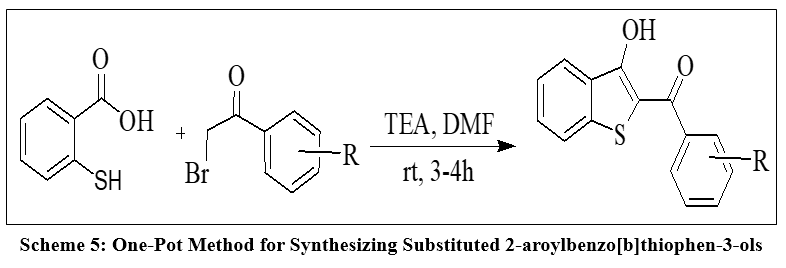 |
Scheme 5: One-Pot Method for Synthesizing Substituted 2-aroylbenzo[b]thiophen-3-ols Click here to View Scheme |
Domino Reaction of Thioisatin Derivatives (Domino/One-Pot, Catalyst-Free)
A prior investigation by Deng et al.,36 presented a K₂CO₃/MgSO₄-facilitated tandem domino reaction involving thioisatin derivatives and α-bromoketones, yielding benzothiophene-fused heterocycles (e.g., thiochromenes and pyranones), refer Scheme 6 for the synthetic route. Modifying MgSO₄ concentrations facilitates selectivity adjustment, beneficial for precise synthesis. Researchers devised a stereotunable, catalyst-free three-component domino reaction for the varied synthesis of benzothiophene-fused N-heterocycles, encompassing intricate polycyclic frameworks and medium-sized nitrogen-containing rings. The reaction utilizes thioisatin, 2-bromo-1-phenylethan-1-one, and cyclohexane-1,2-diamine as accessible building blocks, with the stereoconfiguration of the diamine determining the generation of unique structural motifs under moderate, metal-free conditions. Comprehensive density functional theory (DFT) analyses elucidated the mechanistic basis of the process’s chemoselectivity, demonstrating that intramolecular interactions and steric effects dictate the diverse routes. This methodology enhances the structural diversity achievable through domino reactions while adhering to green chemistry principles by eliminating transition metals, operating under straightforward conditions, and facilitating stereocontrolled synthesis of biologically significant benzothiophene derivatives.
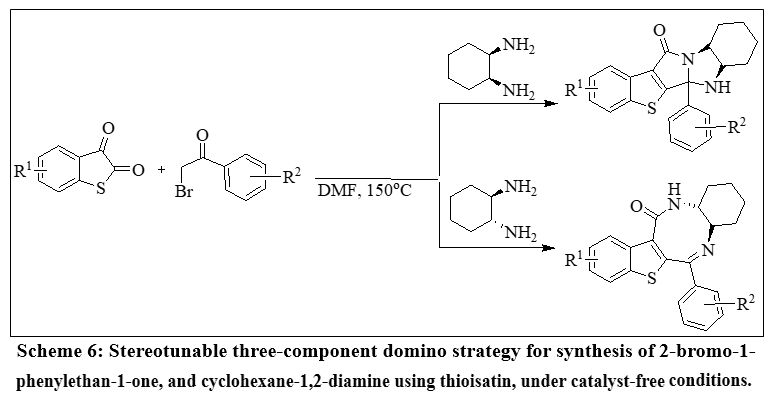 |
Scheme 6: Stereotunable three-component domino strategy for synthesis of 2-bromo-1-phenylethan-1-one, and cyclohexane-1,2-diamine using thioisatin, under catalyst-free conditions. |
Silica Gel-Promoted Cyclization of Ynamides (Metal-Free)
Kim et al.,37 delineated a mild, protonative intramolecular cyclization method for synthesizing 2-amidobenzo[b]thiophenes, utilizing silica gel (or solvent) to facilitate the activation of o-methylthio-ynamides in a one-pot procedure, follow Scheme 7. This process eliminates the necessity for potent Brønsted acids or costly transition-metal catalysts, providing a more cost-effective and straightforward methodology. The principal mechanistic step entails the protonation of the ynamide triple bond by the mildly acidic surface of silica gel, which initiates intramolecular cyclization through the attack of the ortho-methylthio aryl group, resulting in the production of the benzothiophene core. A range of functionalized 2-amidobenzo[b]thiophenes was easily synthesized employing this methodology, highlighting its extensive applicability and simplicity in the production of physiologically pertinent heterocycles.
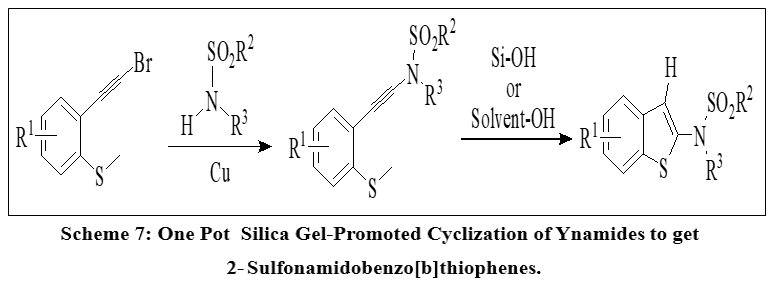 |
Scheme 7: One Pot Silica Gel-Promoted Cyclization of Ynamides to get 2-Sulfonamidobenzo[b]thiophenes. Click here to View Scheme |
Aryne–Alkynyl Sulfide One-Step Coupling (Metal-Free)
Matsuzawa et al.,38 presented a very efficient one-step aryne–alkynyl sulfide coupling method for the synthesis of 3-substituted benzo[b]thiophenes, as depicted in Scheme 8. This refined process utilizes readily available o-silylaryl triflates as precursors to create arynes in situ through fluoride activation, commonly employing CsF in acetonitrile. The reactive arynes experience nucleophilic attack by the sulfur atom of an alkynyl sulfide, initiating intramolecular cyclization to produce the benzothiophene core, subsequently followed by protonation and deethylation to generate the final heterocycle. This metal-free approach offers a notable benefit due to its extensive substrate range: it accommodates both electron-donating (e.g., methoxy) and electron-withdrawing (e.g., chloro, methoxycarbonyl) aryl substituents on the alkynyl sulfide while maintaining yield integrity. Secondary and primary alkylethynyl sulfides, together with sterically hindered and π-extended aromatics, are effectively tolerated. The approach facilitates the synthesis of intricate benzo[b]thiophene variations, encompassing pentacyclic derivatives, and permits varied C2 functionalization. This study introduces a direct, expedited, and functional-group-tolerant methodology for synthesizing benzothiophene frameworks from basic building blocks, offering significant potential for pharmaceutical and materials applications due to its operational ease, synthetic flexibility, and efficiency in producing multisubstituted structures.
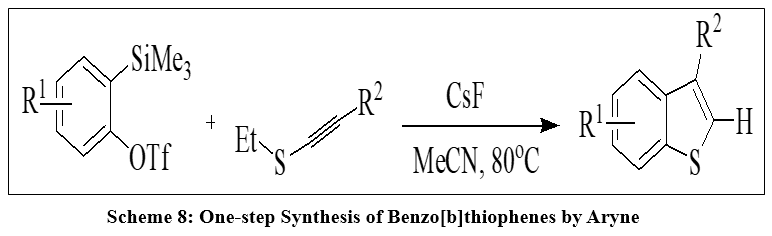 |
Scheme 8: One-step Synthesis of Benzo[b]thiophenes by Aryne Click here to View Scheme |
Transition-Metal-Free Acylation Using Trifluoroacetates (Metal-Free, Solvent-Free)
Pal et al.,39 described a transition-metal- and Lewis-acid-free methodology for the direct synthesis of 2- and 3-acylbenzothiophenes using an ecologically friendly C–C bond-forming acylation, performed under solvent-free conditions at ambient temperature (25–30 °C). The method utilizes in situ produced acyl trifluoroacetates, consisting of readily accessible aliphatic or aromatic carboxylic acids, trifluoroacetic anhydride (TFAA), and 85% phosphoric acid, facilitating the efficient acylation of benzothiophene with favorable overall yields. Both aliphatic (e.g., acetyl, propanoyl) and aromatic (e.g., benzoyl, p-methoxybenzoyl, p-nitrobenzoyl) acids effectively engaged, consistently favoring the C-3 acylated isomer as the predominant product throughout the substrate range. Phosphoric acid likely functions as a covalent catalyst, transforming acyl trifluoroacetate into a highly electrophilic acyl bis(trifluoroacetyl)phosphate species, which subsequently reacts at the most activated position on the benzothiophene ring—preferentially C-3 due to its increased reactivity—resulting in the acylated heterocycles in a single, atom-efficient process. This method is distinguished by its operational simplicity, the removal of toxic solvents and metals, the utilization of commercially available reagents, and the feasibility for large-scale applications through the recovery and regeneration of TFAA from TFA byproducts—rendering it a sustainable and practical protocol for obtaining pharmaceutically and synthetically valuable acyl-substituted benzothiophenes.
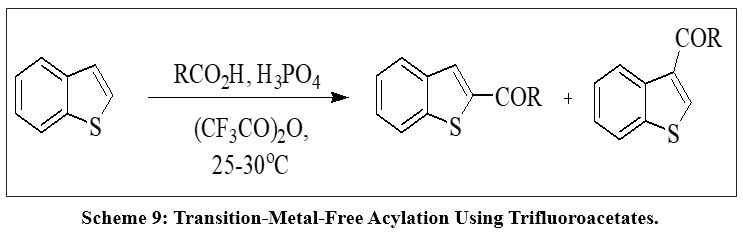 |
Scheme 9: Transition-Metal-Free Acylation Using Trifluoroacetates. Click here to View Scheme |
One-Step Synthesis of 3-Amino-1-benzothiophene-2-carbonitriles (One-Pot)
Ivanov et al.,40 established a unique and operationally straightforward methodology for synthesizing 3-amino-1-benzothiophene-2-carbonitriles, offering a speedy and efficient pathway to this synthetically significant scaffold as mentioned in Scheme 10. The process utilizes accessible starting materials and operates under mild, one-pot conditions, facilitating the direct synthesis of the fused benzothiophene core with both amino and cyano groups. Electron-rich and electron-withdrawing groups markedly augment the reactivity profile of the products, rendering them valuable precursors for further derivatization. This method avoids the necessity for multi-step sequences or aggressive reagents often linked to such targets, thereby enhancing atom economy, decreasing reaction time, and maximizing structural diversity potential. Considering the physiological significance of 3-amino-benzothiophene derivatives, this methodology is promising for drug development, material science, and serves as a diverse intermediate platform for heterocyclic transformations.
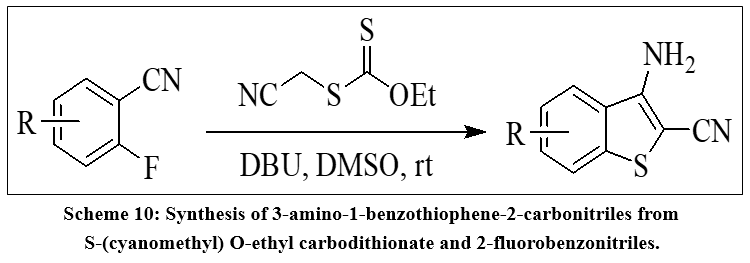 |
Scheme 10: Synthesis of 3-amino-1-benzothiophene-2-carbonitriles from S-(cyanomethyl) O-ethyl carbodithionate and 2-fluorobenzonitriles. Click here to View Scheme |
Suzuki–Miyaura Coupling-Initiated Sulfinylation (Cross-Coupling)
Kumagai et al.,41 presented a highly effective two-step technique for synthesizing dibenzothiophene S-oxides from 2-bromoaryl sulfinate esters, Scheme 11 shows the synthetic process involved in this work. The procedure initiates with a Br-selective Suzuki–Miyaura coupling utilizing arylboronic acids, effectively circumventing undesired sulfoxide formation, succeeded by intramolecular electrophilic cyclization of the resultant sulfinate ester with triflic anhydride (Tf₂O), yielding the desired S-oxide in outstanding yields under mild conditions. This strategy is notable for its extensive functional-group tolerance, facilitating the seamless synthesis of various dibenzothiophene S-oxides with electron-rich, electron-deficient, sterically hindered, or π-extended substituents, including an o-silylaryl triflate moiety—essential for subsequent aryne-mediated transformations. Moreover, the resultant S-oxide products act as adaptable substrates for Pummerer-type C–H propargylations and aryne chemistry, enabling the synthesis of various functionalized dibenzothiophene derivatives. This novel methodology facilitates access to structurally intricate and functionally diverse dibenzothiophene S-oxides, presenting considerable potential for applications in chemical biology, materials science, and heterocyclic synthesis.
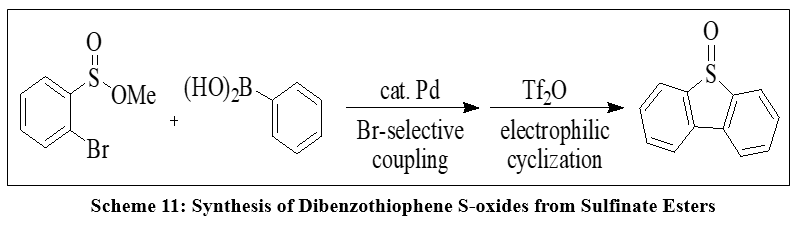 |
Scheme 11: Synthesis of Dibenzothiophene S-oxides from Sulfinate Esters Click here to View Scheme |
KI-Assisted Sulfur Insertion/Denitration for Acylbenzothiophenes (One-Pot)
Singh et al.,42 devised a KI-facilitated sulfur insertion protocol that transforms aromatic nitro precursors into β-carboline-tethered 2-acylbenzothiophenes through a singular, one-pot process. The gentle sequence concurrently facilitates the removal of the nitro group and the incorporation of sulfur, resulting in the formation of the benzothiophene core linked to a β-carboline fragment via an effective, regiocontrolled cascade. The proposed mechanism for the transformation involves the reduction and activation of the nitroarene, facilitated by iodide, followed by a series of C–S bond-forming events that construct the benzothiophene ring while incorporating the acyl functionality. KI serves dual roles as both a promoter and a nucleophilic source, aiding in the demasking of the nitro group and the transfer of sulfur. The approach is straightforward in its execution, operates under mild conditions, and accommodates a variety of structurally distinct aryl partners, facilitating the swift construction of intricate, pharmacophore-dense frameworks with remarkable efficiency. By integrating sulfur insertion chemistry with heterocycle construction in a single pot, this approach offers a flexible pathway to acylbenzothiophene derivatives that can be further modified and hold promise for applications in medicinal chemistry lead development and heterocyclic synthesis.
Table 3; Summary Table of Key Synthetic Approaches
|
Sr. No. |
Synthetic Strategy | Key Method / Cond. | Key Outcome / Limitation |
| 1 | PdI₂/KI oxidative cyclization–carbonylation⁷ | Aerobic; CO insertion; recyclable IL |
57–83% yield; Pd/CO handling |
|
2 |
Electrophilic S cyclization⁸ | Metal-free; sulfonium BF₄; mild | Near-quant. yield; sulfonium reagent required |
| 3 | Visible-light radical cyclization⁹ | 5 W LED; catalyst/additive-free |
Yield not quantified |
|
4 |
Aqueous domino CF₃ synthesis¹⁰ | 3-component; H₂O; catalyst-free; RT | Mod.–good yield; scalable |
| 5 | BTT semiconductor synthesis²⁰ | Cross-coupling; π-conjugated BTTs |
Hole mobility ≤0.005 cm²/Vs |
|
6 |
Enantiospecific C2-alkylation²¹ | S-oxide/boronate intermediates | High yield/ee; boronate synthesis required |
| 7 | Aroylation–click hybridization²² | Sequential SN2/click |
Up to 87% yield |
|
8 |
Thioisatin domino reaction³⁶ | K₂CO₃/MgSO₄-promoted tandem | Selectivity depends on MgSO₄ loading |
| 9 | Silica-gel ynamide cyclization³⁷ | Protonative cyclization; no strong acid/metal |
Yield not quantified |
|
10 |
Aryne–alkynyl sulfide coupling³⁸ | CsF-mediated; metal-free | Broad scope; yields not tabulated |
| 11 | Trifluoroacetate acylation³⁹ | Solvent-free; RT; metal-free |
Favorable yield; TFAA recovery |
|
12 |
3-Amino-carbonitrile synthesis⁴⁰ | One-pot; mild conditions | Yield/mechanistic details limited |
| 13 | Suzuki–sulfinylation cascade⁴¹ | Br-selective coupling/cyclization |
High yield reported |
|
14 |
KI-S insertion/denitration⁴² | One-pot; mild conditions |
Yield not quantified |
Biological Activity of Benzothiophenes
Antimicrobial Activity
Barbier et al.,11 meticulously designed and synthesized a targeted library of 26 benzo[b]thiophene 2 carbohydrazide acylhydrazones through the reaction of substituted benzo[b]thiophene-2-carboxylic hydrazides with a range of aromatic and heteroaromatic aldehydes, thereby introducing structural diversity at both the C 6 position of the benzo[b]thiophene and the arylidene moiety. The antibacterial evaluation conducted against three strains of S. aureus—comprising a reference strain alongside two clinically isolated strains exhibiting resistance to methicillin and daptomycin—yielded the identification of eight potent analogues. Among these, (E)-6-chloro-N′-(pyridin-2-ylmethylene)benzo[b]thiophene-2-carbohydrazide (designated II.b) demonstrated a minimum inhibitory concentration of 4 µg/mL across all tested strains. Cytotoxicity assays demonstrated that compound II.b exhibited no cytotoxic effects on human A549 lung cells, thereby reinforcing its potential for therapeutic application. This research highlights the collaborative potential of the benzo[b]thiophene framework and acylhydrazone functional group in eliciting antimicrobial effects against multidrug-resistant pathogens, while also showcasing advantageous safety profiles and the versatility of the scaffold for subsequent enhancements.11 Fig. 3 depicts representative structure of reported compounds in this work.
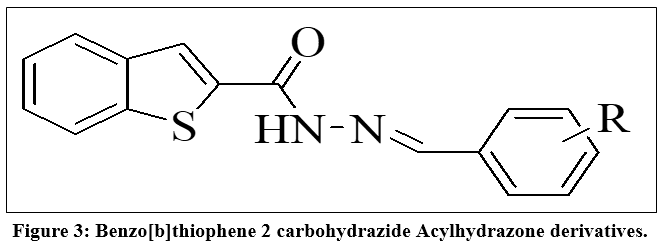 |
Figure 3: Benzo[b]thiophene 2 carbohydrazide Acylhydrazone derivatives. Click here to View Figure |
Ahmad et al.,12 documented the design, synthesis, and antibacterial assessment of a series of N-(4-methylpyridin-2-yl)thiophene-2-carboxamide analogues targeting multidrug-resistant bacterial pathogens, specifically the ESBL (Extended-Spectrum β-Lactamase)-producing Escherichia coli ST131 strains, which are widely prevalent and exhibit significant resistance as uropathogens. The research entailed the creation of a targeted library of carboxamide derivatives, succeeded by comprehensive biological evaluation against clinical isolates. Multiple compounds in the series demonstrated significant antibacterial efficacy, with minimum inhibitory concentrations (MICs) reflecting strong activity against the target strain. The structural design included both electron-withdrawing and electron-donating substituents, affecting their antibacterial efficacy. SAR analysis revealed that the thiophene and pyridine ring systems played a substantial role in bacterial membrane contact and enzymatic inhibition. The findings indicate that benzothiophene-based compounds are viable frameworks for the development of next-generation antimicrobial drugs effective against resistant Gram-negative bacteria, such as E. coli ST131.
Masih et al.,13 documented the synthesis and antibacterial assessment of a novel series of 3-halobenzo[b]thiophene derivatives Fig. 4., employing an environmentally friendly electrophilic cyclization method. The authors conducted halogen-mediated cyclizations using sodium halides in ethanol, beginning with 2-alkynyl thioanisoles, resulting in the formation of chlorinated and brominated benzothiophene products with yields above 90%. The cyclohexanol-linked 3-chloro and 3-bromo derivatives shown significant action, with minimum inhibitory concentrations (MICs) of 16 µg/mL against Staphylococcus aureus and several yeast strains. Time-kill experiments demonstrated swift bactericidal efficacy against S. aureus, attaining a decrease of >3 log₁₀ CFU/mL within 1 hour at the minimum inhibitory concentration (MIC) or 2× MIC. Significantly, in silico ADME profiling by SwissADME demonstrated that the prospective compounds adhered to Lipinski’s, Veber’s, and Muegge’s drug-like criteria, with no PAINS or Brenk alarms, suggesting advantageous physicochemical and pharmacokinetic characteristics. This study emphasizes the antimicrobial effectiveness and drug-like potential of basic halogenated benzothiophenes, establishing these structures as attractive candidates in antibacterial drug development.
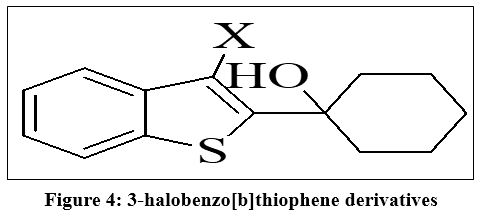 |
Figure 4. 3-halobenzo[b]thiophene derivatives Click here to View Figure |
El Yacoubi et al.,18 investigated the antibacterial efficacy of benzothiophene derivatives Fig. 5., against methicillin-resistant and methicillin-sensitive Staphylococcus aureus (MRSA/MSSA) via a computational drug development methodology. The research utilized quantitative structure–activity relationship (QSAR) modelling to associate molecular descriptors with antibiotic efficacy, effectively pinpointing structural characteristics crucial for potency. Molecular docking experiments concurrently demonstrated robust projected binding affinities of certain benzothiophene derivatives for MRSA-related bacterial enzymes, underscoring several lead candidates with potential theoretical efficacy. This study highlights the significance of in silico methods in facilitating the rational creation of innovative antibacterials aimed at resistant microorganisms. Fig. 5 represents the benzothiophene hydrazide derivatives reported in the said literature.
It should be noted explicitly that the MRSA/MSSA activity reported by El Yacoubi et al.,18 is derived entirely from QSAR modelling and molecular docking; no wet-laboratory antibiotic susceptibility testing (AST), including disc-diffusion or broth microdilution assays, was performed or reported in the cited study. Because the present manuscript is a review and no new experimental work was conducted for it, in vitro AST data and disc-diffusion images cannot be presented here; experimental validation of these in silico leads by AST is identified as a priority for future work (Section 5.1).
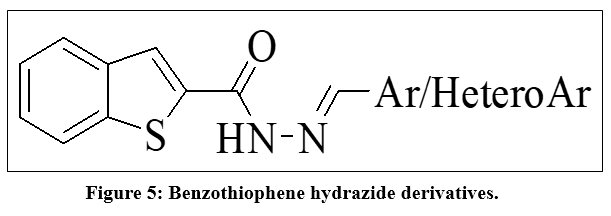 |
Figure 5: Benzothiophene hydrazide derivatives. Click here to View Figure |
Molina Panadero et al.,19 undertook a comprehensive approach that integrated virtual screening with experimental assessment to identify new thiophene derivatives exhibiting antimicrobial properties against colistin-resistant Acinetobacter baumannii and Escherichia coli—significant Gram-negative pathogens that pose critical challenges in clinical settings. Among a collection of 24 structurally interconnected heterocyclic compounds originating from thiophene, compounds 4, 5, and 8 exhibited noteworthy MIC₅₀ values: ranging from 16–32 mg/L against colistin-resistant A. baumannii, and 8–32 mg/L against colistin-resistant E. coli. The time kill assays demonstrated that derivatives 4 and 8 exhibit bactericidal properties, achieving reductions of over 3–5 log₁₀ CFU within 8–24 hours at concentrations of 2–4× MIC against these resistant strains. Mechanistic investigations demonstrated an elevation in bacterial membrane permeability coupled with a decrease in adherence to HeLa epithelial cells post-treatment, signifying a disruption of essential bacterial defence mechanisms. Furthermore, molecular docking simulations revealed significant binding affinities of these compounds, particularly compound 4, to outer membrane proteins including CarO1 and Omp33 in A. baumannii, as well as OmpW and OmpC in E. coli. This suggests a potential disruption of nutrient transport or the structural integrity of the membrane.
Lai and colleagues have introduced an innovative series of tetrahydrobenzothiophene-based amide derivatives Fig. 6, posited as potential antibacterial agents. The synthesis commenced with the intramolecular cyclization of 2-chloroethylthiophenol derivatives to form the tetrahydrobenzothiophene (THBT) core, subsequently followed by acylation or sulfonylation at the amino position to enhance structural diversity. Forty derivatives were synthesized and evaluated for their antibacterial efficacy against both Gram-positive and Gram-negative pathogens, including E. coli, S. aureus, P. aeruginosa, and S. enterica. The evaluation of antibacterial potency was conducted through MIC (minimum inhibitory concentration) assays, revealing values that spanned from 0.54 to 99.92 µM. Among the synthesized compounds, 3b demonstrated the most noteworthy activity, revealing submicromolar MICs across various bacterial strains. The analysis of SAR indicated that the presence of electron-withdrawing substituents on the aromatic amide ring, including halogens and nitro groups, markedly improved antibacterial activity. This enhancement is likely attributable to increased membrane permeability and interactions with microbial targets. This research illustrates the promise of the THBT scaffold in the realm of antibacterial drug discovery and advocates for additional exploration into its therapeutic uses.43
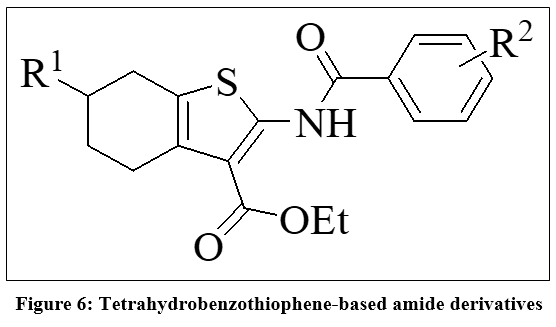 |
Figure 6: Tetrahydrobenzothiophene-based amide derivatives Click here to View Figure |
Li et al.,44 developed and synthesized a new series of α-methylene-γ-butyrolactone (MBL) derivatives with a benzothiophene moiety for antifungal purposes Fig. 7. The structural design concepts integrate a recognized bioactive lactone scaffold with the benzothiophene motif to amalgamate advantageous pharmacophores. Biological evaluation demonstrated that multiple compounds displayed moderate to substantial fungicidal efficacy, with notable candidates—compound 2 (3-F-Ph) and compound 7 (4-Cl-Ph)—attaining EC₅₀ values of 0.94 and 0.99 mg/L, respectively, against Rhizoctonia solani, comparable to the commercial fungicide tebuconazole (EC₅₀ = 0.96 mg/L). Both compounds surpassed recognized drugs like famoxadone and carabrone in suppressing Valsa mali, with EC₅₀ values of 2.26 and 1.67 mg/L, respectively. Compound 2 exhibited in vivo protective and curative efficacy at 100 mg/L (57.2% and 53.7%, respectively), comparable to tebuconazole (51.6% and 52.4%). Mechanistic investigations indicated that compound 2 compromises fungal cells by modifying ultrastructure, enhancing membrane permeability, and decreasing mitochondrial complex III activity; molecular docking corroborated robust binding of compound 2 within the Qo pocket of complex III. This study identifies MBL–benzothiophene hybrids as interesting scaffolds for fungicide development, demonstrating significant efficacy, advantageous structure–activity correlations, and a feasible mechanism of action conducive to further lead modification.
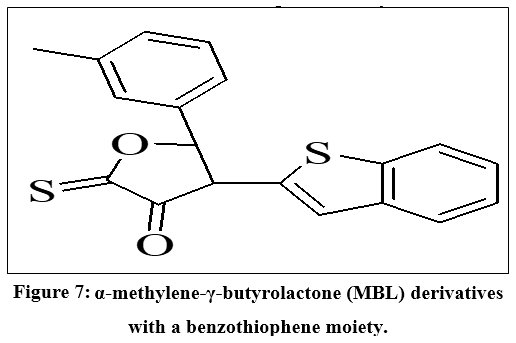 |
Figure 7: α-methylene-γ-butyrolactone (MBL) derivatives with a benzothiophene moiety. Click here to View Figure |
Seethaler et al.,45 developed and synthesized an innovative series of fluorinated benzothiophene–indole hybrid compounds Fig. 8., utilizing a simple one-pot condensation method. The compounds in question are categorized into four interconnected subclasses, synthesized through the coupling of fluoro-substituted benzothiophene cores with indole motifs under mild acidic conditions in acetic acid. This process is subsequently followed by column purification, resulting in yields that typically exceed 50%. The assessment of antimicrobial efficacy against both methicillin-sensitive (S. aureus) and methicillin-resistant (MRSA) strains demonstrated significant activity, with multiple analogues attaining MICs within the low micromolar to sub-micromolar spectrum. In the series of substituents, the 5-cyano derivatives (such as compound 3d) typically exhibited enhanced potency, demonstrating MRSA MICs near 1 µg/mL, which is on par with conventional antibiotics. Analysis of structure–activity relationships suggests that diminutive electron-withdrawing substituents at the 5 position significantly augment antibacterial efficacy, surpassing the effects of larger groups. Mechanistic investigations have pinpointed bacterial pyruvate kinase as a probable molecular target, corroborated by biochemical inhibition assays. The capacity of these hybrids to disrupt glycolytic enzyme function may be fundamental to their antibacterial efficacy. The study illustrates that the straightforward one-pot synthesis of benzothiophene–indole hybrids produce promising antimicrobial agents that exhibit activity against difficult S. aureus strains, including MRSA. This positions these scaffolds as compelling candidates for future antibiotic development. Table 4. highlights the important aspects of antimicrobial properties of compounds discussed in this article.
Critical assessment: across the antimicrobial studies reviewed above, potency is reported almost exclusively as MIC or MIC₅₀ values (typically 1–32 µg/mL or mg/L) generated by broth microdilution or, in one case, QSAR/docking prediction, with only two studies reporting bactericidal time-kill kinetics.13,19 Direct comparison across studies is complicated by the use of different bacterial strains, media, and inoculum sizes, and by the near-total absence of head-to-head comparison with clinically used antibiotics (e.g., vancomycin, colistin) under matched conditions; only compound II.b and the fluorinated benzothiophene–indole hybrids approach the potency of first-line anti-MRSA agents.11,45 Mechanistically, only the benzothiophene–indole hybrids and the colistin-resistant Gram-negative-active thiophenes identify a putative molecular target (pyruvate kinase; outer-membrane porins CarO1, Omp33, OmpW, OmpC, respectively); resistance mechanisms such as efflux-pump upregulation or target mutation were not systematically investigated for any compound class discussed here, and cytotoxicity/selectivity data against mammalian cells were reported for only one series (Barbier et al.,11 compound II.b, non-cytotoxic to A549 cells). These gaps are addressed further in Section 4.7.
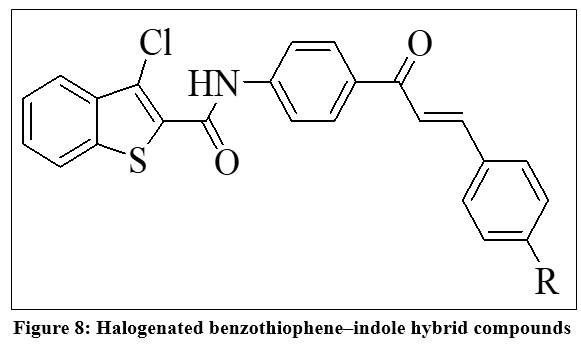 |
Figure 8: Halogenated benzothiophene–indole hybrid compounds Click here to View Figure |
Table 4: Key Highlights of Antimicrobial Activity.
|
Sr. No. |
Compound Class | Target Pathogens | Antimicrobial Activity | Key Findings |
| 1 | Benzo[b]thiophene-2-carbohydrazide acylhydrazones11 | S. aureus (MRSA, daptomycin-resistant) | MIC ≤4 µg/mL |
Broad anti-MRSA activity; non-cytotoxic |
|
2 |
Thiophene-2-carboxamides12 | ESBL-producing E. coli ST131 | Potent MICs | Active against multidrug-resistant uropathogens |
| 3 | 3-Halobenzo[b]thiophenes13 | S. aureus, yeasts | MIC ~16 µg/mL |
Rapid bactericidal action; favorable ADME |
|
4 |
Benzothiophene derivatives18 | MRSA, MSSA | QSAR/docking prediction | Promising antibacterial enzyme inhibitors |
| 5 | Thiophene-based heterocycles19 | Colistin-resistant A. baumannii, E. coli | MIC₅₀ 8–32 mg/L |
Membrane disruption; bactericidal activity |
|
6 |
THBT-based amides43 | E. coli, S. aureus, P. aeruginosa, S. enterica | MIC 0.54–99.92 µM | Broad-spectrum; electron-withdrawing groups improved potency |
| 7 | MBL–benzothiophene hybrids44 | Rhizoctonia solani, Valsa mali | EC₅₀ 0.94–2.26 mg/L |
Strong antifungal activity; comparable to tebuconazole |
|
8 |
Fluorinated benzothiophene–indole hybrids45 | MSSA, MRSA | MIC ~1 µg/mL |
Highly potent; inhibits pyruvate kinase |
Anticancer Activity
Mostafa et al.,46 documented the design, synthesis, and biological assessment of a new family of N-benzylated 5-hydroxybenzothiophene-2-carboxamide derivatives as group-selective inhibitors aimed at Dyrk1A, Dyrk1B, and Clk1 kinases—crucial regulators associated with cancer proliferation and survival. The synthesis of these compounds involved the integration of a 5-hydroxyl group into existing Clk1-selective scaffolds, thereby broadening their inhibitory efficacy to encompass Dyrk1A and Dyrk1B. Within the library, compounds 12 and 17 had significant efficacy as multi-kinase inhibitors, exhibiting low nanomolar IC₅₀ values for all three targets. Both compounds demonstrated action against structurally similar kinases, including Clk2 and Haspin. In cellular experiments including various cancer cell lines (e.g., T24 bladder carcinoma), compound 17 significantly triggered G₂/M cell-cycle arrest, elevated apoptotic markers such as cleaved caspase 3 and Bax, and reduced the anti-apoptotic protein Bcl-2, while exerting negligible effects on non-tumorigenic cells. Compound 12 demonstrated similar cellular potency and selectivity. Analysis of structure–activity relationships indicated that substitution patterns on the benzylcarboxamide moiety markedly affected kinase selectivity, with electron-withdrawing groups—such as 3,5-difluoro benzyl (compound 17)—improving potency for Dyrk1B and Clk1 compared to methoxy or methyl analogues. This study effectively illustrates the applicability of the 5-hydroxybenzothiophene carboxamide framework in the creation of multikinase inhibitors aimed at Dyrk and Clk families, exhibiting encouraging anticancer efficacy, advantageous selectivity, and a molecular basis for subsequent preclinical enhancement.46
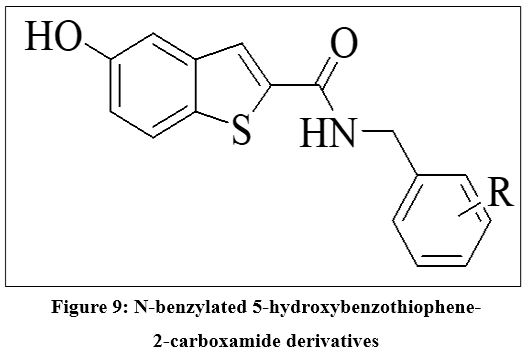 |
Figure 9: N-benzylated 5-hydroxybenzothiophene-2-carboxamide derivatives Click here to View Figure |
Eldehna et al.,47 documented the synthesis and biological assessment of a new series of ureido-substituted benzothiophene derivatives Fig. 10., as dual inhibitors of vascular endothelial growth factor receptor 2 (VEGFR-2) and epidermal growth factor receptor (EGFR), which are two critical receptor tyrosine kinases involved in tumor angiogenesis and cellular proliferation. The study concentrated on the development of benzothiophene-derived aryl urea hybrids capable of engaging with the ATP-binding sites of both kinases. Several produced compounds displayed significant in vitro antiproliferative activity against MCF-7 (breast), PanC-1 (pancreatic), and HepG2 (liver) cancer cell lines, with compound 6q yielding the most promising outcomes. It demonstrated IC₅₀ values ranging from 3.65 to 4.78 μg/mL against these cell lines and shown nanomolar inhibitory activity against VEGFR-2 (IC₅₀ = 11.3 nM) and EGFR (IC₅₀ = 46.6 nM), exceeding the efficacy of the reference medicines sorafenib and erlotinib, respectively. Molecular docking simulations additionally verified that 6q established essential hydrogen bonds and hydrophobic contacts inside the active regions of both kinases, substantiating its dual-target mechanism. This study emphasizes the therapeutic potential of ureido benzothiophenes as multi-target kinase inhibitors and advocates for their further development as promising anticancer medicines that can surmount resistance linked to single-target therapy.
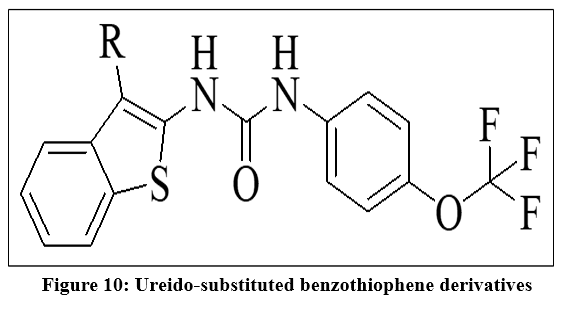 |
Figure 10: Ureido-substituted benzothiophene derivatives Click here to View Figure |
Haridevamuthu et al.,48 documented the design, synthesis, and biological assessment of a range of functionalized sulfur-containing heterocyclic analogs, including benzothiophene derivatives Fig. 11., as prospective anticancer drugs targeting laryngeal carcinoma (HEp-2 cells). These analogs were systematically altered to improve their electrical characteristics and biological activity through the incorporation of diverse aryl and alkyl substituents. Among the evaluated compounds, several demonstrated considerable cytotoxicity, with compound 3d exhibiting the highest potency (IC₅₀ = 15.23 μM), akin to the reference medication cisplatin. Mechanistic studies demonstrated that these drugs caused sub-G1 cell cycle arrest and facilitated apoptotic cell death, as validated by flow cytometry, DAPI nuclear staining, and Annexin V-FITC/PI staining. Furthermore, treated cells exhibited significant reactive oxygen species (ROS) production, a decline in mitochondrial membrane potential, and activation of caspase-3, suggesting that the mode of action involves intrinsic (mitochondrial-mediated) apoptosis. The research performed molecular docking simulations, demonstrating significant binding affinities to crucial apoptosis-regulating proteins, including Bcl-2 and caspase-3, indicating a multi-targeted mechanism. The study underscores the potential of benzothiophene-derived heterocycles as viable candidates for the development of anticancer treatments aimed at apoptotic pathways, particularly in laryngeal cancer.
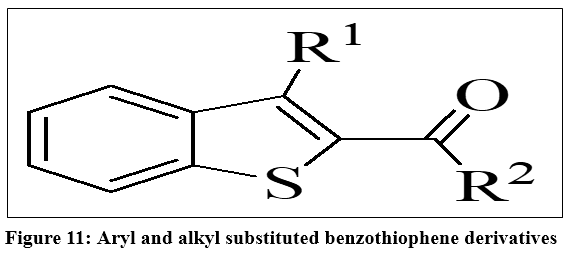 |
Figure 11: Aryl and alkyl substituted benzothiophene derivatives Click here to View Figure |
Huang et al.,49 reported the creation of a novel series of benzothiophene-based inhibitors aimed at the Polo-like kinase 1 polo-box domain (PLK1-PBD) in a structure-guided drug design investigation, highlighting its role as a recognized mitotic regulator associated with cancer progression. Acknowledging the pivotal function of PLK1 in cellular proliferation and tumorigenesis, the researchers utilized molecular docking, structure-activity relationship (SAR) analysis, and biophysical experiments to enhance benzothiophene scaffolds for superior binding affinity and selectivity. Multiple produced compounds exhibited significant PLK1-PBD inhibition, with compound 6f displaying the highest activity (IC₅₀ = 0.26 μM) and pronounced antiproliferative effects against human cancer cell lines, notably HeLa, HepG2 and MG63 cells. Binding mode analysis identified significant interactions between the benzothiophene core and the hydrophobic groove of PLK1-PBD, facilitated by hydrogen bonding and π–π stacking interactions. Moreover, in vitro experiments demonstrated that these compounds successfully produced mitotic arrest and apoptosis, corresponding with PLK1 suppression. This research confirms PLK1-PBD as a viable target for anticancer treatment and identifies benzothiophene compounds as potential lead scaffolds for the creation of selective PLK1 inhibitors.
Segretti et al.,50 conducted a concentrated medicinal chemistry initiative that resulted in the identification and advancement of innovative benzothiophene-based inhibitors aimed at DYRK1A and DYRK1B, dual-specificity tyrosine phosphorylation-regulated kinases associated with cancer, neurological disorders, and metabolic diseases. The authors produced a varied array of benzothiophene derivatives Fig. 12., integrating essential structural features that affect kinase selectivity and binding affinity. Structure–activity relationship (SAR) investigations demonstrated that substituents at particular places on the benzothiophene scaffold—especially halogen or alkyl groups—significantly increased inhibitory potency. Multiple drugs demonstrated submicromolar IC₅₀ values against DYRK1A/B, exhibiting little off-target effects on other kinases, hence demonstrating a desirable narrow-spectrum selectivity for targeted therapy. These inhibitors exhibited significant antiproliferative action in cancer cell models with overexpressed DYRK1A/B, underscoring their potential in suppressing oncogenic signaling. Molecular docking analyses and in vitro biochemical testing corroborated the engagement of the benzothiophene core within the ATP-binding pocket of DYRK1 kinases. The research identifies benzothiophene compounds as potential frameworks for selective DYRK1 inhibition, necessitating more optimization for anticancer drug development.
DYRK1A and DYRK1B (dual-specificity tyrosine-phosphorylation-regulated kinases 1A and 1B) are structurally related but functionally distinct members of the CMGC kinase group. DYRK1A is broadly expressed; its gene lies within the Down-syndrome critical region on chromosome 21 and has been linked to amyloid-β production and tau hyperphosphorylation relevant to Alzheimer’s disease.51 DYRK1B (Mirk) shows more restricted, tissue-specific expression and has been implicated in maintaining the quiescence and survival of pancreatic and ovarian tumour cells, where its inhibition can sensitise cells to apoptosis.52 Segretti et al.,50 specifically designed their benzothiophene series for narrow-spectrum DYRK1A/DYRK1B inhibition rather than broad Clk/Dyrk polypharmacology, which the authors’ own SAR data (halogen/alkyl substitution driving selectivity) support; this is distinct from the Mostafa et al.,46 series discussed above, which is deliberately multi-targeted across Dyrk1A, Dyrk1B, and Clk1/Clk2/Haspin. The general kinase-biology context above is drawn from dedicated DYRK1A/DYRK1B literature,51,52 in addition to the benzothiophene-specific primary studies discussed in this review.46,50
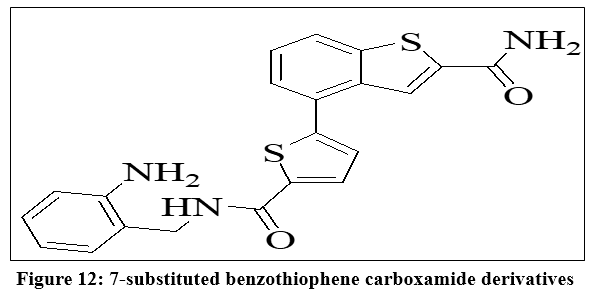 |
Figure 12: 7-substituted benzothiophene carboxamide derivatives Click here to View Figure |
Bai et al.,56 documented the design, synthesis, and assessment of innovative benzothiophene-derived analogues as selective covalent antagonists of estrogen receptors (ER) for breast cancer treatment. The authors, acknowledging the ongoing issue of ER-positive breast cancer and resistance to existing endocrine therapies, created a series of benzothiophene derivatives featuring an electrophilic warhead designed to covalently attach to ERα Cys530, a nucleophilic residue within the estrogen receptor binding domain. Several of the produced compounds exhibited a strong affinity for ERα, with covalent interactions verified using LC-MS analysis. Biological experiments demonstrated that these analogues significantly suppressed the proliferation of ER-positive breast cancer cell lines (e.g., MCF-7), while preserving selectivity for ER-negative cell lines. Compound 12b emerged as a lead candidate, exhibiting significant antiestrogenic action, estrogen receptor degradation, and apoptosis induction in vitro. Molecular docking and covalent docking analyses corroborated the reported activity by demonstrating the engagement of the benzothiophene scaffold within the estrogen receptor ligand-binding pocket. This research underscores the promise of benzothiophene-derived covalent modulators as a novel class of ER-targeted anticancer therapeutics, particularly for individuals with endocrine-resistant breast cancer. Fig. 13. represents structure of one of the reported compound in the above mentioned literature.
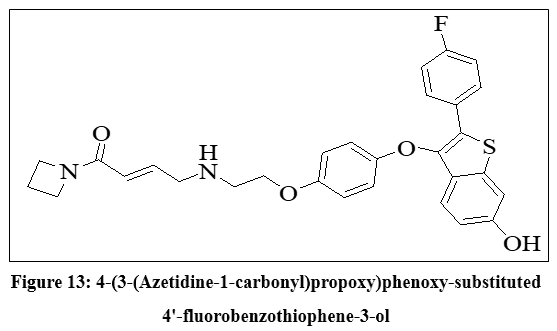 |
Figure 13: 4-(3-(Azetidine-1-carbonyl)propoxy)phenoxy-substituted 4′-fluorobenzothiophene-3-ol Click here to View Figure |
Amoroso et al.,57 examined a range of benzothiazole derivatives chemically analogous to benzothiophene Fig. 14., assessing their antiproliferative effects on rare and aggressive malignancies, particularly paraganglioma (PGL) and pancreatic ductal adenocarcinoma (PDAC). The researchers conducted structure–activity relationship (SAR) experiments to design and synthesize a library of substituted benzothiazoles, subsequently assessing their cytotoxicity against human PGL (PTJ64i) and PDAC (PANC-1) cell lines. Multiple drugs exhibited significant antiproliferative action, with IC₅₀ values in the low micromolar range. Derivatives with particular substituents at the 2-position of the benzothiazole ring exhibited enhanced potency. molecule 3i, featuring a sulfonamide moiety, emerged as a principal molecule, eliciting substantial cell cycle arrest and death. The authors conducted target prediction investigations utilizing computational techniques, revealing possible interactions of these drugs with critical cancer-related proteins, including EGFR, VEGFR, and CDK1. Moreover, in silico ADME profiling indicated advantageous pharmacokinetic characteristics for the most powerful molecules, implying their suitability for further advancement. This discovery highlights the significance of sulfur-containing heterocycles, such as benzothiazoles (and by extension, benzothiophenes), as potential frameworks for the creation of multi-targeted anticancer medicines, particularly for resistant tumour types.
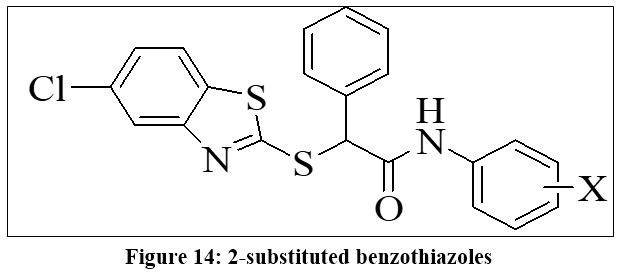 |
Figure 14: 2-substituted benzothiazoles Click here to View Figure |
Ammazzalorso et al.,58 performed an extensive study on the antiproliferative properties of 2-substituted benzothiazoles, emphasizing the elucidation of structure–activity correlations (SAR) to inform future drug development. Through the synthesis and assessment of a derivative library, the authors determined that various substituents at the 2-position of the benzothiazole core markedly affected cytotoxicity in multiple human cancer cell lines, including MCF-7 (breast), A549 (lung), and HCT-116 (colon). Compounds having electron-donating groups and alkyl or aryl substitutions exhibited increased activity, indicating a beneficial interaction with biological targets perhaps associated with cell cycle regulation. SAR analysis indicated that lipophilicity, steric bulk, and hydrogen-bonding capability of substituents influenced cellular absorption and target affinity. Multiple drugs exhibited low micromolar IC₅₀ values, validating their anticancer efficacy. The research indicated that certain chemicals could trigger apoptotic cell death, as demonstrated by morphological alterations and annexin V staining. This study offers significant insights into the optimization of the benzothiazole pharmacophore and highlights its therapeutic potential in oncology, complementing the wider category of benzothiophene-based scaffolds that possess analogous heteroaromatic structures and biological targets. Refer Table 5. for summary of anticancer activity.
Critical assessment: the anticancer studies summarised in Table 5 target a heterogeneous set of mechanisms — kinase inhibition (DYRK1A/B, Clk1/2, VEGFR-2, EGFR, PLK1-PBD), covalent estrogen-receptor antagonism, and general cytotoxicity via apoptosis induction — and potency values (IC₅₀ in the low nanomolar to low micromolar range) are not directly comparable across studies because different cell lines, exposure times, and assay formats (SRB, MTT, CCK-8) were used. Of the kinase targets discussed, VEGFR-2 and EGFR are well-validated, clinically druggable targets with approved inhibitors already in use, whereas PLK1-PBD and DYRK1A/B remain less clinically mature targets for which no approved benzothiophene-derived drug yet exists; multi-target kinase inhibition (e.g., dual VEGFR-2/EGFR or pan-Dyrk/Clk activity) can offer resistance-bypass advantages but equally raises the risk of off-target toxicity, and none of the reviewed studies report counter-screening against a broad kinase panel or normal-tissue selectivity indices beyond a single comparator cell line. Resistance mechanisms that might emerge against these compounds (e.g., kinase gatekeeper mutations, ER mutation in the case of covalent ER antagonists) were not addressed in the cited primary literature and represent an important open question, discussed further in Section 4.7. Reference-standard comparisons were reported for only a subset of compounds (e.g., 6q vs sorafenib/erlotinib; compound 3d vs cisplatin), and in vivo efficacy data are absent for all series discussed in this subsection, so translational potential should be regarded as preliminary.
Table 5: Summary of Anticancer Activity.
|
Sr. No. |
Target/Mechanism | Compound Type | Cancer Models | Activity Range | Mechanism Details |
| 1 | Dyrk1A/B, Clk1 inhibition46 | N-benzylated 5-hydroxybenzothiophenes | T24 bladder carcinoma | Low nanomolar IC₅₀ |
G₂/M arrest, caspase activation |
|
2 |
VEGFR-2/EGFR dual targeting47 | Ureido-benzothiophenes | MCF-7, PanC-1, HepG2 | IC₅₀ 3.65-4.78 μg/mL | Dual kinase inhibition, resistance bypass |
| 3 | Apoptosis induction48 | Functionalized sulfur heterocycles | HEp-2 laryngeal carcinoma | IC₅₀ 15.23 μM |
Mitochondrial-mediated apoptosis |
|
4 |
PLK1-PBD inhibition49 | Structure-guided benzothiophenes | HeLa, HepG2, MG63 | IC₅₀ 0.26 µM | Mitotic arrest, selective binding |
| 5 | DYRK1A/B selectivity50 | Substituted benzothiophenes | Cancer cell models | Submicromolar IC₅₀ |
Narrow-spectrum kinase selectivity |
|
6 |
ER covalent antagonism56 | Electrophilic benzothiophenes | MCF-7 ER-positive | High affinity binding | Cys530 covalent binding, ER degradation |
| 7 | Multi-target activity57 | Benzothiazole analogues | PGL, PDAC rare cancers | Low μM IC₅₀ |
EGFR/VEGFR/CDK1 interaction |
|
8 |
SAR-guided design58 | 2-Substituted benzothiazoles | MCF-7, A549, HCT-116 | Low μM IC₅₀ |
Cell cycle regulation, apoptosis |
Central Nervous System Activity
Zhao et al.,17 investigated a new series of benzofuran and benzo[b]thiophene-2-carboxamide derivatives Fig. 15., exploring their potential as modulators of amyloid beta (Aβ42) aggregation, which is a pathological hallmark of Alzheimer’s disease (AD). The research sought to engineer molecules capable of inhibiting or interrupting Aβ42 fibrillogenesis, thus alleviating neuronal injury. The synthesized compounds underwent evaluation through Thioflavin T (ThT) fluorescence assays, which substantiated a notable decrease in Aβ42 fibril formation. Among the examined derivatives, those featuring electron-withdrawing substituents on the aryl moiety exhibited the most significant inhibition rates. The compounds demonstrated significant neuroprotective effects in SH-SY5Y neuroblastoma cells, as evidenced by cell viability assays. The results substantiate their dual function as inhibitors of aggregation and as agents that confer neuroprotection. Molecular docking and molecular dynamics (MD) simulations elucidated that these benzothiophene-2-carboxamides engage with critical hydrophobic domains of Aβ42, notably the central hydrophobic cluster (CHC, residues 17–21), consequently impeding β-sheet assembly and promoting the stabilization of non-toxic oligomers. This mechanism of action is unique compared to conventional amyloid inhibitors and emphasizes the particularity of the benzothiophene framework. The findings collectively indicate that benzothiophene-based compounds may represent a novel category of disease-modifying agents for Alzheimer’s disease, effectively targeting amyloidogenic pathways while exhibiting favorable drug-like characteristics and commendable CNS permeability. The implications of these findings lay a foundation for subsequent preclinical investigations and enhancements concerning CNS disorders.
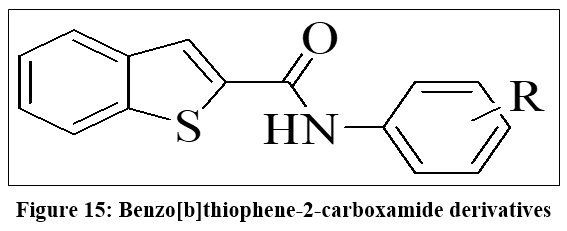 |
Figure 15: Benzo[b]thiophene-2-carboxamide derivatives Click here to View Figure |
Kuppusamy et al.,59 introduced an innovative series of benzo[b]thiophene-2-carboxamide derivatives Fig. 16., that function as selective opioid receptor agonists, exhibiting strong analgesic properties while notably minimizing gastrointestinal adverse effects, especially constipation. The design strategy entailed the structural modification of the benzo[b]thiophene core to improve selectivity for μ-opioid receptors (MOR) while preserving activity at δ-opioid receptors (DOR). The binding affinity and functional activity assays demonstrated that multiple derivatives functioned as balanced dual MOR/DOR agonists, a profile that is advantageous for pain management while minimizing the likelihood of opioid-induced bowel dysfunction (OIBD). In in vivo antinociceptive studies, specifically the hot plate and tail-flick assays conducted on mice, lead compound 9e demonstrated significant central analgesic activity that is comparable to that of morphine. Significantly, in contrast to morphine, compound 9e demonstrated a negligible effect on gastrointestinal transit during charcoal meal assessments, suggesting a reduced likelihood of inducing constipation. Furthermore, the pharmacokinetic analysis indicated advantageous brain permeability and satisfactory metabolic stability in human liver microsomes, implying a promising avenue for CNS drug development. The computational docking analysis revealed a robust interaction between the ligand and the orthosteric binding pocket of the MOR, driven by hydrophobic interactions and hydrogen bonding with critical residues. The research identifies benzo[b]thiophene-2-carboxamide derivatives as potential frontrunners for the development of next-generation opioid analgesics, addressing the shortcomings of conventional opioids, especially regarding tolerability and gastrointestinal side effects.
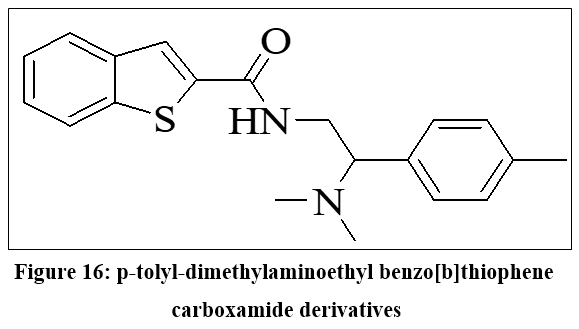 |
Figure 16: p-tolyl-dimethylaminoethyl benzo[b]thiophene carboxamide derivatives Click here to View Figure |
A recent investigation by Rapacz et al.,60 involved the synthesis and assessment of a new series of 3-(benzo[b]thiophen-2-yl)pyrrolidine-2,5-dione derivatives Fig. 17., focusing on their antiseizure and antinociceptive characteristics through both in vitro and in vivo methodologies. The design of these compounds involved the integration of the benzo[b]thiophene scaffold, a structure recognized for its activity in the central nervous system, with the pyrrolidine-2,5-dione core, which has demonstrated anticonvulsant potential. Among the synthesized derivatives, compound 8 exhibited the most noteworthy profile. It provided substantial protection to mice against seizures in both the maximal electroshock (MES) and 6-Hz psychomotor seizure models. The ED₅₀ values were determined to be 62.1 mg/kg for MES and 75.6 mg/kg for 6-Hz. The assessment via the rotarod test revealed negligible neurotoxicity, suggesting a positive therapeutic index. Furthermore, the compound demonstrated antinociceptive properties in the hot-plate test, indicating a dual central nervous system activity that may be advantageous in addressing pain associated with epilepsy. The researchers undertook in silico docking studies, which demonstrated robust binding interactions with GABA_A receptors and voltage-gated sodium channels, thereby corroborating the proposed mechanism of action for seizure suppression. The findings emphasize the promising therapeutic capabilities of benzo[b]thiophene-derived compounds as dual-action agents in the treatment of neurological disorders characterized by seizures and chronic pain, thereby offering a novel avenue for the advancement of CNS pharmacotherapy.
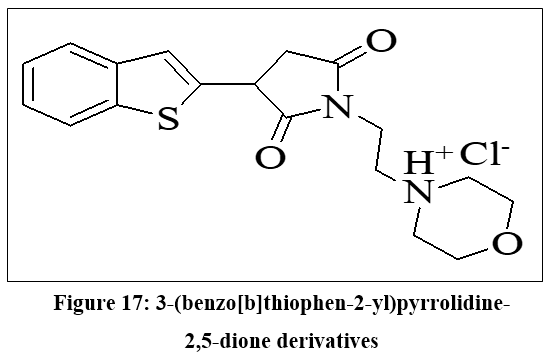 |
Figure 17: 3-(benzo[b]thiophen-2-yl)pyrrolidine-2,5-dione derivatives Click here to View Figure |
Rudin et al.,61 conducted an exploration into a new category of compounds, (2-aminopropyl)benzo[b]thiophenes (APBTs) Fig. 18., focusing on their possible effects on the central nervous system (CNS), especially regarding their interactions with monoamine transporters and the resulting behavioral implications in vivo. These compounds share structural similarities with amphetamines; however, they demonstrate unique pharmacological properties. APBTs exhibited a pronounced affinity for serotonin transporters (SERT) and displayed moderate activity at dopamine (DAT) and norepinephrine (NET) transporters, while notably lacking the traditional properties associated with CNS stimulants. In contrast, APBTs induced head-twitch responses (HTR) in mice, serving as a behavioural indicator of 5-HT2A receptor activation and potential hallucinogenic effects, thereby implying a profile reminiscent of psychedelic activity. Unlike traditional stimulants, APBTs did not elicit locomotor stimulation or stereotypy in rodent models, thereby underscoring their distinction from standard amphetamines. The researchers further performed receptor binding and functional assays, thereby validating that multiple APBT derivatives functioned as partial agonists at the 5-HT2A receptor. These compounds hold significant potential as instruments for exploring serotonergic signalling pathways or as precursors for the creation of innovative neuropsychiatric therapeutics characterized by distinct activity profiles and diminished risk of abuse. The results underscore the capacity of benzothiophene derivatives to influence central nervous system activity through serotonergic pathways, all while avoiding stimulant effects, thereby broadening their therapeutic significance beyond conventional neurostimulants. Table 6. highlights summary of CNS activity.
Critical assessment: the CNS-active benzothiophenes discussed above span disease-modifying (Aβ42 aggregation inhibition), analgesic (opioid receptor agonism), anticonvulsant, and serotonergic mechanisms, and the strength of evidence differs considerably between them. Claims of “CNS permeability” or “brain exposure” in the Zhao et al.,17 Aβ42 study rest on favourable in silico/physicochemical drug-likeness predictions rather than on measured brain or cerebrospinal-fluid drug concentrations, and this distinction should not be blurred: predicted blood–brain-barrier (BBB) permeability is not equivalent to experimentally demonstrated brain exposure. By contrast, the opioid-agonist study and the anticonvulsant study report genuine in vivo behavioural pharmacology in rodents (hot-plate/tail-flick, MES/6-Hz seizure models) together with pharmacokinetic and microsomal-stability data, providing a stronger evidentiary basis for CNS activity claims.59,60 None of the studies discussed report full CNS toxicity, dependence-liability, or chronic-dosing safety data, and only compound 9e and compound 8 were carried beyond initial in vitro/ex vivo characterisation into whole-animal testing.59,60
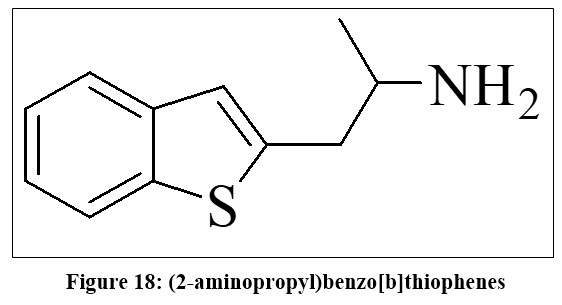 |
Figure 18: (2-aminopropyl)benzo[b]thiophenes Click here to View Figure |
Table 6: Activity Summary of CNS Activity.
|
Sr. No. |
Application | Compound Design | Target/Mechanism | Models Used | Key Results | Therapeutic Potential |
| 1 | Alzheimer’s disease17 | Benzofuran/BT-2-carboxamides | Aβ42 aggregation inhibition | SH-SY5Y cells, ThT assays | Significant fibril reduction |
Neuroprotection, CNS permeability |
|
2 |
Analgesic activity59 | BT-2-carboxamide opioid agonists | μ/δ-opioid receptor selectivity | Hot plate, tail-flick assays | Reduced constipation vs morphine | Next-generation opioids |
| 3 | Anticonvulsant60 | 3-(BT-2-yl)pyrrolidine-2,5-diones | GABA_A/Na⁺ channel modulation | MES, 6-Hz seizure models | ED₅₀ 62.1-75.6 mg/kg |
Dual seizure/pain activity |
|
4 |
Psychedelic-like effects61 | (2-Aminopropyl)benzothiophenes | 5-HT2A receptor activation | Head-twitch response assays | HTR without stimulation |
Novel neuropsychiatric tools |
Anti-Inflammatory Activity
Mak et al.,62 detailed the synthesis of eighteen novel 2-amino-4,5,6,7-tetrahydrobenzo[b]thiophene (THBT) derivatives Fig. 19., and assessed their NRF2-activating and anti-inflammatory properties in cellular models. In Hepa 1c1c7 cells, various THBT compounds markedly enhanced NQO1 enzymatic activity and elevated the expression of NQO1 and HO 1 mRNA, suggesting a robust activation of the NRF2 pathway. Mechanistic investigations revealed that they interfere with the KEAP1–NRF2 interaction, thereby affirming direct involvement with the Kelch domain of KEAP1. In LPS-stimulated RAW 264.7 macrophages, the primary THBTs exhibited a substantial inhibition of nitric oxide (NO) production, achieving approximately 78–87% suppression at a concentration of 50 µM. Furthermore, there was a notable reduction in pro-inflammatory cytokines, including IL 1β, IL 6, TNF α, and IFN γ, alongside a decrease in NF κB activation, COX 2 expression, and PGE₂ levels, nearing the efficacy of the reference activator sulforaphane, which reached about 92%. The compounds exhibited metabolic stability across human, rat, and mouse liver microsomes, characterized by advantageous half-lives and intrinsic clearance values. The analysis of molecular docking and dynamics simulations demonstrated a stable interaction with the Kelch domain of KEAP1, thereby clarifying the non-electrophilic mechanism of NRF2 activation and highlighting the drug-like characteristics of the compounds involved. This research presents THBT derivatives as an innovative framework for non-electrophilic NRF2 activation, providing a compelling mechanistic foundation for the development of anti-inflammatory drugs, especially in contexts where oxidative stress and inflammation play a pivotal role.62
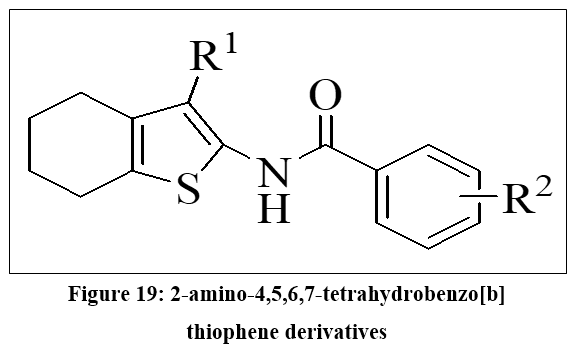 |
Figure 19: 2-amino-4,5,6,7-tetrahydrobenzo[b]thiophene derivatives Click here to View Figure |
Isloor and colleagues documented the synthesis and characterization of a range of benzo[b]thiophene analogs, particularly N-[3-(benzo[b]thiophen-2-yl)propyl]acetamide and benzo[b]thiophen-2-yl chalcones Fig. 20. The compounds underwent evaluation for their anti-inflammatory, analgesic, and antioxidant properties using established in vitro and in vivo models. In the context of carrageenan-induced paw edema in rats, certain benzo[b]thiophene derivatives demonstrated an inhibition of edema between 40–65% at a dosage of 50 mg/kg, which is comparable to the effects observed with aspirin controls, thereby indicating significant anti-inflammatory properties. The evaluation of analgesic activity, conducted through the acetic acid–induced writhing test, revealed a reduction of up to 55% in peritoneal writhes, suggesting a moderate capacity for pain relief. The evaluation of antioxidant properties was conducted through DPPH radical scavenging assays; the most potent derivative exhibited an IC₅₀ of approximately 35 µg/mL, indicating a significant antioxidant capacity likely attributed to the conjugated benzo[b]thiophene framework. This investigation substantiates the idea that benzo[b]thiophene scaffolds may play a significant role in anti-inflammatory and antioxidant pharmacology, establishing a foundation for contemporary structure-activity relationship studies centred on NRF2 activators and COX-2 inhibition.63
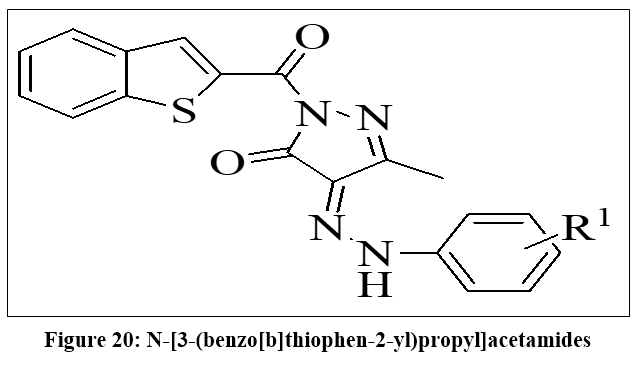 |
Figure 20: N-[3-(benzo[b]thiophen-2-yl)propyl]acetamides Click here to View Figure |
Pathak et al.,64 developed a new series of bromo-substituted benzothiophene-2-carboxamide derivatives and assessed their anti-inflammatory and analgesic properties through rigorous experimentation with established rodent models. The evaluation of anti-inflammatory activity was conducted using carrageenan-induced rat paw edema, revealing that several derivatives, notably compounds 4, 6, 7, 8, and 9, demonstrated considerable inhibition of paw edema at doses ranging from 5 to 15 mg/kg. These compounds exhibited a remarkable level of efficacy when juxtaposed with the standard drug ibuprofen (50 mg/kg), particularly regarding their potency and the rapidity of their onset of action. The analgesic effects were substantiated through the tail-flick latency test, wherein the same derivatives exhibited enhanced antinociceptive activity, attaining a superior percentage of maximum possible effect (%MPE) at reduced doses compared to the reference standard. Mechanistic investigations indicated a targeted suppression of COX-2 enzyme activity, alongside diminished concentrations of pro-inflammatory mediators including prostaglandin E₂ (PGE₂), tumour necrosis factor-alpha (TNF-α), and interleukin-6 (IL-6). Moreover, a notable decrease in neutrophil infiltration and COX-2 expression was noted in the inflamed tissues. Significantly, toxicity studies demonstrated commendable tolerability and an absence of detectable gastric mucosal damage at the effective doses, underscoring the potential of benzothiophene carboxamides as noteworthy candidates for safer anti-inflammatory and analgesic therapies. Key points for antiinflammatory activity from above articles are summarized in Table 7.
Critical assessment: anti-inflammatory activity in the reviewed literature is supported by a mixture of cellular (NRF2/KEAP1 reporter and cytokine assays in RAW 264.7 macrophages) and in vivo rodent paw-oedema/analgesia models, giving this subsection comparatively stronger translational grounding than the antioxidant or antidiabetic sections below. However, efficacy is generally benchmarked against a single reference compound (sulforaphane or ibuprofen) rather than a panel of clinically used anti-inflammatories, and mechanistic claims of “non-electrophilic NRF2 activation” rely on molecular docking/dynamics simulations of the KEAP1–Kelch interaction that have not been confirmed by direct biophysical binding measurements (e.g., ITC or SPR) in the cited source. Chronic-dosing safety and gastrointestinal-tolerability data are reported for only the series.62,64
Table 7: Antiinflammatory Potential of Benzothiophene derivatives.
|
Sr. No. |
Compound Class | Mechanism/Target | Assay Systems | Key Results | Therapeutic Implications |
| 1 | 2-Amino-THBT derivatives62 | NRF2/KEAP1 pathway | RAW 264.7 macrophages | 78-87% NO suppression |
Non-electrophilic NRF2 activation |
|
2 |
BT chalcones/acetamides63 | COX-2 inhibition | Carrageenan paw edema | 40-65% edema inhibition | Moderate anti-inflammatory potential |
| 3 | Bromo-BT-2-carboxamides64 | Selective COX-2 inhibition | Paw edema, tail-flick tests | Superior to ibuprofen |
Safer anti-inflammatory profile |
Antioxidant Activity
Haridevamuthu et al.,65 conducted a thorough investigation into the antioxidant potential of 2-hydroxyl-containing benzo[b]thiophene analogues Fig. 21., BP and EP, employing in vitro assays alongside an in vivo zebrafish model to assess the effects of acrylamide-induced oxidative stress. In vitro studies on radical scavenging demonstrated a significant capacity for quenching free radicals. In zebrafish larvae subjected to acrylamide (0.75 mM), prior administration of BP or EP at 5 mg/kg markedly enhanced the activity of enzymatic antioxidants—specifically superoxide dismutase (SOD) and catalase (CAT)—while concurrently diminishing levels of reactive oxygen species (ROS), lipid peroxidation, and cellular mortality. Both compounds additionally reinstated glutathione redox homeostasis through the stabilization of gene expression associated with glutathione regeneration. The larvae that received treatment exhibited enhanced locomotion and a restoration of social behaviours that had been disrupted by acrylamide exposure. Histological analyses indicated a reduction in neurotoxicity among the treated groups. The data emphasize BP and EP as noteworthy benzothiophene-derived antioxidants that have the potential to bolster endogenous antioxidant defences and reduce oxidative damage in vivo.
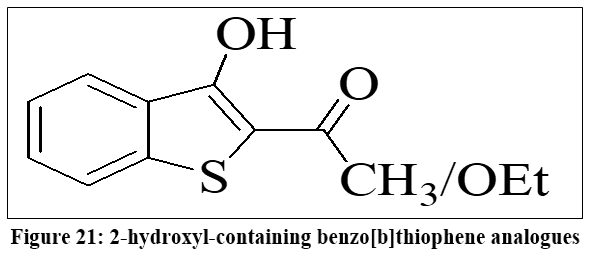 |
Figure 21: 2-hydroxyl-containing benzo[b]thiophene analogues Click here to View Figure |
Ko et al.,66 detailed the design and synthesis of resveratrol derivatives that extend aromaticity by incorporating chalcogen-containing heterocycles, specifically benzofuran, benzothiophene, and benzoselenophene, with the aim of enhancing antioxidant activity Fig. 22. Among these, the resveratrol–benzothiophene hybrid (Res-BT) demonstrated a markedly enhanced capacity for antioxidant activity in the ABTS radical cation scavenging assay (IC₅₀ ≈ 2.8 µM) when juxtaposed with native resveratrol (IC₅₀ ≈ 4.7 µM). The increased activity can be ascribed to the prolonged π-conjugation offered by the benzothiophene structure, which promoted electron delocalization, stabilized phenoxyl radicals, and enabled an advantageous hydrogen atom transfer (HAT) mechanism. Theoretical investigations employing Density Functional Theory (DFT) corroborated these findings, demonstrating diminished HOMO–LUMO gaps and decreased bond dissociation enthalpies in Res-BT. The findings substantiate benzothiophene as a noteworthy framework for the advancement of innovative antioxidant agents. Antioxidant highlights are mentioned in Table 8.
Critical assessment: it is important to distinguish chemical radical-scavenging assays (ABTS, and by extension DPPH/FRAP-type assays) from biological antioxidant evidence. The ABTS-based IC₅₀ values reported for Res-BT (≈2.8 µM) reflect direct electron/hydrogen-atom transfer to a synthetic radical cation in solution and do not, by themselves, establish intracellular reactive-oxygen-species (ROS) suppression, antioxidant-enzyme induction, or in vivo efficacy. Only the Haridevamuthu et al.,65 study provided biological antioxidant evidence in this subsection, using an in vivo zebrafish model with measured SOD/catalase activity, ROS levels, and lipid peroxidation; the Ko et al.,66 findings therefore represent chemical radical-scavenging potential supported by DFT calculations rather than demonstrated cellular or organismal antioxidant efficacy, and this distinction should be preserved when the two studies are compared.
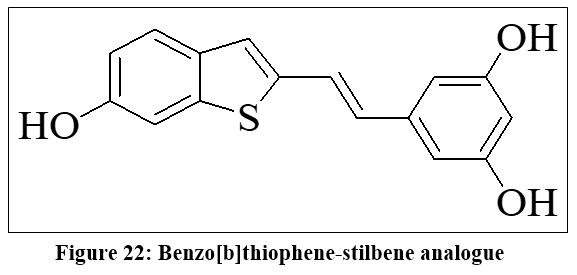 |
Figure 22: Benzo[b]thiophene-stilbene analogue Click here to View Figure |
Table 8: Antioxidant Highlights.
|
Sr. No. |
Compound Class | Mechanism/Target | Assay Systems | Key Results | Therapeutic Implications |
| 1 | 2-Hydroxyl benzothiophenes (BP, EP)65 | SOD/CAT induction; ROS & lipid-peroxidation reduction | Zebrafish larvae, in vivo (acrylamide-induced oxidative stress) | Restored SOD/CAT activity; reduced ROS, lipid peroxidation, mortality |
Biological (in vivo) antioxidant evidence; neuroprotection |
|
2 |
Resveratrol-benzothiophene hybrid (Res-BT)66 | ABTS radical scavenging (chemical assay) | ABTS cation-radical assay, in vitro (cell-free) + DFT | IC50 ~2.8 uM vs ~4.7 uM resveratrol; lower HOMO-LUMO gap |
Chemical radical-scavenging potential only; not biological/cellular evidence |
Antidiabetic (Hypoglycemic) Activity
Khan et al.,67 documented the synthesis and pharmacological assessment of various benzothiophene-derived hydrazone derivatives Fig. 23., as effective antidiabetic drugs. The compounds were evaluated for their inhibitory activity against α-glucosidase, a crucial target in the management of postprandial hyperglycemia in type 2 diabetes mellitus. Among the produced compounds, numerous derivatives exhibited markedly greater potency than acarbose, a benchmark antidiabetic medication. Compound 6d demonstrated an IC₅₀ value of 5.8 µM, surpassing acarbose, which has an IC₅₀ of 13.4 µM. Structure–activity relationship (SAR) analyses demonstrated that the inclusion of electron-donating groups on the aromatic moiety enhanced activity. Molecular docking and dynamics simulations verified that these derivatives establish robust hydrogen bonds and π–π stacking interactions within the active site of α-glucosidase. Moreover, ADME predictions suggested advantageous gastrointestinal absorption, non-toxicity, and drug-likeness, reinforcing their potential as orally active antidiabetic drugs. This thorough experimental and computational study highlights the potential of benzothiophene scaffolds in creating selective α-glucosidase inhibitors for the treatment of diabetic mellitus.
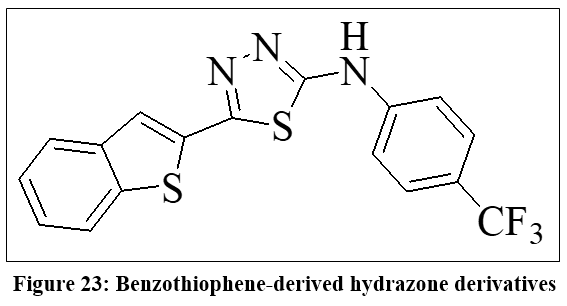 |
Figure 23: Benzothiophene-derived hydrazone derivatives Click here to View Figure |
Joshi et al.,68 formulated and synthesized a series of benzo[b]thiophene-derived hydrazone derivatives Fig. 24., and assessed their efficacy as inhibitors of α-amylase, an enzyme pivotal to carbohydrate metabolism and postprandial glucose increase. In vitro enzymatic studies revealed that all drugs displayed significant inhibition, with IC₅₀ values between 0.51 to 7.99 µM, with several surpassing the benchmark acarbose (IC₅₀ = 0.68 µM). The most active molecules exhibited sub-micromolar potency, signifying excellent efficacy. A thorough structure–activity relationship (SAR) investigation shown that electron-donating substituents, such as methoxy or hydroxyl groups on the aromatic ring, enhanced inhibitory action. Molecular docking experiments validated strong interactions with the α-amylase active site, including hydrogen bonds, π–π stacking, and hydrophobic interactions that supported in vitro efficacy. In silico ADME profile indicated advantageous drug-like characteristics, such as elevated gastrointestinal absorption, adherence to Lipinski’s guidelines, and absence of expected toxicity. These findings establish benzo[b]thiophene–hydrazone hybrids as prospective lead compounds for the creation of new α-amylase inhibitors with potential hypoglycemic use in type 2 diabetes mellitus.
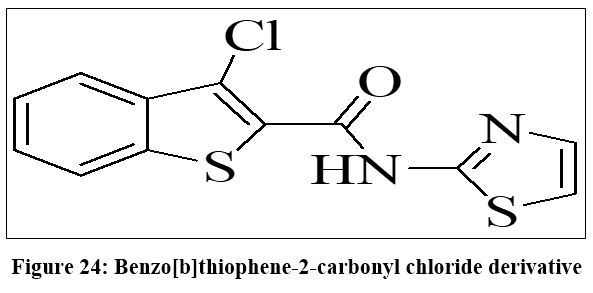 |
Figure 24: Benzo[b]thiophene-2-carbonyl chloride derivative Click here to View Figure |
Ghareb et al.,69 synthesized and assessed a range of benzene sulfonamide derivatives, several of which feature a benzothiophene core, as inhibitors of protein tyrosine phosphatase 1B (PTP1B)—a significant target in the treatment of insulin resistance and type 2 diabetes. Among the produced compounds, a sulfonamide derivative containing benzothiophene Fig. 25., had significant effectiveness in inhibiting PTP1B, with IC₅₀ values in the low nanomolar range, and shown remarkable selectivity for related phosphatases. In vitro experiments demonstrated that this chemical significantly augmented insulin receptor phosphorylation, facilitating greater insulin signalling in hepatic cell lines. at silico molecular modelling validated stable binding at the PTP1B active site, emphasizing critical hydrogen bonds and hydrophobic interactions with the catalytic site residues. ADME predictions indicated advantageous pharmacokinetic characteristics—namely, elevated oral bioavailability, reduced clearance, and negligible toxicity—bolstering its advancement as a candidate for oral antidiabetic medication. This study presents benzothiophene-linked benzene-sulfonamide scaffolds as possible multifunctional PTP1B inhibitors, capable of mitigating insulin resistance and metabolic problems related to diabetes mellitus. Table 9. depicts summarized points of hypoglycemic properties of benzothiophenes.
Critical assessment: all three antidiabetic studies summarised in Table 9 report enzyme-inhibition potency (against α-glucosidase, α-amylase, or PTP1B) benchmarked, where stated, against acarbose; none report whole-animal glucose-tolerance testing, insulin-sensitivity measurement, or chronic glycaemic-control data in a diabetic animal model. Enzyme inhibition in vitro is a necessary but not sufficient condition for glucose-lowering efficacy in vivo, since factors such as oral absorption, first-pass metabolism, and compensatory physiology are not captured by isolated-enzyme assays; the ADME predictions cited (Lipinski compliance, predicted GI absorption) are in silico estimates and should not be read as evidence of demonstrated oral bioavailability or safety.
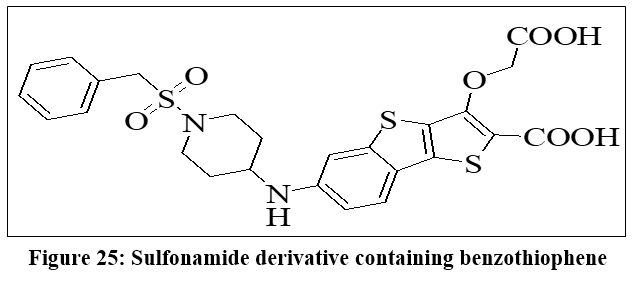 |
Figure 25: Sulfonamide derivative containing benzothiophene Click here to View Figure |
Table 9: Antidiabetic (Hypoglycemic) Activity of Benzothiophenes.
|
Sr. No. |
Compound Class | Mechanism/Target | Assay Systems | Key Results | Therapeutic Implications |
| 1 | BT-hydrazone derivatives67 | α-Glucosidase inhibition | Enzymatic inhibition assays | IC₅₀ 5.8 μM vs 13.4 μM acarbose |
Superior postprandial glucose control |
|
2 |
BT-hydrazone α-amylase inhibitors68 | Carbohydrate digestion inhibition | α-Amylase activity assays | IC₅₀ 0.51-7.99 μM | Sub-micromolar enzyme inhibition |
| 3 | BT-sulfonamide derivatives69 | PTP1B inhibition | Insulin receptor phosphorylation | Low nanomolar IC₅₀ |
Insulin resistance reversal |
Mechanistic Lessons, Methodological Considerations, and Translational Challenges
This subsection consolidates methodological points that recur across Sections 4.1–4.6 and that are important for interpreting the biological data discussed in this review.
Kinase druggability and multi-target inhibition. Among the kinase targets discussed in Section 4.2, VEGFR-2 and EGFR are clinically validated, druggable targets with multiple approved small-molecule inhibitors already in clinical use for oncology indications,53 providing external benchmarks (e.g., sorafenib, erlotinib) against which the benzothiophene-derived compounds discussed here were favourably compared in vitro. PLK1-PBD and DYRK1A/B are comparatively less clinically mature: no benzothiophene-derived inhibitor of either target has yet reached clinical development in the literature reviewed here. Multi-target inhibition (e.g., dual VEGFR-2/EGFR activity, or broad Dyrk/Clk/Haspin activity) is generally framed in the primary literature as advantageous for overcoming resistance associated with single-target agents; however, this advantage is a hypothesis rather than a demonstrated clinical outcome for the compounds discussed here, and broader kinase inhibition also increases the theoretical risk of off-target toxicity, which was not systematically assessed via kinase-panel profiling in any of the cited studies.
Antimicrobial resistance mechanisms. Efflux-pump upregulation and biofilm formation are well-established, general bacterial resistance/tolerance mechanisms in the broader antimicrobial-resistance literature,54,55 and are introduced here for context. However, with the exception of the outer-membrane-protein docking analysis reported by Molina-Panadero et al.,19 and the pyruvate-kinase target proposed by Seethaler et al.,45 the antimicrobial studies discussed in Section 4.1 do not investigate these mechanisms specifically for benzothiophene derivatives (e.g., no efflux-pump inhibition assay, biofilm-penetration assay, or target-site mutation analysis was reported for any benzothiophene compound reviewed here). The membrane-disrupting, efflux-pump-blocking, and biofilm-penetrating capabilities mentioned as a future direction in Section 5.3 are therefore presented there as a forward-looking research hypothesis grounded in general antimicrobial-resistance biology, not as a property demonstrated for any specific benzothiophene compound in the studies cited in this review.
Structural characterisation of reviewed compounds. The structural and physicochemical data discussed in Section 2 (crystallographic planarity, bond lengths, packing interactions) were obtained in the original studies principally by single-crystal X-ray diffraction, complemented in the broader benzothiophene literature by standard characterisation techniques such as ¹H/¹³C NMR spectroscopy, IR spectroscopy, mass spectrometry, and, for organic-semiconductor derivatives, UV–Vis spectroscopy, thermogravimetric analysis (TGA), and differential scanning calorimetry (DSC), as cited in the relevant primary references (refs. 16, 19, 21–31). As this is a review article, no new structural characterisation experiments were performed for this manuscript; all structural data presented derive from the cited primary sources.
Cell-line and reagent sourcing. As this is a review article, information regarding the cell lines discussed in Section 4.2 was extracted from the original studies cited herein; the present authors did not independently procure or authenticate any cell line. Supplier information is reported below only where it could be confirmed from material accessible for this review; where it could not be confirmed, this is stated explicitly rather than assumed. For the T24 bladder-carcinoma line used by Mostafa et al.,46 the original publication states that all cell lines used (including T24, HCT-116, MCF-7, A549, U87, HeLa, and HaCaT) were purchased from the Bioresource Collection and Research Center (BCRC), Hsinchu, Taiwan. For the MCF-7/PanC-1/HepG2 lines used by Eldehna et al.,47 the HEp-2 line used by Haridevamuthu et al.,48 and the HeLa/HepG2/MG63 lines used by Huang et al.,49 a cell-bank supplier could not be confirmed from the material accessible for this review; the authors should consult the Materials and Methods or Supporting Information sections of these original publications directly to confirm and cite the specific source. No cell-bank name has been assumed or invented for these entries.
Toxicity language. Several of the primary studies discussed above describe compounds as “non-cytotoxic” or predict “negligible toxicity,” but in each case this reflects either (i) the absence of cytotoxicity against a single non-tumorigenic or non-target cell line tested alongside the primary assay (e.g., compound II.b vs A549 lung cells in Barbier et al.,11), or (ii) an in silico ADME/toxicity prediction (e.g., absence of PAINS/Brenk alerts, predicted non-toxicity) rather than a measured in vivo lethal-dose value. No study discussed in this review reports a formal LD₅₀ (median lethal dose) determination, and IC₅₀ cytotoxicity values were reported for only a minority of compound series and only against the specific cell lines tested. Consistent with the source literature, toxicity in this review is described as compound-, model-, dose-, and exposure-dependent rather than as a general safety property of the benzothiophene scaffold, and blanket claims of non-toxicity have been avoided throughout the manuscript.
Methodological glossary (review-level description only; no experiments were performed by the present authors). MIC (minimum inhibitory concentration) and MIC₅₀/MIC9₀ quantify the lowest antimicrobial concentration that inhibits visible growth for all or 50/90% of tested isolates, typically via broth microdilution; antibiotic susceptibility testing (AST, including disc diffusion) measures inhibition-zone diameters on agar and was not performed for any compound in this review beyond what is reported in the cited primary sources (see Section 4.1). MTT and CCK-8 assays measure cellular metabolic activity as a surrogate for viable cell number in cytotoxicity/antiproliferative screening. Radical-scavenging assays (DPPH, ABTS, FRAP) measure direct chemical electron/hydrogen-atom transfer to a stable radical or oxidant in solution. Enzyme-inhibition assays (α-glucosidase, α-amylase, PTP1B) measure loss of substrate turnover in the presence of inhibitor, typically expressed as IC₅₀. Molecular docking predicts a static binding pose and a computed score within a target structure, while molecular dynamics (MD) simulations extend this to assess pose stability over simulated time; both are computational predictions and do not by themselves confirm binding in a biological system. In silico ADME prediction (e.g., SwissADME, Lipinski/Veber/Muegge filters) estimates drug-likeness and pharmacokinetic risk from molecular structure alone. These techniques were used by the authors of the cited primary studies and are described here only to aid interpretation of the reviewed data.
Future Prospects
The benzothiophene framework remains very promising for the advancement of next-generation therapeutic medicines, especially in light of increasing antimicrobial resistance (AMR) and the pressing demand for target-selective, low-toxicity medications. The extensive biological activities linked to benzothiophene derivatives—such as antibacterial, anticancer, CNS-active, anti-inflammatory, antioxidant, and antidiabetic properties—underscore their considerable pharmacological versatility; however, numerous domains require additional research and innovation.
Enhancing Target-Specificity and Selectivity
Future initiatives should concentrate on improving selectivity for the specific targets already identified within this review, including pyruvate kinase and outer-membrane porins (CarO1, Omp33, OmpW, OmpC) in Gram-negative pathogens (Section 4.1), PTP1B and alpha-glucosidase in diabetes (Section 4.6), Abeta42 aggregation in neurodegeneration (Section 4.3), and VEGFR-2/EGFR in cancer (Section 4.2). For several of these targets (e.g., compound 6q against VEGFR-2/EGFR; compounds 12 and 17 against DYRK1A/B, Clk1/2, and Haspin), sub-micromolar potency has already been demonstrated in vitro, but target engagement was inferred principally from molecular docking rather than confirmed by orthogonal biophysical methods. Techniques such as activity-based protein profiling (ABPP), photoaffinity labelling, or cellular thermal shift assays (CETSA) would strengthen mechanistic confidence for these specific candidates and help distinguish direct target engagement from downstream or off-target effects.
Integrating AI-Enhanced Pharmaceutical Design
AI and machine-learning techniques remain an emerging rather than a demonstrated strategy for this scaffold: as noted in Section 4.7, none of the primary studies reviewed here report validated AI-driven design of benzothiophene derivatives. Deep generative models, quantum machine learning, and automated retrosynthesis planning are increasingly used elsewhere in medicinal chemistry to explore chemical space, and could plausibly be applied to prioritise substitution patterns at the benzothiophene 2- and 3-positions, which SAR data throughout this review (Sections 4.1-4.6) consistently identify as the principal determinants of potency and selectivity. Future benzothiophene-focused studies that apply and experimentally validate AI-augmented QSAR or docking-guided design would meaningfully extend the current literature.
Addressing Antimicrobial Resistance (AMR)
The worldwide AMR crisis demands the identification of unconventional antibacterial agents. Bacterial efflux-pump overexpression and biofilm-associated tolerance are two of the most clinically significant, well-established general mechanisms of antimicrobial resistance,54,55 and represent plausible future mechanistic targets for benzothiophene-based antimicrobials. However, as noted in Section 4.7, direct experimental evidence that benzothiophene derivatives specifically act through these mechanisms is limited within the literature reviewed here: only outer-membrane-protein docking and a putative pyruvate-kinase target have been proposed to date for benzothiophene compounds, and neither efflux-pump inhibition nor biofilm penetration has been experimentally demonstrated for any benzothiophene derivative in the studies cited in this review. This distinction is important — the underlying resistance mechanisms are firmly established in the general antimicrobial literature, but their relevance to benzothiophene chemistry specifically remains a research hypothesis rather than a demonstrated finding, and is presented as such. Hybridisation approaches linking benzothiophenes with triazoles, quinolones, or peptides may produce multimodal antimicrobials capable of evading resistance mechanisms and merit further investigation.
Development of Hybrid Molecules
Molecular hybridization strategies are already represented within the literature reviewed here, including the resveratrol-benzothiophene hybrid discussed for antioxidant activity (Section 4.5) and the fluorinated benzothiophene-indole hybrid antibacterials discussed in Section 4.1. Extending this approach to benzothiophene-triazole or benzothiophene-chalcone hybrids may yield dual- or triple-pharmacophore agents relevant to multifactorial diseases such as cancer, diabetes, or neurodegeneration. As with the parent scaffold, such hybrids would require their own dedicated SAR, selectivity, and resistance-mechanism studies rather than being assumed to inherit the favourable properties of each individual pharmacophore.
Strategies for Drug Delivery and Formulation
As discussed in Section 2, the lipophilicity (Log P ~2.78) and rigid planar structure that favour target binding in this scaffold are also associated with the aqueous-solubility and pharmacokinetic limitations noted elsewhere in this review (e.g., the high protein binding and rapid metabolism that limit the therapeutic potential of otherwise potent antimicrobial leads discussed in Section 4.1). Formulation approaches such as liposomes, polymeric nanoparticles, or solid lipid carriers merit systematic evaluation to address this gap, particularly for the CNS-active candidates discussed in Section 4.3, whose blood-brain-barrier penetration has so far been assessed only by in silico prediction rather than measured brain exposure.
Examining Environmental and Toxicological Safety
As detailed in Section 4.7, toxicity data for the compounds discussed in this review are limited to single-cell-line cytotoxicity screening or in silico ADME prediction; no study reviewed here reports a formal LD50 determination or systematic in vivo toxicity assessment. Future work should prioritise in vivo toxicity studies for the most advanced candidates identified in this review (e.g., the sub-micromolar DYRK1A/B and PLK1-PBD inhibitors discussed in Section 4.2), alongside ecotoxicological evaluation given the environmental persistence reported for some sulfur-containing heterocycles.
Trends in Clinical Translation and Patenting
Consistent with the absence, from Sections 4.1-4.6, of any benzothiophene-derived candidate discussed in this review having reached late-stage clinical development for the specific indications covered here, most compounds remain at the discovery or preclinical stage. Progression will require the pharmacokinetic, toxicological, and resistance-mechanism data identified as gaps throughout Section 4.7, together with multi-centric collaboration between academic and industry groups. The continued clinical use of established benzothiophene drugs such as raloxifene and zileuton demonstrates that the scaffold itself is not a barrier to clinical translation, even though the specific derivatives discussed in this review remain preclinical.
Conclusion
Benzothiophene remains a well-established and versatile heterocyclic scaffold in medicinal chemistry, underpinned by a rigid, planar fused thiophene–benzene ring system that supports favourable membrane permeability and target engagement, and by clinical precedent from approved agents such as raloxifene, zileuton, and sertaconazole. Synthetic access to substituted benzothiophenes has broadened considerably over the past decade, with palladium-catalyzed carbonylative cyclization, metal-free electrophilic and protonative cyclizations, visible-light-mediated radical chemistry, and aqueous domino/one-pot multicomponent reactions now complementing classical cyclization and cross-coupling methods (Section 3).
The biological literature reviewed here (Section 4) is genuinely encouraging: several benzothiophene derivatives show sub-micromolar to low-micromolar in vitro potency against multidrug-resistant S. aureus, colistin-resistant Gram-negative pathogens, and validated anticancer kinase targets (DYRK1A/B, VEGFR-2, EGFR, PLK1-PBD), and structure–activity relationship analyses consistently identify substitution at the 2- and 3-positions of the core as the principal lever for potency and selectivity. These findings are supported chiefly by in vitro biological activity and, in several cases, by molecular docking; they are not yet supported by comparable in vivo pharmacokinetic or toxicological data. As detailed in Section 4.7, important limitations recur across the literature: in vivo pharmacokinetic and bioavailability data are almost entirely absent (existing pharmacokinetic statements rest on in silico ADME prediction rather than measured bioavailability or half-life); resistance mechanisms against candidate antimicrobials and anticancer kinase inhibitors have been investigated in only a small minority of studies; quantitative green-chemistry metrics (E-factor, PMI, atom economy) are inconsistently reported for the synthetic methods reviewed; and cell-line source information and systematic cytotoxicity/selectivity screening are frequently incomplete. Benzothiophene is an established rather than a newly discovered scaffold, and no benzothiophene-derived candidate discussed in this review has yet reached late-stage (Phase III) clinical development for the indications covered here; claims of transformative or unprecedented potential should therefore be read with this preclinical status in mind.
Realising this scaffold’s therapeutic potential will require closing these specific gaps rather than restating its general promise. Given the sub-micromolar DYRK1A/B and PLK1-PBD inhibition already reported for several compounds (Section 4.2), priority should be given to in vivo pharmacokinetic and efficacy studies, kinase-panel selectivity profiling, and resistance-mechanism characterisation for the most active antimicrobial and anticancer leads identified in Sections 4.1–4.2. Given the aqueous-solubility and bioavailability limitations typical of lipophilic, rigid aromatic scaffolds such as benzothiophene (Log P ≈ 2.78), formulation approaches (e.g., nanoparticulate or lipid-based delivery) warrant systematic evaluation, particularly for CNS-active candidates requiring blood–brain-barrier penetration. AI/machine-learning-assisted design, molecular hybridisation, and targeted delivery remain promising but still emerging strategies for this scaffold, not approaches that have already been validated in the primary literature reviewed here, and should be pursued and reported as such in future work.
Acknowledgement
The authors are grateful to MET’s Institute of Pharmacy, Bhujbal Knowledge City, Nashik, and Savitribai Phule Pune University, Pune, for providing the necessary academic support and research facilities for this work.
Funding Sources
The author(s) received no financial support for the research, authorship, and/or publication of this article.
Conflict of Interest
The authors do not have any conflict of interest.
Data Availability Statement
This statement does not apply to this article.
Ethics Statement
This research did not involve human participants, animal subjects, or any material that requires ethical approval.
Informed Consent Statement
This study did not involve human participants, and therefore, informed consent was not required.
Clinical Trial Registration
This research does not involve any clinical trials.
Permission to reproduce material from other sources
Not Applicable.
Author Contributions:
- Shantanu Sanjay Ghodke: Investigation, Formal analysis, Writing – original draft, review & editing.
- Dinesh Dattatray Rishipathak: Conceptualization, Supervision, Investigation, Formal analysis.
References
- Keri RS, Chand K, Budagumpi S, Somappa SB, Patil SA, Nagaraja BM. An overview of benzo[b]thiophene-based medicinal chemistry. Eur J Med Chem. 2017;138:1002-1033. doi:10.1016/j.ejmech.2017.07.038.
CrossRef - Pathak S, Singh AP, Sharma R, Pandey R. An overview of the pharmacological activities and synthesis of benzothiophene derivatives. Med Chem. 2024;20(9):839-854. doi:10.2174/0115734064315107240603055845.
CrossRef - Clemett D, Spencer CM. Raloxifene: a review of its use in postmenopausal osteoporosis. Drugs. 2000;60(2):379-411. doi:10.2165/00003495-200060020-00013
CrossRef - Overk CR, Peng KW, Asghodom RT, et al. Structure-activity relationships for a family of benzothiophene selective estrogen receptor modulators including raloxifene and arzoxifene. Chem Med Chem. 2007;2(10):1520-1526. doi:10.1002/cmdc.200700104
CrossRef - Benati L, Montevecchi PC, Spagnolo P. Reaction of diphenyl disulfide with alkynes promoted by di-tert-butyl and dibenzoyl peroxide: a useful synthetic route to 3-(and 2,3-) substituted benzo[b]thiophenes. J Chem Soc Perkin Trans 1992;1659-1664. doi:10.1039/P19920001659
CrossRef - Masuya Y, Tobisu M, Chatani N. Palladium-catalyzed synthesis of 2,3-disubstituted benzothiophenes via the annulation of aryl sulfides with alkynes. Org Lett. 2016;18(17):4312-4315. doi:10.1021/acs.orglett.6b02055
CrossRef - Mancuso R, Cuglietta S, Strangis R, Gabriele B. Synthesis of benzothiophene-3-carboxylic esters by palladium iodide-catalyzed oxidative cyclization-deprotection-alkoxycarbonylation sequence under aerobic conditions. Org. Chem. 2023;88(8):5180–5186. doi: 10.1021/acs.joc.2c00686.
CrossRef - Alikhani Z, Albertson AG, Walter CA, Masih PJ, Kesharwani T. Synthesis of benzo[b]thiophenes via electrophilic sulfur-mediated cyclization of alkynylthioanisoles. J Org Chem. 2022;87(9):6312-6320. doi:10.1021/acs.joc.1c02606.
CrossRef - Sujith K.P., Lee A. Synthesis of 3-Arylselanyl Benzothiophenes through Visible-Light-Mediated Radical Cyclization. Eur J Org Chem. 2023;26(24):e202300257. doi:10.1002/ejoc.202300257
CrossRef - Deng Q, Gu J, Zhang H, Zhang Y, Meng X. Catalyst-free three-component domino reaction in water for the synthesis of trifluoromethyl-containing benzothiophene-fused pyrrolidones. Org Biomol Chem. 2022;20(37):7424-7433. doi:10.1039/D2OB01314K.
CrossRef - Barbier T, Barbry A, Magand J, et al. Synthesis and biological evaluation of benzo[b]thiophene acylhydrazones as antimicrobial agents against multidrug-resistant Staphylococcus aureus. 2022;12(1):131. doi:10.3390/biom12010131.
CrossRef - Ahmad G, Khalid A, Qamar MU, Rasool N, Saadullah M, Bilal M, Bajaber MA, Obaidullah AJ, Alotaibi HF, Alotaibi JM. Antibacterial efficacy of N-(4-methylpyridin-2-yl) thiophene-2-carboxamide analogues against extended-spectrum-β-lactamase producing clinical strain of Escherichia coli ST 131. 2023;28(7):3118. doi:10.3390/molecules28073118.
CrossRef - Masih PJ, Kesharwani T, Rodriguez E, et al. Synthesis and evaluation of 3-halobenzo[b]thiophenes as potential antibacterial and antifungal agents. Pharmaceuticals (Basel). 2022;15(1):39. doi:10.3390/ph15010039.
CrossRef - Mahaleh SPG, Algso MAS, Ozok Arici O, Kivrak A, Arslan S. Synthesis, in silico pharmaceutical properties, anticancer and anti-inflammatory activities of novel benzo[b]thiophene derivative. Prog Biomater. 2023;12(3). doi:10.57647/pibm.2023.122315.
- Kocabıyık K, Özok-Arici O, Kivrak A, Arslan S. Evaluation of anticancer and anti-inflammatory activities of some benzothiophene-based artemisinin. Chemistry Select. 2025;10(28):e202501133. doi:10.1002/slct.202501133.
CrossRef - Dhanya TM, Anjali Krishna G, Savitha DP, et al. Synthesis, characterization, biological evaluation and molecular docking studies of some novel benzo[b]thiophene derivatives. Phosphorus Sulfur Silicon Relat Elem. 2023;198(4):283-294. doi:10.1080/10426507.2022.2156718.
CrossRef - Zhao Y, Singh K, Karuturi RC, et al. Benzofuran and benzo[b]thiophene-2-carboxamide derivatives as modulators of amyloid beta (Aβ42) aggregation. Chem Med Chem. 2024;19(22):e202400198. doi:10.1002/cmdc.202400198.
CrossRef - El Yaqoubi M, Hafez B, Lahyaoui M, et al. Computational insights into benzothiophene derivatives as potential antibiotics against multidrug-resistant Staphylococcus aureus: QSAR modeling and molecular docking studies. Moroccan J Chem. 2025;13(2):774-806. doi:10.48317/IMIST.PRSM/morjchem-v13i2.54818.
- Molina-Panadero I, Morales-Tenorio M, García-Rubia A, et al. Discovery of new antimicrobial thiophene derivatives with activity against drug-resistant Gram-negative bacteria. Front Pharmacol. 2024;15:1412797. doi:10.3389/fphar.2024.1412797.
CrossRef - Kim S, Ryu S, Ahn J, et al. Solution-processable benzo[b]thieno[2,3-d]thiophene derivatives as organic semiconductors for organic thin-film transistors. Coatings. 2023;13(8):1417. doi:10.3390/coatings13081417.
CrossRef - Sang R, Noble A, Aggarwal VK. Chiral benzothiophene synthesis via enantiospecific coupling of benzothiophene S-oxides with boronic esters. Angew Chem Int Ed. 2021;60(48):25313-25317. doi:10.1002/anie.202112180.
CrossRef - Mukhtar A, Hussain A, Younas F, Yousuf S, Saeed M. Facile synthesis of substituted 2-aroylbenzo[b]thiophen-3-ols to form novel triazole hybrids using click chemistry. RSC Adv. 2024;14(15):10270-10279. doi:10.1039/D4RA01146E.
CrossRef - Chirico RD, Knipmeyer SE, Nguyen A, Steele WV. The thermodynamic properties of benzothiophene. J Chem Thermodyn. 1991;23(8):759-781. doi:10.1016/S0021-9614(05)80165-5.
CrossRef - SPRESIweb data entry: Benzothiophene. Springer Nature. Published 2020. Accessed July 4, 2026.
- Finke HL, Gross ME, Messerly JF, Waddington G. Benzothiophene: Heat capacity, heat of fusion, thermodynamic properties from 12 to 320 K, and ultraviolet absorption. J Am Chem Soc. 1954;76(3):854-858. doi:10.1021/ja01632a032.
CrossRef - Dykyj J, Svoboda J, Wilhoit RC, Frenkel M, Hall KR, eds. Vapor Pressure of Chemicals: Part A: Critical Evaluation of Vapor Pressure Data for Organic and Organometallic Compounds. Berlin, Germany: Springer; 1999:135.
- Bol’shakov GF, Vatago VS, Agrest FB. UV Spectra of Heteroorganic Compounds. Moscow, Russia: INEOS, Academy of Sciences of the USSR; 1969:13.
- Silambarasan V, Srinivasan T, Sivasakthikumaran R, Mohanakrishnan AK, Velmurugan D. Crystal structure of 2-[(benzo[b]thiophen-3-yl)methyl]-1H-isoindole-1,3(2H)-dione. Acta Crystallogr Sect E Struct Rep Online. 2012;68(Pt 12):o3408. doi:10.1107/S1600536812045750.
CrossRef - Gunasekaran B, Dhayalan V, Mohanakrishnan AK, Chakkaravarthi G, Manivannan V. Ethyl 3-(4-methoxyphenyl)-1-benzothiophene-2-carboxylate. Acta Crystallogr Sect E Struct Rep Online. 2010;66(Pt 6):o1449. doi:10.1107/S1600536810017386.
CrossRef - O’Neil MJ, ed. The Merck Index: An Encyclopedia of Chemicals, Drugs, and Biologicals. 15th ed. Whitehouse Station, NJ: Merck & Co., Inc.; 2013:246.
- Ziaulla M, Banu A, Begum NS, Panchamukhi SI, Khazi IM. Ethyl 5-(1-benzothiophen-3-yl)-2-methylfuran-3-carboxylate. Acta Crystallogr Sect E Struct Rep Online. 2010;66(Pt 10):o2616. doi:10.1107/S1600536810036943.
CrossRef - Haynes WM, ed. CRC Handbook of Chemistry and Physics. 95th ed. Boca Raton, FL: CRC Press; 2014:497. doi:10.1201/b17118.
CrossRef - Vyas VS, Haase F, Stegbauer L, et al. A tunable azine covalent organic framework platform for visible light-induced hydrogen generation. Nat Commun. 2015;6:8508. doi:10.1038/ncomms9508.
CrossRef - Yao C, Chen X, He Y, Guo Y, Murtaza I, Meng H. Design and characterization of methoxy modified organic semiconductors based on phenyl[1]benzothieno[3,2-b][1]benzothiophene. RSC Adv. 2017;7:5514-5518. doi:10.1039/C6RA27492F.
CrossRef - Yan S, Cazorla A, Babuji A, et al. Temperature-induced polymorphism of a benzothiophene derivative: reversibility and impact on the thin film morphology. Phys Chem Chem Phys. 2022;24(40):24562-24571. doi:10.1039/D2CP03467K.
CrossRef - Deng Q, Yu A, Zhou J, Cao Q, Meng X. Construction of benzothiophene or benzothiopheno[2,3-e]azepinedione derivatives via three-component domino or one-pot sequences. J Org Chem. 2020;85(19):12270-12283. doi:10.1021/acs.joc.0c01505.
CrossRef - Kim SY, Lim HN, Kwak K, Yeom HS. Protonative silica gel intramolecular cyclization of o-methylthio ynamides to 2-amidobenzo[b]thiophenes. 2022;54(24):5451-5460. doi:10.1055/a-1880-8912.
CrossRef - Matsuzawa T, Hosoya T, Yoshida S. One-step synthesis of benzo[b]thiophenes by aryne reaction with alkynyl sulfides. Chem Sci. 2020;11:9691-9696. doi:10.1039/D0SC04450D.
CrossRef - Pal S, Khan MA, Bindu P, Dubey PK. Transition-metal/Lewis acid free synthesis of acyl benzothiophenes via C-C bond forming reaction. Beilstein J Org Chem. 2007;3:35. doi:10.1186/1860-5397-3-35.
CrossRef - Ivanov DS, Sokolov AI, Smirnov AYu, Baranov MS. A novel approach to obtain 3-amino-1-benzothiophene-2-carbonitriles. Chem Heterocycl Compd. 2024;60(1):99-102. doi:10.1007/s10593-024-03299-y.
CrossRef - Kumagai Y, Kobayashi A, Nakamura S, Yoshida S. Facile synthesis of dibenzothiophene S-oxides from sulfinate esters via aryne chemistry. Chem Commun (Camb). 2024;60:1203-1206. doi:10.1039/D3CC05703H.
CrossRef - Singh M, Jamra R, Paul AK, Malakar CC, Singh V. KI-assisted sulfur activation/insertion/denitration strategy towards dual C-S bond formation for one-pot synthesis of β-carboline-tethered 2-acylbenzothiophenes. Asian J Org Chem. 2022;11(2):e202100653. doi:10.1002/ajoc.202100653.
CrossRef - Lai L, Yang J, Sun W, et al. Design, synthesis and antibacterial evaluation of a novel class of tetrahydrobenzothiophene derivatives. RSC Med Chem. 2023;14(1):166-172. doi:10.1039/D2MD00373B.
CrossRef - Li L, Hui T, Li Y, et al. Design, synthesis and antifungal activity of novel α-methylene-γ-butyrolactone derivatives containing benzothiophene moiety. Pest Manag Sci. 2024;80(8):3776-3785. doi:10.1002/ps.8080.
CrossRef - Seethaler M, Hertlein T, Hopke E, et al. Novel effective fluorinated benzothiophene-indole hybrid antibacterials against Staphylococcus aureus and MRSA strains. Pharmaceuticals (Basel). 2022;15(9):1138. doi:10.3390/ph15091138.
CrossRef - Mostafa N, Chen PJ, Darwish SS, et al. N-Benzylated 5-hydroxybenzothiophene-2-carboxamides as multi-targeted Clk/Dyrk inhibitors and potential anticancer agents. Cancers (Basel). 2024;16(11):2033. doi:10.3390/cancers16112033.
CrossRef - Eldehna WM, Al-Ansary GH, Al-Warhi T, Jaballah MY, Elaasser M, Rashed M. Identification of novel ureido benzothiophenes as dual VEGFR-2/EGFR anticancer agents. Bioorg Chem. 2024;143:107037. doi:10.1016/j.bioorg.2023.107037.
CrossRef - Haridevamuthu B, Manjunathan T, Alphonse CRW, et al. Functionalized sulfur-containing heterocyclic analogs induce sub-G1 arrest and apoptotic cell death of laryngeal carcinoma in vitro. 2023;28(4):1856. doi:10.3390/molecules28041856.
CrossRef - Huang D, Zhang J, Yang X, et al. Structure-guided development of novel benzothiophene derivatives as PLK1-PBD inhibitors. Lett Drug Des Discov. 2024;21(11):2163-2174. doi:10.2174/1570180811666231020152052.
CrossRef - Segretti ND, Takarada JE, Ferreira MA Jr, et al. Discovery of novel benzothiophene derivatives as potent and narrow-spectrum inhibitors of DYRK1A and DYRK1B. Bioorg Med Chem Lett. 2022;68:128764. doi:10.1016/j.bmcl.2022.128764.
CrossRef - Kimura R, Kamino K, Yamashita S, et al. The DYRK1A gene, encoded in chromosome 21 Down syndrome critical region, bridges between beta-amyloid production and tau phosphorylation in Alzheimer disease. Hum Mol Genet. 2007;16(1):15-23. doi:10.1093/hmg/ddl437
CrossRef - Friedman E. The kinase Mirk/dyrk1B: a possible therapeutic target in pancreatic cancer. Cancers (Basel). 2010;2(3):1492-1512. doi:10.3390/cancers2031492
CrossRef - Press MF, Lenz HJ. EGFR, HER2 and VEGF pathways: validated targets for cancer treatment. Drugs. 2007;67(14):2045-2075. doi:10.2165/00003495-200767140-00006
CrossRef - Blair JMA, Richmond GE, Piddock LJV. Multidrug efflux pumps in Gram-negative bacteria and their role in antibiotic resistance. Future Microbiol. 2014;9(10):1165-1177. doi:10.2217/fmb.14.66
CrossRef - Stewart PS, Costerton JW. Antibiotic resistance of bacteria in biofilms. Lancet. 2001;358(9276):135-138. doi:10.1016/S0140-6736(01)05321-1
CrossRef - Bai C, Ren S, Wu S, Zhu M, Luo G, Xiang H. Design, synthesis, and biological evaluation of novel benzothiophene derivatives as selective estrogen receptor covalent antagonists. Eur J Med Chem. 2021;221:113543. doi:10.1016/j.ejmech.2021.113543.
CrossRef - Amoroso R, De Lellis L, Florio R, et al. Benzothiazole derivatives endowed with antiproliferative activity in paraganglioma and pancreatic cancer cells: structure–activity relationship studies and target prediction analysis. Pharmaceuticals (Basel). 2022;15(8):937. doi:10.3390/ph15080937.
CrossRef - Ammazzalorso A, Carradori S, Amoroso R, Fernández Fernández I. 2-Substituted benzothiazoles as antiproliferative agents: Novel insights on structure-activity relationships. Eur J Med Chem. 2020;207:112762. doi:10.1016/j.ejmech.2020.112762.
CrossRef - Kuppusamy R, Hsu YT, Ke YY, et al. Benzo[b]thiophene-2-carboxamides as novel opioid receptor agonists with potent analgesic effect and reduced constipation. Eur J Med Chem. 2022;243:114728. doi:10.1016/j.ejmech.2022.114728.
CrossRef - Rapacz A, Jakubiec M, Abram M, et al. Discovery of new 3-(benzo[b]thiophen-2-yl)pyrrolidine-2,5-dione derivatives as potent antiseizure and antinociceptive agents—in vitro and in vivo Pharmaceuticals (Basel). 2024;17(11):1532. doi:10.3390/ph17111532.
CrossRef - Rudin D, McCorvy JD, Glatfelter GC, et al. (2-Aminopropyl)benzo[b]thiophenes (APBTs) are novel monoamine transporter ligands that lack stimulant effects but display psychedelic-like activity in mice. 2022;47(4):914-923. doi:10.1038/s41386-021-01211-9.
CrossRef - Mak KK, Zhang S, Epemolu O, et al. Synthesis and anti-inflammatory activity of 2-amino-4,5,6,7-tetrahydrobenzo[b]thiophene-derived NRF2 activators. Chemistry Open. 2022;11(10):e202200181. doi:10.1002/open.202200181.
CrossRef - Isloor AM, Kalluraya B, Pai KSR. Synthesis, characterization and biological activities of some new benzo[b]thiophene derivatives. Eur J Med Chem. 2010;45(2):825-830. doi:10.1016/j.ejmech.2009.10.022.
CrossRef - Pathak C, Singh RR, Yadav S, et al. Evaluation of benzothiophene carboxamides as analgesics and anti-inflammatory agents. IUBMB Life. 2014;66(3):201-211. doi:10.1002/iub.1252.
CrossRef
- Haridevamuthu B, Manjunathan T, Guru A, et al. Hydroxyl containing benzo[b]thiophene analogs mitigates the acrylamide induced oxidative stress in the zebrafish larvae by stabilizing the glutathione redox cycle. Life Sci. 2022;298:120507. doi:10.1016/j.lfs.2022.120507.
CrossRef - Ko S, Lim HM, Song Y, Hwang H, Lee JT. Design, synthesis, theoretical study, and antioxidant activity of aromaticity-extended resveratrol derivatives incorporating chalcogen. Int J Mol Sci. 2025;26(12):5872. doi:10.3390/ijms26125872.
CrossRef - Khan S, Rehman MU, Iqbal T, et al. Experimental and computational analysis of benzothiophene derivatives as selective inhibitors for diabetes mellitus. J Mol Graph Model. 2025;138:109010. doi:10.1016/j.jmgm.2025.109010.
CrossRef - Joshi RJ, Dholariya MP, Chothani SR, et al. Synthesis, antidiabetic activity and in silico studies of benzo[b]thiophene-based small-molecule α-amylase inhibitors. J Mol Struct. 2024;1312:138570. doi:10.1016/j.molstruc.2024.138570.
CrossRef - Ghareb N, Darwish KM, Nafie MS, et al. Development, biological evaluation, and molecular modelling of some benzene-sulfonamide derivatives as protein tyrosine phosphatase-1B inhibitors for managing diabetes mellitus and associated metabolic disorders. RSC Med Chem. 2025;16(1):247-273. doi:10.1039/D4MD00594E.
CrossRef
Accepted on: 11-09-2026
Second Review by: Dr. Nkoyo Nubila
Final Approval by: Dr. Jagdish Chandra Joshi