Artificial Intelligence-Driven Preclinical Frameworks for Alzheimer’s Disease: A Systematic Review of Murine, Other Animal, and Non-Animal Models, Biomarkers, Monitoring, and Translational Gaps
 , Alberto Alfonso Aguilar-Lasserre1*, Daniel Cuervo-Zanatta2, José Ernesto Domínguez-Herrera3 and Armin Trujillo-Mata4
1Graduate Studies and Research Division, Instituto Tecnológico de Orizaba, Tecnológico Nacional de México, Orizaba, Veracruz, México
2Center for Studies and Applied Technology in Health Sciences (CETACS), Córdoba-Orizaba Campus, Anáhuac Veracruz University, Veracruz, Mexico
3Industrial Maintenance Engineering, Technological University of the Center of Veracruz, Cuitlahuac, Veracruz, México
4Industrial Engineering, Anahuac University, Córdoba, Veracruz, México
Corresponding Author’s E-mail: albertoaal@hotmail.com
Download this article as:
ABSTRACT:Artificial intelligence (AI) is transforming preclinical research in Alzheimer’s disease (AD), particularly through its integration with Murine experimental models (MEMs) for early detection, monitoring, and therapeutic evaluation. However, current research remains fragmented, with limited standardization and insufficient integration across methodological and translational domains. This systematic literature review (SLR) analyzes 221 peer-reviewed studies published between 2009 and 2025, focusing on AI applications in preclinical AD models. The study takes a closer look at a wide range of AI techniques, from machine learning and deep learning to computer vision, natural language processing, and generative models, mapping out how each is used at various stages of AD and within different experimental approaches. In examining these studies, the results reveal a strong predominance of unimodal approaches, limited use of multimodal data fusion, and significant variability in validation protocols, which collectively hinder reproducibility and translational impact. Additionally, the analysis identifies key gaps in real-time monitoring, explainability, and integration of heterogeneous datasets. Based on these findings, this work proposes a conceptual framework for AI-assisted preclinical pipelines that integrates multimodal data, adaptive learning systems, and translational validation strategies. This framework is designed to enhance potential implications, such as the clinical relevance of preclinical AD research, to facilitate the development of scalable, precision medicine-oriented diagnostic and therapeutic solutions.
KEYWORDS:Alzheimer's disease (AD); Artificial Intelligence (AI); Murine Experimental models (MEMs); Preclinical Frameworks (PF); Systematic Literature Review (SLR)
Introduction
Dementia stands as a major force behind disability, dependency, and loss of life among older adults today. In 2021, over 57 million people worldwide faced the challenges of dementia, with the majority—more than 60 percent—living in low- and middle-income countries. Among them, AD stands out as the most prevalent, responsible for around 60 to 70 percent of all cases. Looking ahead to 2050, experts warn that the number of people living with dementia could soar to between 139 and 152 million worldwide.1
Figure 1, panel [A], shows evidence that the age-standardized prevalence of dementia has remained relatively stable over the past three decades, with average values ranging from 700 to 900 cases per 100,000 inhabitants in women and 550 to 700 per 100,000 in men. However, growth is projected to continue on an upward trend over the next four decades. Panel [B] reveals a dramatic surge in dementia cases spanning every age group, with numbers soaring from around 30 million in 1990 to a staggering 100 million expected by 2050. This exponential growth is primarily attributed to global population aging, particularly in low- and middle-income regions where the demographic transition is relatively recent.2
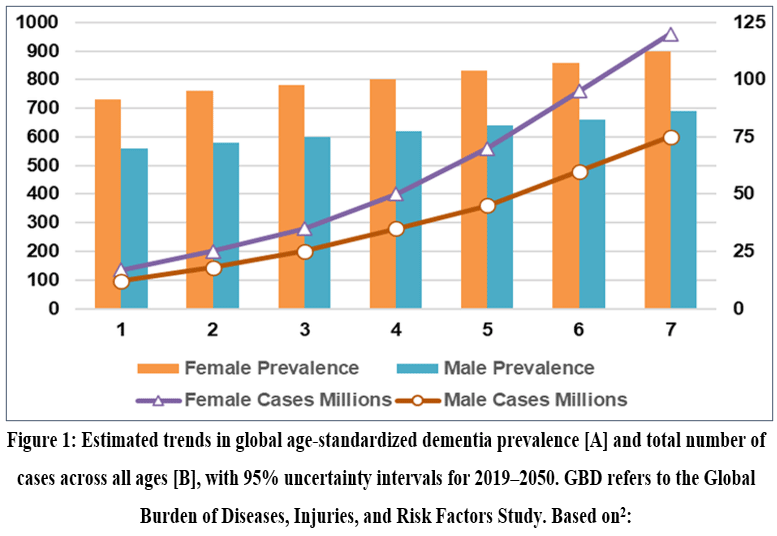 |
Figure 1: Estimated trends in global age-standardized dementia prevalence [A] and total number of cases across all ages [B], with 95% uncertainty intervals for 2019–2050. GBD refers to the Global Burden of Diseases, Injuries, and Risk Factors Study. Based on2: |
In the Mexican context, the situation is no different and presents particularities that make it doubly relevant. Recent population studies in Mexico indicate an overall dementia prevalence of approximately 7.8% among people aged 60 and over, of whom a significant proportion meet the clinical criteria for AD. Certain analyses have observed that AD and other dementias in Mexico went from representing a relatively minor burden between 1990 and 2019 to experiencing increases of 200% or more in incidence and age-standardized prevalence.3
The study of AD is of increasing importance globally and regionally due to its epidemiological, socioeconomic, and health impacts. The rapid aging of the population has steadily increased the incidence and prevalence of AD, requiring updated local data, predictive models, and analyses of specific risk factors. Beyond its individual effects, AD represents a significant burden on families, healthcare systems, and national economies, especially in developing countries where healthcare infrastructure, support for caregivers, and public strategies are still limited. Furthermore, significant inequalities persist in research and care for the disease. While most studies focus on high-income countries, regions like Latin America lack longitudinal data and representative biomarkers, which restricts the understanding of the genetic, environmental, and sociocultural factors involved in its progression.3
Although AD still lacks a definitive cure, advances in drug therapies, early diagnostic strategies, and preventive approaches based on modifiable risk factors highlight the need to strengthen local research. Further study of AD will not only optimize care and prevention strategies but also reduce the humanitarian and economic burden associated with this neurodegenerative disease.
Alzheimer’s Disease: Harnessing Artificial Intelligence to Transform Preclinical Experimental Models.
AD stands as the most common type of neurodegenerative dementia, marked by the relentless buildup of β-amyloid plaques, tangled tau fibers, and the gradual fading of neurons and synapses. Even after decades of dedicated research, turning preclinical breakthroughs into real clinical success remains rare, largely because current experimental models fall short of capturing the true complexity of human disease. Against this backdrop, weaving AI and machine learning (ML) techniques into preclinical models opens up exciting new possibilities to boost reproducibility, deepen data interpretation, and sharpen predictions for human translation. This integrative approach opens new avenues for optimizing experimental design, analyzing large volumes of multi-omics data, and evaluating diagnostic, monitoring, follow-up, and treatment procedures for the disease.
Bibliometric analysis reveals accelerated growth in scientific output on AI applied to experimental AD models (See Table 1), especially since 2015, driven by advances in ML and computer vision (CV) [A]. This surge in research is led by the United States and China, followed by India, the United Kingdom, and Italy, reflecting a concentration in economies with high scientific investment [B]. Furthermore, publications are concentrated in high-impact journals in neuroscience, biomedicine, and computational intelligence, confirming the interdisciplinary convergence between engineering, biology, and data science [C]. Notably, original articles predominate, followed by reviews, thereby indicating the maturity and consolidation of the field in the preclinical realm [D].
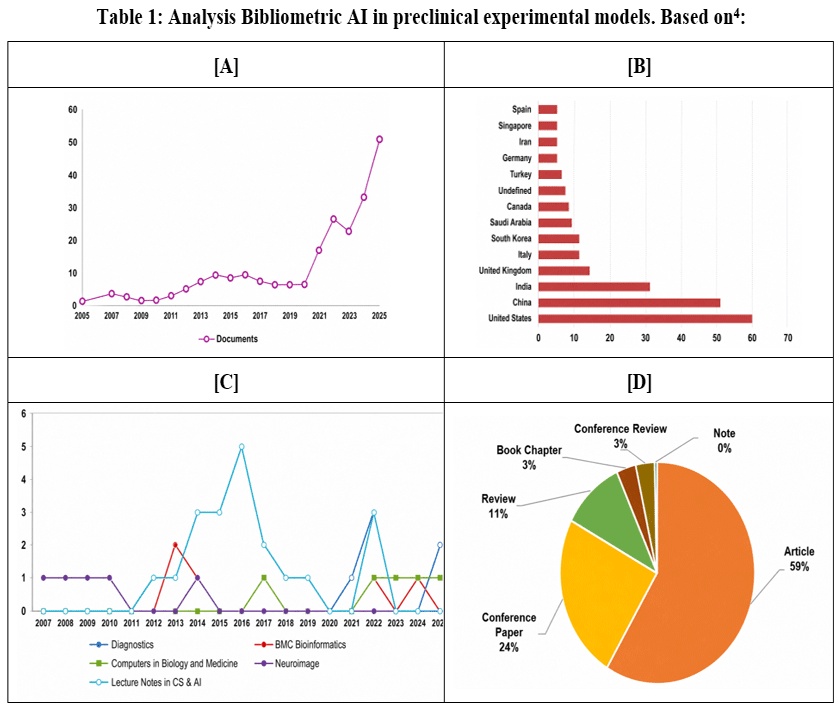 |
Table 1: Analysis Bibliometric AI in preclinical experimental models. Based on4: Click here to View Table |
Harnessing Artificial Intelligence: Transforming Mouse Models for Alzheimer’s Disease Research.
Preclinical research on AD in experimental animal models using AI is accelerating the discovery of biomarkers and developing new hybrid methods to support healthcare stages for the disease. Using ML and deep learning (DL) techniques, these models have shown high performance for classification, segmentation, and multimodal fusion in neuroimaging, omics, and behavior, with direct implications for early detection, risk stratification, and prognosis in the care pathway.5 In parallel, MEMs (e.g., 5xFAD, APP/PS1; knock-in/knock-out strategies, and Aβ/tau inoculation) enable robust modeling of amyloid pathology and, to a lesser extent, tau pathology. Where AI automates behavioral analysis (gait/open-field, Morris water maze) and histological/imaging quantification to improve the statistical power and reproducibility of studies, bridging the preclinical-clinical gap.
AD represents one of the major challenges in neuroscience due to its complexity and heterogeneous progression. This systematic literature review (SLR) seeks to deepen our understanding of intelligent disease management processes in MEMs, which play a vital role in generating preclinical data. By thoroughly assessing their application and effectiveness, this review sheds light on their true potential. The research questions (RQ) are classified in Table 2.
Table 2: Research questions
|
Identification |
Question |
|
RQ1 |
Which AI techniques are most frequently harnessed to advance AD treatment in MEMs? |
|
RQ2 |
How effective are AI techniques in AD for early detection and monitoring of progression in MEMs? |
|
RQ3 |
What limitations and challenges do AI applications present in the study of AD in MEMs compared to traditional experimental approaches? |
Objective
Current AI-based preclinical AD studies lack standardized multimodal integration frameworks, leading to inconsistent translational outcomes. This SLR aims to integrate and critically analyze AI techniques applied to the monitoring, control, and follow-up of AD stages in MEMs. The objective is to identify the key methodologies, variables, and technological trends driving this research. By integrating empirical and theoretical studies from January 2009 and December 2025, the aim is to develop a comprehensive and up-to-date framework that provides specialists with a complete overview, facilitating more informed decision-making and accelerating the development of precision medicine solutions.
Design/Methodology/Approach
This review embarked on a rigorous journey, systematically scouring SCOPUS and Web of Science for academic literature by weaving together the keywords “Alzheimer’s disease (AD),” “Artificial Intelligence (AI),” “Preclinical Frameworks,” and “Murine Experimental Models (MEMs)” using the logical operator “AND.” Only peer-reviewed journal articles published between 2009 and early 2025 in English or Spanish, with the search terms featured in the title, abstract, or keywords, were considered. Conference proceedings, unpublished manuscripts, and other materials were set aside. The initial search yielded 1383 documents, which were meticulously refined and organized by type and thematic relevance. After removing duplicates, the studies faced a thorough evaluation through three Research Questions (RQ) and three Quality Assessment Questions (QAQ). Ultimately, 221 articles made the final cut for data extraction and analysis. The findings were then synthesized and grouped into thematic categories, highlighting their relevance to the perception of AD, all guided by PRISMA protocols. The research and quality questions served as a filter, allowing only the most relevant articles to be categorized, which significantly reduced the number of references included.
Practical Implications
The results have significant implications for applied engineering and scientific research. They show that AI can improve the diagnosis, treatment, and monitoring of AD by predicting patient deterioration, which supports more efficient clinical planning. The study also highlights the need to standardize and update preclinical records in MEMs, since model accuracy relies on data quality and frequency.6 Given the variability in abnormal protein accumulation, oxidative stress, mitochondrial damage, neuroinflammation, synaptic dysfunction, genetic and epigenetic changes, and the disease’s slow progression, these factors are critical for adaptive systems to recalibrate as patient conditions change.
Originality/Value
This SLR significantly advances preclinical engineering by analyzing the interplay between neurodegenerative disease stages, monitoring techniques, and AI methods in a single study. Unlike previous research (See Table 8), which addressed these elements separately, this work provides an interdisciplinary perspective, connecting disease care, traditional procedures, and intelligent modeling.
Identifying key factors, monitoring stages, and predictive techniques establishes a strong foundation for developing intelligent diagnostic, monitoring, and treatment systems. By highlighting knowledge gaps and methodological limitations, this study directs future research toward more accurate and adaptive hybrid models for various preclinical animal models, with the goal of meeting clinical standards for human application. These findings enhance both theoretical understanding and practical strategies to address neurodegenerative disease impacts.
Research Gap/Contribution
Despite the rapid growth of AI in preclinical AD research, current studies remain fragmented across methodologies, experimental models, and data modalities. Existing reviews typically address isolated domains—such as neuroimaging, biomarker discovery, or specific AI techniques. They do not provide an integrative framework linking AI methods to disease progression stages and experimental validation in MEMs. Moreover, the lack of standardization in data acquisition, model validation, and translational evaluation limits reproducibility and hinders clinical transferability. This issue is exacerbated by the predominance of unimodal approaches and the limited adoption of multimodal data fusion strategies.
In response, this study provides a critical, structured synthesis of AI-driven preclinical frameworks for AD. It integrates methodological, experimental, and translational dimensions within a unified analytical framework. Specifically, it (i) develops a taxonomy linking AI techniques with both experimental methodologies and clinical stages of AD, (ii) identifies systemic limitations affecting reproducibility and translational success, and (iii) proposes an integrated conceptual framework for multimodal, AI-assisted preclinical pipelines.
By moving beyond descriptive analysis, this work advances a critical understanding of AI. It shows how AI can effectively support the design, monitoring, and translation of preclinical AD models toward clinically relevant outcomes.
Methodology: Systematic Literature Review (SLR)
The purpose of this study is to conduct an SLR focused on the treatment of AD, specifically in MEMs. Currently, there is a growing interest in integrating AI techniques as a tool to model the behavior, monitoring, and treatment of neurodegenerative diseases, with the aim of optimizing results in preclinical models and ensuring the reliability of future applications in humans. This document analyzes various approaches from scientific articles and literature reviews published between January 2009 and December 2025, with the objective of identifying the advantages of using AI in animal and other experimental models. The methodology employed is innovative for the three-phase structure used in this work, comprising planning, execution, and documentation, which was combined with the PRISMA protocol to ensure the reliability of the review.7 Sections 2.1 and 2.2 provide a summary of the review protocol.
Integrates the study selection process, the main AI techniques identified, their application across the AD care continuum, the principal experimental data modalities, and the key translational gaps detected in the literature. Based on 221 studies published between 2009 and 2025, the visual synthesis highlights the predominance of ML, ANNs, DL, CV, and GM, while also emphasizing the limited adoption of XAI, embedded systems, multimodal fusion, and real-time monitoring. The proposed framework integrates multimodal data, performs preprocessing, supports AI modeling, enables explainable interpretation, supports longitudinal monitoring, and delivers translational outputs. The figure illustrates the need for standardized, interpretable, and multimodal AI-assisted pipelines to improve reproducibility, biological interpretability, therapeutic evaluation, and translational relevance in preclinical AD research.
Study Selection and Quality Assessment
The search criteria were constructed by combining the operator “and” with the key terms: “Alzheimer’s disease (AD), “Artificial Intelligence (AI),” “Preclinical Frameworks,” “Murine Experimental Models (MEMs),” The systematic search included two main databases: SCOPUS and Web of Science, with the aim of collecting academic articles and reviews that met the following criteria: (i) published in peer-reviewed journals between 2009 and early 2025; (ii) written in English or Spanish; and (iii) including key terms in the title, abstract, and keywords. The application of these criteria resulted in the identification of 2396 articles in Mendeley, SCOPUS, and Web of Science. The results were then classified according to the type of document (article, book, or review). After eliminating duplicates, the references were organized alphabetically by author, avoiding biases related to the publication year or “relevance”. Finally, the selected studies were evaluated using the Quality Assessment Questions (QAQ) presented in Table 3.
Table 3: Quality assessment questions
|
Quality assessment questions |
Identification |
|
Are the applications of AI techniques in MEMs for AD clearly defined and well explained? |
QAQ1 |
|
Does the existing literature provide relevant evidence of the effectiveness of AI techniques in AD using MEMs? |
QAQ2 |
|
Do the presented AI techniques offer novel and useful contributions compared with traditional approaches in MEMs for AD? |
QAQ3 |
The authors defined the questions to ensure they were aligned with the research methodology and the questions outlined in Table 2. The primary goal was to meet the criteria established by the research questions, ensuring a high-quality evaluation. The study criteria included both the title and abstract; if a document did not meet these criteria, it was discarded because it did not address the posed questions. We excluded articles for various reasons. These included incomplete information on application techniques, variables unrelated to the research question, inappropriate populations or contexts, weak research designs, unclear or incomplete data, unvalidated measurement tools, and lack of access to the full text.Finally, a sample of 221 documents was selected for data extraction. Table 4 summarizes the results of the search strategy and the quality assessment process using the PRISMA flowchart (See, Figure 2) (Accessed December 31, 2025).
Table 4: Results of the Search Strategy and Quality Assessment
|
|
Results |
Data Range 2009–2025 |
|
Web of science core collection search |
2396 |
Timespan: 2009–2025. Indexes: SCI-EXPANDED, SSCI, A&HCI, CPCI-S, CPCISSH.ESCI. |
|
SCOPUS search |
1942 |
Timespan: 2009–2025.Indexes: SCI-EXPANDED, SSCI, A&HCI, CPCI-S, CPCISSH.ESCI. |
|
Web of science core collection search refinement search |
824 |
Timespan: 2009–2025.Indexes: SCI-EXPANDED, SSCI, A&HCI, CPCI-S, CPCI-SSH.ESCI. |
|
SCOPUS refinement search |
1640 |
Timespan: 2009–2025.Indexes: SCI-EXPANDED, SSCI, A&HCI, CPCI-S, CPCI-SSH.ESCI. |
|
Papers recovered |
1383 |
|
|
Duplicates |
351 |
|
|
Papers for quality assessment |
1032 |
|
|
Excluded for not addressing the QAQs |
811 |
|
|
Sample for data extraction |
221 |
|
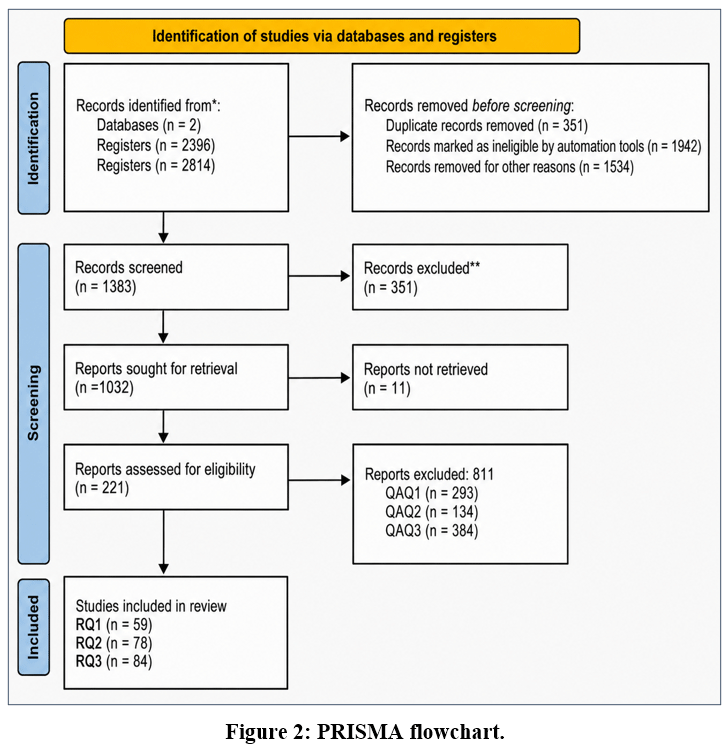 |
Figure 2: PRISMA flowchart. Click here to View Figure |
Figure 3 provides a graphical summary of the key topics of interest in this study, with RQ2 being the most relevant topic: the application of artificial intelligence techniques for detecting, monitoring, and controlling AD in MEMs. [A] Temporal trend: A pronounced rise in publications during 2021–2025 indicates rapid field maturation following a gradual growth phase from 2009–2020. [B] Experimental models: Non-MEMs dominate (66.97%), reflecting methodological diversification, while MEMs remain scientifically relevant (33.03%) in biomedical research. [C] Document types: Reviews prevail (55.93%), followed by research articles and conference papers (40.68%), demonstrating a consolidation phase characterized by critical synthesis rather than primary exploratory output; theses/books are minimal (3.39%). [D] Research questions: Evidence concentrates on RQ2–RQ3, emphasizing applied, integrative, and translational perspectives, whereas RQ1 is less represented, aligning with a shift toward impact-oriented research. [E] Open Data: Restricted access predominates (75%), limiting transparency and equitable knowledge dissemination; only 25% of studies are openly accessible.
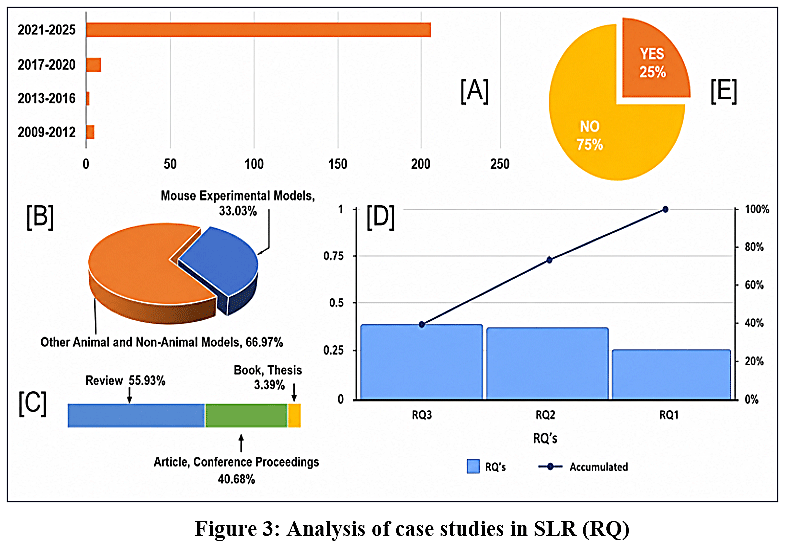 |
Figure 3: Analysis of case studies in SLR (RQ) Click here to View Figure |
Analysis of case studies in SLR (RQ)
For each research question, the analysis group followed a deductive approach to define the category framework based on theoretical considerations. By establishing categories parallel to known subsets and deriving innovative applications found in the literature, we emphasize that this study excludes traditional statistical methods, as it is a review focused on AI.
In question RQ1, an exhaustive analysis of documents addressing AI techniques used in MEMs, as well as in other animal models (Invertebrates, simple vertebrates, and large mammals), was carried out. The applicability of the techniques in diagnostic, progression, and therapeutic processes was examined. Among the main techniques studied are ML, with learning variants in applications to predict progression and personalize medical care for patients with AD8; ANN, which determine the stages of the disease using artificial learning algorithms; Natural Language Processing (NLP), to analyze biomarkers and neuroimaging; CV, for the classification of magnetic resonance images6; DL, for diagnosis and prognosis of the disease; Evolutionary Optimization (EO), in early detection through non-invasive biomarkers; and Generative Models (GM), for drug design, unraveling pathologies and advancing treatment strategies with Explainable Artificial Intelligence (XAI) and Embedded Systems (ES). This analysis enabled us to identify key factors for applying the techniques in the literature.9
In RQ2, they examined the application of AI in the stages of AD, healthcare from early detection to palliative care. Advancing preventative diagnosis (PRV) of neurodegenerative disease with AI-enhanced MRI.8 Comprehensive Diagnosis (CDx), with intelligent behavioral tracking of the mouse model based on the activity of the hippocampal complex, is used to improve neurofunctionality within multidisciplinary treatment (MDT) settings. Modifying reaction time task parameters on platforms for continuous monitoring (CFU) and palliative care (PC), such as the automated “IntelliCage,” identifies impulsivity and attention, and classifies abnormalities in disease progression in the 3xTg-AD model.10
In RQ3, the experimental methods in MEMs of AD with AI are analyzed, ranging from genetic tools to generate the pathology to behavioral, molecular, histological, and neuroimaging evaluations, allowing for a comprehensive view of the disease and the validation of therapies. Using Genetic Methods (GM) with DL approaches for the early detection of the disease through multimodal images.11 Behavioral Methods (BM), for the evaluation of locomotion and anxiety patterns in the open field through automated analysis. Histopathological Methods (HM), with the integration of transcriptomics, proteomics, and metabolomics to identify early biomarkers.12 Biochemical and Molecular Methods (BMM), through supervised learning to differentiate progression states based on molecular profiles. Through deep learning to obtain comprehensive biomarkers in Neuroimaging Methods (NM), Electrophysiological Methods (EM), combined with unsupervised learning to identify hidden patterns in complex datasets, as well as the interpretation of molecular, histological, and behavioral data to predict cognitive progression in mice.13,14 Pharmacological and Therapeutic Methods (PTM).
The SLR analyzes the medical care provided to a patient with AD using an experimental mouse model using AI techniques. This provides significant benefits to society by introducing innovative approaches to preclinical studies for diagnosing, treating, monitoring, and managing the behavior of neurodegenerative diseases. The application of AI enables the modeling of complex processes, such as disease progression, which has accelerated discoveries, reduced human bias, and improved the translation of findings into clinical research. Furthermore, it fosters innovative practices that can limit the future impact of the disease.
From a research perspective, this review serves as an essential tool, as it identifies knowledge gaps and highlights areas that require further study, thereby guiding new research toward relevant and unresolved problems. It also promotes interdisciplinary collaboration by connecting diverse topics, especially in the treatment of AD, and provides up-to-date references that offer a solid and contemporary theoretical framework. This facilitates researchers in the design of experiments, hypothesis validation, and the development of innovative methodologies.
Results and Discussion
Artificial intelligence techniques in Alzheimer’s care.
The objective of Research Question (RQ1) is to analyze the influence of applying various AI techniques to the monitoring of AD, considering its main areas of study.
This analysis includes ML techniques, considering supervised, unsupervised, and reinforcement learning; ANNs, including multilayer perceptron, convolutional, recurrent, and transformer networks; NLP, through data analysis and generation; CV, for object detection and recognition, 3D reconstruction, and image processing; DL through generative and advanced prediction models; EO methods with genetic algorithms, particle swarms, and evolutionary programming; GM with generative and diffusion models; XAI with design-interpreted or complex models; and ES through autonomous and path-planning systems. From Optical projection tomography acquisition, the projections are used to reconstruct a 3D image with a filtered back-projection algorithm. After a normalization step, a random forest classifier identifies voxels corresponding to plaques in the image volume. Quantitative measurements can be extracted from the segmentation mask, allowing for statistical analyses to be conducted. This study highlights the importance of applying these techniques to understand their role in AD care in MEMs, as presented in Figure 4.
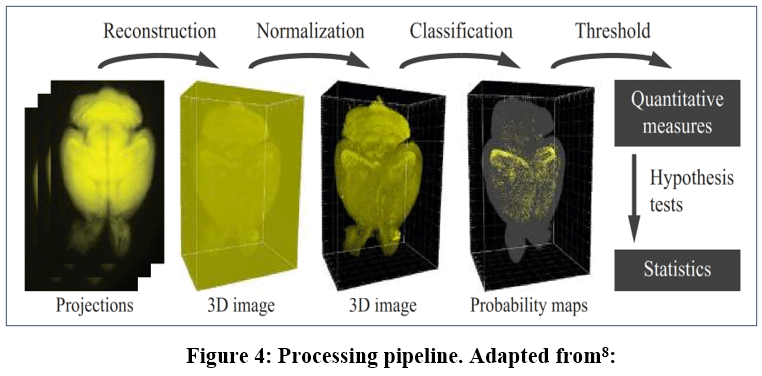 |
Figure 4: Processing pipeline. Adapted from8: Click here to View Figure |
An analysis was conducted of 59 studies, classified into two main categories. The first, “Murine Experimental Models,” includes research focused on this area. The second, “Other Animal and Non-Animal Models,” encompasses studies focused on medium and large animals, primates, as well as cell cultures, organoids, and computational models. Studies providing Open Data (OD) were also identified to improve the verification and transparency of the results.
Each study was systematically evaluated and weighted based on the number of analytical tools used for the topic of interest. Table 5 presents a complete summary of this classification, including weighting, categorization, and references for each study included in the SLR.
Table 5: AI techniques in Alzheimer’s care.
|
|
|
|
|
|
|
|
|
|
|
|
|
|
References according to the unit of analysis |
|
|
AI |
Type |
ML |
ANN |
NLP |
CV |
DL |
EO |
GM |
XAI |
ES |
No. |
OD |
Mouse Experimental Models |
Other animal and non-animal models |
|
57. Nguyen et al.,8 |
A |
● |
● |
|
● |
● |
|
|
|
|
4 |
✓ |
✓
|
|
|
58. Masuda et al.,6 |
A |
● |
● |
|
● |
● |
|
|
|
|
4 |
✓ |
✓ |
|
|
59. Chabrier et al.,9 |
R |
|
● |
|
|
● |
|
|
|
|
2 |
|
✓ |
|
|
Total (59) |
|
57 |
58 |
18 |
19 |
19 |
13 |
25 |
9 |
4 |
222 |
14 |
18 |
41 |
|
A (24) R (33) B (2) |
||||||||||||||
|
Note: AI (Artificial Intelligence); ML (Machine Learning); ANN (Artificial Neural Networks); NLP (Natural Language Processing); CV (Computer Vision); DL (Deep Learning); EO (Evolutionary Optimization); GM (Generative models); XAI (Explainable Artificial Intelligence); ES (Embedded Systems); OD (Open Data); Type: A (Article, Conference Proceedings) R (Review) B (Book, Thesis). |
||||||||||||||
The 59 analyzed studies were classified based on their examined properties, year of publication, availability of open data, and associated MEMs or Other animal and non-animal models, as shown in Figure 5. [A] Temporal distribution: Publication volume concentrates in 2021–2025, confirming rapid field consolidation after limited activity in previous periods. [B] Experimental models: Non-murine and alternative models dominate (69.49%), indicating methodological diversification, while MEMs remain relevant (30.51%). [C] Document types: Reviews prevail (55.93%), followed by articles and conference papers (40.68%), reflecting a knowledge-synthesis phase; theses/books represent a minor contribution (3.39%). [D] AI techniques: ANN and ML predominate, with GM, CV, and DL as secondary approaches; XAI and ES remain underrepresented, highlighting opportunities for future methodological maturation. [E] OD: Only 24% of publications are open access, underscoring limited transparency and restricted knowledge dissemination.
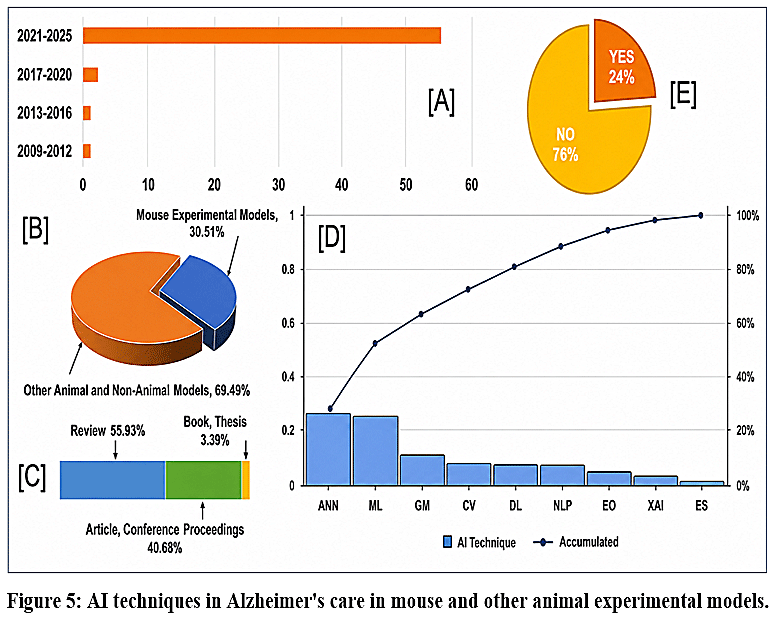 |
Figure 5: AI techniques in Alzheimer’s care in mouse and other animal experimental models. Click here to View table |
Analysis and Discussion of Artificial Intelligence Approaches
AI approaches are increasingly used across preclinical and non-animal AD research, though their roles differ by data type, experimental model, and translational application. In MEMs, ML and ANNs quantify amyloidosis, automate cognitive and behavioral assessment, and identify nonlinear associations between behavioral, molecular, structural, and functional variables.5,6,13,15,16 Graph-based approaches enable characterization of brain aging and functionally relevant connections. Multimodal integration links proteomic, connectomic, and behavioral information across biological scales.11,15 CV and DL extend these capabilities by enabling automated phenotype extraction, three-dimensional segmentation of amyloid pathology, and longitudinal behavioral monitoring, including IntelliCage-based assessment.6,8,23 Collectively, these approaches provide quantitative phenotype representations that are difficult to characterize manually, though their generalizability depends on dataset size, experimental standardization, and biological heterogeneity.
Other AI methods address complementary aspects of preclinical modeling. NLP supports structured interpretation of textual or linguistically encoded behavioral and clinical information. When integrated with multimodal systems, it may help align experimental observations with clinically relevant descriptors.20,22-25 EO has been applied to parameter, feature, and model selection, improving AI system adaptation to complex biological datasets and supporting biomarker identification.20,21,23,30 GMs enable synthesis or simulation of biological, molecular, imaging, and behavioral data, with applications in trajectory modeling, virtual experimentation, and drug discovery.11,23,31-34 In parallel, XAI improves interpretability by linking model outputs to measurable biological features, enhancing experimental traceability and facilitating interpretation of neuroimaging, behavioral, and molecular predictions.11,24,35-37 Finally, ES enable AI-assisted acquisition and analysis closer to the experimental environment, supporting continuous behavioral and physiological monitoring.22,37
Beyond murine studies, AI applications include other animal models (Invertebrates, simple vertebrates, and large mammals), human/clinical datasets, and non-animal computational systems (In vitro methods, organs-on-chips, in silico, organoids, 3D bioprinting, and microorganisms). Here, the main objective shifts from experimental phenotype characterization to diagnosis, prognosis, biomarker integration, and translational modeling. ML and ANN frameworks combine neuroimaging, clinical, molecular, genomic, and behavioral variables for disease staging, early detection, and individualized prediction.17-21 DL and CNN-based systems extend these analyses to complex imaging and non-invasive digital biomarkers. Multimodal architectures integrate heterogeneous information and improve representation across data domains.18,24,26-29 NLP-based methods have been investigated for automated speech and semantic analysis, providing complementary digital markers of cognitive decline.24,25 EO optimizes feature selection and model configuration in heterogeneous datasets. GMs offer opportunities for synthetic data generation, trajectory modeling, and virtual experimental environments.30-34 XAI is particularly relevant because interpretability facilitates biological and clinical examination of model predictions and improves reproducibility.24,35-37 ES supports real-time, low-power acquisition and analysis of physiological or behavioral signals.22,37
Despite these advances, the evidence should not be seen as demonstrating uniform clinical or translational superiority. Most AI systems remain sensitive to dataset composition, modality imbalance, model architecture, and external validation. Differences between murine, other animal, clinical, and non-animal datasets can limit direct cross-model extrapolation. Therefore, the main translational opportunity lies not in increasing predictive performance alone, but in developing multimodal, longitudinal, interpretable, and externally validated AI frameworks that connect experimental phenotypes with clinically meaningful biomarkers.61-64 Such integration may reduce the disconnect between computational performance and biological validity and provide a more rigorous basis for transferring findings across experimental and clinical contexts.65-70
Artificial intelligence in the evolutionary stages of Alzheimer’s.
The objective of RQ2 is to identify the relationship between the stages of healthcare for a chronic and progressive AD and ML techniques. This study focuses specifically on PRV, health promotion, screening and early detection; CDx, including medical and family history, physical and neurological examinations, cognitive testing, complementary studies and stage classification; MDT, both pharmacological and non-pharmacological; CFU, including periodic consultations, comorbidity monitoring, functional assessment, caregiver support; and PC, including management of behavioral disorders, management of complications, and safe adaptation to the environment. Figure 6 presents a workflow diagram illustrating the application of machine learning algorithms in AD diagnosis. The architecture includes data preprocessing, feature selection, model training, and validation using neuroimaging datasets.
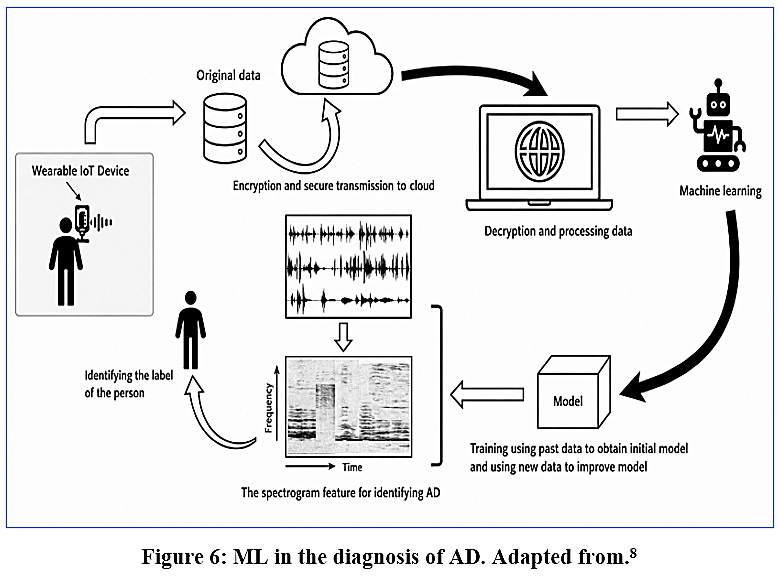 |
Figure 6: ML in the diagnosis of AD. Adapted from.8 Click here to View Figure |
An analysis was conducted of 78 studies, classified into two main categories. The first, “Mouse Experimental Models,” encompasses research focused on the use of the mouse model. The second, “Other Animal and Non-Animal Models,” encompasses studies focused on medium and large animals, primates, as well as cell cultures, organoids, and computational models. Studies providing OD were also identified to improve the verification and transparency of results. Each study was systematically evaluated and weighted based on the number of analytical tools employed in relation to the topic of interest. Table 6 presents a complete summary of this classification, including weighting, categorization, and references for each study included in the SLR.
Table 6: AI in the evolutionary stages of AD.
|
|
|
|
|
|
|
|
|
|
|
References according to the unit of analysis |
|
AI |
Type |
PRV |
CDx |
MDT |
CFU |
PC |
No. |
OD |
Mouse Experimental Models |
Other animal and non-animal models |
|
75. Wiltfang et al.,30 |
B |
● |
● |
● |
|
3 |
|
|
✓ |
|
|
76. Nguyen et al.,8 |
A |
● |
● |
● |
|
|
3 |
✓ |
✓ |
|
|
77. Masuda et al.,6 |
A |
● |
● |
● |
● |
● |
5 |
✓ |
✓ |
|
|
78. Muskulus et al.,10 |
R |
● |
● |
● |
|
|
3 |
✓ |
✓ |
|
|
Total (78) |
|
75 |
74 |
43 |
27 |
9 |
228 |
18 |
26 |
52 |
|
A (28) R (44) B (6) |
||||||||||
|
Note: AI (Artificial Intelligence); PRV (Prevention); CDx (Comprehensive Diagnosis); MDT (Multidisciplinary Treatment); CFU (Continuous Follow-up); PC (Palliative Care); OD (Open Data); Type: A (Article, Conference Proceedings) R (Review) B (Book, Thesis). |
||||||||||
The 78 analyzed studies were classified the stage of disease care, year of publication, availability of open data, and associated Mouse Experimental Models or Other animal and non-animal models, as shown in Figure 7. [A] Temporal distribution: Research activity clusters in 2021–2025, confirming recent consolidation after limited earlier development. [B] Experimental models: Non-murine and alternative models predominate (66.67%), while MEMs remain relevant but less frequent (33.33%). [C] Document types: Reviews dominate (56.41%), followed by articles/conference papers (35.90%), reflecting a synthesis-focused stage; theses/books show marginal presence (7.69%). [D] Medical care stages: Highest representation in prevention and diagnosis, followed by multidisciplinary treatment; follow-up and palliative care are underrepresented. [E] OD: Only 23% of studies are openly accessible, indicating restricted knowledge diffusion and limited scientific accessibility.
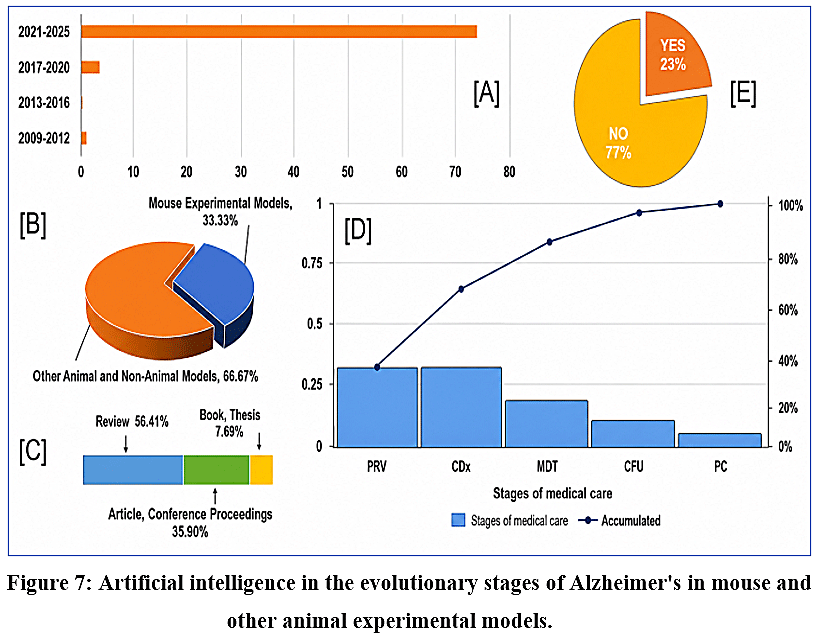 |
Figure 7: Artificial intelligence in the evolutionary stages of Alzheimer’s in mouse and other animal experimental models. Click here to View Figure |
Analysis and Discussion of AI Across the AD Prevention-to-Care Continuum.
AI applications in AD extend beyond disease detection to a continuum including prevention, comprehensive diagnosis, multidisciplinary treatment, continuous follow-up, and supportive or palliative care. In MEMs, prevention-oriented applications focus on identifying early structural, behavioral, and functional alterations before overt neurodegeneration. DL, neuroimaging, and automated behavioral platforms identify candidate early biomarkers and evaluate responses to neuroprotective interventions.8,38,39 IntelliCage-based monitoring and brain-age modeling support longitudinal characterization of cognitive vulnerability and disease-related phenotypes.40 For CDx, integrating MRI, behavioral measures, and graph-based approaches characterizes structural, functional, and cognitive alterations, while automated phenotyping facilitates standardized assessment.39,40 In MDT, multimodal AI frameworks integrate imaging, biomarkers, and behavioral information to characterize therapeutic responses and longitudinal changes in connectivity and plasticity.6,16 Similarly, CFU is supported by AI-enhanced neuroimaging, graph-based models, and automated behavioral monitoring, enabling temporal associations among molecular biomarkers, neural alterations, cognition, and treatment response.15,22 For welfare-oriented applications, automated and non-invasive monitoring reduces handling and detects behavioral or neurofunctional changes relevant to animal welfare and humane experimental management.38,40
In other animal, human/clinical, and non-animal models, the emphasis shifts to risk prediction, multimodal diagnosis, individualized intervention, and longitudinal disease management. AI systems integrating clinical, genetic, imaging, and digital biomarkers have been investigated for risk stratification and early identification of neurodegenerative changes.18,41-43 Multimodal approaches combine structural, functional, and molecular information to characterize subclinical cognitive decline and support individualized diagnostic assessment.41,44 Within MDT frameworks, DL, neuroimaging, and ES integrate heterogeneous signals to assess treatment response and characterize affected neural circuits.16,45,46 Longitudinal AI and chronic neurotechnology’s enable integration of imaging, clinical, physiological, and cognitive trajectories, supporting continuous assessment of disease progression and pharmacological response.18,47 In supportive and palliative contexts, ML and AI-enhanced neuroimaging may assist progression assessment and individualized management while reducing the need for invasive monitoring; however, these applications should be distinguished from direct evidence of improved patient outcomes.17,48
Across this continuum, AI’s main contribution is the integration and temporal interpretation of heterogeneous data rather than replacing conventional clinical or experimental assessment. In MEMs, AI enables sensitive and longitudinal phenotyping and evaluation of therapeutic responses. In human and non-animal settings, it increasingly supports risk stratification, multimodal diagnosis, individualized management, and disease monitoring.71-75 However, differences in datasets, experimental conditions, validation strategies, and biological context continue to limit direct translation across models. Robust prevention-to-care frameworks will require longitudinal, multimodal validation, transparent algorithms, standardized endpoints, and evidence of reproducibility across independent experimental and clinical populations.76-82
Artificial intelligence versus traditional experimental methods in Alzheimer’s.
The objective of RQ3 is to analyze the effectiveness of traditional experimental methods in caring for AD patients using AI. In the study of the disease, MEMs transgenic or induced mice are essential because they allow the exploration of molecular, cellular, and behavioral mechanisms associated with the progression of the pathology. GM are employed, using transgenic models (APP, PSEN1, Tau), with specific deletion or insertion of genes related to β-amyloid, tau, or APOE (“Knock-in and Knock-out”), to introduce point mutations or modify genes that modulate neuroinflammation and synaptic plasticity (“CRISPR”). BM are used to evaluate cognitive and memory deficits characteristic of AD, such as spatial memory tests (Morris Water Maze), working memory and recognition tests (Y-Maze and Radial Arm Maze), non-spatial memory tests (Novel Object Recognition Test), and associative learning tests (Fear Conditioning). HM, to visualize β-amyloid plaques and tau tangles; Thioflavin S, Congo Red, or immunohistochemistry staining; confocal and electron microscopy to characterize synapses and protein deposits; detection of astrogliosis and microgliosis; neuroinflammation studies.
BMM, for the quantification of β-amyloid, phosphorylated tau, and synaptic proteins; ELISA and Western blot; RT-qPCR for the analysis of genes related to neuroinflammation, apoptosis, and neuronal plasticity; proteomics and metabolomics for the identification of biomarkers; β-secretase and γ-secretase activity; and enzyme assays.
NM: structural changes such as atrophy (Nuclear Magnetic Resonance Imaging), detection of amyloid deposits and glucose metabolism (PET with radiotracers), dynamic monitoring of plaques and microglial response (in vivo Two-Photon Microscopy). EM: synaptic plasticity, LTP, and LTD (in vitro Electrophysiology), alterations in brain rhythms associated with cognitive impairment (in vivo EEG). PTM: administration of candidate drugs, gene and stem cell therapies, and non-pharmacological interventions.
An analysis was conducted of 84 studies, classified into two main categories. The first, “Mouse Experimental Models,” encompasses research focused on the use of the mouse model. The second, “Other Animal and Non-Animal Models,” encompasses studies focused on medium and large animals, primates, as well as cell cultures, organoids, and computational models. Studies providing OD were also identified to improve the verification and transparency of results. Each study was systematically evaluated and weighted based on the number of analytical tools employed in relation to the topic of interest. Table 7 presents a complete summary of this classification, including weighting, categorization, and references for each study included in the SLR.
Table 7: AI versus traditional experimental methods in Alzheimer’s.
|
References according to the unit of analysis |
||||||||||||
|
AI |
Type |
GM |
BM |
HM |
BMM |
NM |
EM |
PTM |
No. |
OD |
Mouse Experimental Models |
Other animal and non-animal models |
|
81. Nguyen et al.,8 |
A |
● |
● |
|
|
|
|
|
2 |
✓ |
✓ |
|
|
82. Masuda et al.,6 |
A |
● |
● |
● |
● |
● |
● |
6 |
✓ |
✓
|
|
|
|
83. Chabrier et al.,9 |
R |
● |
● |
● |
● |
● |
●
|
● |
7 |
✓ |
✓ |
|
|
84. Muskulus et al.,10 |
R |
|
|
|
|
● |
|
|
1 |
✓ |
✓ |
|
|
Total (84) |
|
57 |
69 |
41 |
50 |
51 |
3 |
5 |
276 |
23 |
29 |
55 |
|
A (31) R (47) B (6) |
||||||||||||
|
Note: AI (Artificial Intelligence); GM (Genetic Methods); BM (Behavioral Methods); HM (Histopathological Methods); BMM (Biochemical and Molecular Methods); NM (Neuroimaging Methods); EM (Electrophysiological Methods); PTM (Pharmacological and Therapeutic Methods); OD (Open Data); Type: A (Article, Conference Proceedings) R (Review) B (Book, Thesis). |
||||||||||||
The 84 reviewed studies were classified according to the experimental method used, year of publication, availability of open data, and their affiliation with the Dyadic Relationship group (Mouse Experimental Models with Other animal and non-animal models), as shown in Figure 8. [A] Temporal distribution: Research is concentrated in 2021–2025, indicating recent field consolidation after limited earlier activity. [B] Experimental models: non-murine and non-animal models predominate (65.48%), with substantial but lower use of MEMs (34.52%). [C] Document types: Reviews are predominant (55.95%), followed by articles/conference papers (35.90%), reflecting emphasis on knowledge synthesis; theses/books show marginal presence (7.14%). [D] Experimental methods: Biochemical methods are most frequent, followed by genetic, neurophysiological, and multimodal approaches; histological and other emerging methods are less represented. [E] OD: Only 35% of studies are openly accessible, indicating limitations in transparency and scientific dissemination.
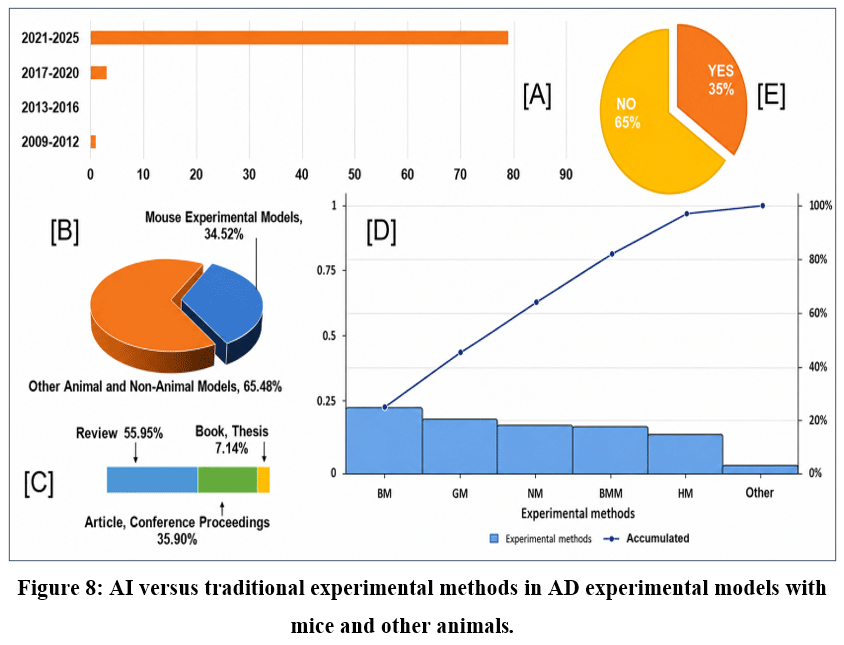 |
Figure 8: AI versus traditional experimental methods in AD experimental models with mice and other animals. Click here to View Figure |
Analysis and Discussion of Experimental Methods and AI Integration.
Integrating AI with experimental methods provides a multidimensional framework for characterizing AD across genetic, behavioral, histopathological, molecular, imaging, electrophysiological, and therapeutic domains. In MEMs, genetic approaches combine humanized 3xTg-AD and APOE models with AI-assisted neuroimaging, behavioral tracking, and gait analysis to link genotype to brain connectivity and phenotypic changes.16,38,49 Behavioral methods provide objective digital phenotypes by quantifying cognitive, emotional, attentional, and motor alterations through platforms such as IntelliCage, skeletal analysis, and graph-based models.40,52,53 Histopathological and biochemical/molecular approaches complement these phenotypes by enabling automated quantification of amyloid plaques, tau pathology, synaptic alterations, glial markers, and multi-omics signatures. This links tissue and molecular changes with disease progression and therapeutic responses.13,55 Neuroimaging integrates structural and functional information with connect omics and behavioral phenotypes. Electrophysiological methods capture alterations in neuronal dynamics and synaptic plasticity that may precede overt pathology.9,13,15,53 Together, these complementary modalities enable AI-assisted characterization of genotype–phenotype relationships and longitudinal responses to experimental interventions, although their predictive value depends on model-specific validation and biological context.
In other animal, human/clinical, and non-animal models, AI-assisted genetic analyses integrate genomic variants, at biomarkers, DNA methylation, and multimodal neuroimaging to investigate molecular determinants of AD and support risk or disease-stage characterization.44,50,51 Behavioral information can be combined with imaging and clinical biomarkers to link cognitive and motor trajectories with structural brain alterations.18,54 Automated histopathological analysis extends tissue-level characterization by quantifying Aβ, tau, and glial pathology and integrating morphological information with imaging and clinical variables.19,43,56 Similarly, biochemical and molecular approaches incorporate non-invasive biomarkers and multi-omics data to identify molecular alterations associated with functional impairment and disease progression.57,58 AI-enhanced neuroimaging and electrophysiological analyses provide complementary measures of structural, functional, and network-level dysfunction. XAI offers additional interpretability when imaging, molecular, and clinical features are jointly analyzed.24,34,36,48 Finally, pharmacological and therapeutic applications combine biomarkers, neuroimaging, connectivity, and automated behavioral measures to characterize treatment response and potential mechanisms, supporting individualized therapeutic modeling.6,34,46
Across these experimental domains, AI’s main contribution is integrating heterogeneous biological measurements into quantitative and potentially longitudinal representations of AD progression and treatment response. MEMs offer controlled environments for linking genetic manipulations with behavioral, molecular, pathological, electrophysiological, and neuroimaging phenotypes. Human and non-animal models provide complementary information on clinical heterogeneity, biomarker associations, and computationally reproducible disease trajectories.83-90 However, methodological heterogeneity, differences in biomarkers and endpoints, limited cross-model validation, and variable biological correspondence between experimental and clinical systems remain important translational constraints. Integrating multimodal experimental evidence with interpretable, externally validated AI models may provide a stronger basis for connecting mechanistic findings in MEMs to clinically relevant AD phenotypes.91-100
Discussion
The predominance of unimodal AI approaches suggests that the field remains methodologically fragmented and primarily oriented toward isolated classification tasks rather than integrative modeling of AD progression. Although models based on neuroimaging, behavioral testing, histopathology, or molecular biomarkers provide valuable predictive signals, they cannot fully capture the multidimensional nature of neurodegeneration in murine models. In these models, amyloid accumulation, tau pathology, neuroinflammation, synaptic dysfunction, metabolic alterations, and behavioral decline interact dynamically. Therefore, future preclinical pipelines should adopt multimodal, longitudinal, and explainable AI architectures that integrate behavioral, imaging, histopathological, molecular, omics, and experimental context data. Such integration would enhance the biological interpretability, reproducibility, and translational value of murine experimental models by linking algorithmic predictions to experimentally verifiable mechanisms and clinically relevant outcomes.
The limited adoption of explainable AI further restricts translational applicability. In preclinical AD research, predictive accuracy alone is insufficient; models must also generate biologically interpretable outputs related to amyloid burden, tau-related alterations, neuroinflammation, synaptic loss, cognitive impairment, or therapeutic response. Without explainability, AI systems remain black-box tools with limited acceptance in experimental neuroscience and clinical translation. Moreover, translational performance is constrained by heterogeneity in animal strains, disease induction strategies, behavioral protocols, data acquisition methods, sample sizes, and validation procedures. Robust frameworks should therefore combine multimodal data fusion, external validation, longitudinal monitoring, and explainable outputs to ensure that computational predictions are statistically reliable, biologically meaningful, and clinically relevant.
This study conducted a comprehensive analysis of 1,383 scientific documents, identifying 351 duplicates and 811 studies that did not meet the strict quality criteria established.59 After this selection process, 221 relevant studies were chosen to support the theoretical and methodological framework of the present research. It should be noted that some documents only meet one or two QAQs; however, due to their relevance, they were included in the study because it is a prominent trending topic that is currently under-explored in the literature. The results of this review are summarized in Table 8, which ranks the studies according to their relevance to the central theme of the research.
Table 8: Works and parameters to evaluate AI for Alzheimer’s treatment in mouse experimental models.
|
RQ issue |
Type |
ML |
ANN |
NLP |
CV |
D L |
E O |
GM |
XA I |
E S |
P RV |
C D x |
M DT |
C FU |
PC |
GM |
BM |
HM |
B MM |
NM |
EM |
P TM |
No. |
OD |
Author |
|
1- Other models |
R |
● |
● |
● |
● |
● |
● |
● |
● |
● |
|
|
|
|
|
|
|
|
|
|
|
|
9 |
|
Christodoulou et al.,45 |
|
2- Other models |
R |
● |
● |
● |
● |
● |
● |
● |
● |
● |
|
|
|
|
|
|
|
|
|
|
|
|
9 |
|
Song et al.,24 |
|
3- Other models |
R |
● |
● |
● |
● |
● |
● |
● |
● |
● |
|
|
|
|
|
|
|
|
|
|
|
|
9 |
|
Gou et al.,22 |
|
4- Other models |
R |
● |
● |
● |
● |
● |
● |
● |
● |
|
|
|
|
|
|
|
|
|
|
|
|
|
8 |
|
Babu et al.,21 |
|
5- Other models |
R |
● |
● |
● |
● |
● |
● |
● |
|
|
|
|
|
|
|
|
|
|
|
|
|
|
7 |
|
Wang et al.,79 |
|
6 – MEMs |
R |
|
|
|
|
|
|
|
|
|
● |
● |
● |
● |
● |
|
|
|
|
|
|
|
5 |
|
Batool et al.,38 |
|
7 – MEMs |
A |
|
|
|
|
|
|
|
|
|
● |
● |
● |
● |
● |
|
|
|
|
|
|
|
5 |
|
Judd et al.,40 |
|
8 – MEMs |
A |
|
|
|
|
|
|
|
|
|
● |
● |
● |
● |
● |
|
|
|
|
|
|
|
5 |
|
Moon et al.,11 |
|
9- Other models |
R |
|
|
|
|
|
|
|
|
|
● |
● |
● |
● |
● |
|
|
|
|
|
|
|
5 |
|
Neha Patwari et al.,48 |
|
10-Othermodels |
R |
|
|
|
|
|
|
|
|
|
● |
● |
● |
● |
● |
|
|
|
|
|
|
|
5 |
|
Kale et al.,18 |
|
11- MEMs |
R |
|
|
|
|
|
|
|
|
|
|
|
|
|
|
● |
● |
● |
● |
● |
● |
● |
7 |
✓ |
Chabrier et al.,9 |
|
12 – MEMs |
A |
|
|
|
|
|
|
|
|
|
|
|
|
|
|
● |
● |
● |
● |
● |
|
● |
6 |
✓ |
Masuda et al.,6 |
|
13 – MEMs |
A |
|
|
|
|
|
|
|
|
|
|
|
|
|
|
● |
● |
● |
● |
● |
● |
|
6 |
✓ |
Perovic et al.,13 |
|
14-Othermodels |
A |
|
|
|
|
|
|
|
|
|
|
|
|
|
|
● |
● |
● |
● |
● |
|
|
5 |
✓ |
Bulut et al.,60 |
|
15-Othermodels |
A |
|
|
|
|
|
|
|
|
|
|
|
|
|
|
● |
● |
● |
● |
● |
|
|
5 |
✓ |
Ünal et al.,19 |
|
SLR |
R |
● |
● |
● |
● |
● |
● |
● |
● |
● |
● |
● |
● |
● |
● |
● |
● |
● |
● |
● |
● |
● |
21 |
✓ |
Among the most important documents, studies numbered 1 to 5 examine AI techniques in AD, focusing on diagnostic, progression, and therapeutic processes, with special attention to MEMs, which provide essential preclinical data for understanding disease behavior. These studies offer a comprehensive perspective on how the combination of intelligent techniques can automate and optimize disease monitoring.
Studies classified from 6 to 10 offer a comprehensive analysis of the application of AI in the stages of Alzheimer’s healthcare, from early detection to palliative care. Furthermore, they explore the practical implications of these stages and innovative strategies, ranging from AI-enhanced diagnosis to modifying reaction time parameters on platforms for continuous monitoring and care.
Meanwhile, papers 11 through 15 stand out for their focus on applying AI in the experimental field of disease. These studies assess the potential of AI-based models for behavioral, molecular, histological, and neuroimaging evaluations, offering a comprehensive understanding of the disease and validating therapeutic approaches. The implementation of these technological tools represents a significant step toward automation and accuracy in disease management.
The selected literature not only provides a solid foundation for this research but also establishes a roadmap for future multidisciplinary studies. This work defines essential parameters and establishes clear boundaries for designing practical applications in AD monitoring, while opening new perspectives on the impact of interactions between diagnosis, monitoring, and treatment of neurodegenerative diseases and emerging technologies. For interested readers, this SLR offers an updated and enlightening overview of a constantly evolving field, highlighting its relevance to technological innovation. This review presents the 15 most relevant studies on AI techniques for AD diagnosis, treatment, and monitoring in mouse experimental models and other animal and non-animal models. These studies were selected for their comprehensive coverage of key aspects of each topic, providing in-depth analyses of the applied techniques and their interactions with associated variables, as well as the most effective computational methodologies for modeling and predicting the behavior of neurodegenerative diseases at each stage. The information gathered enables the identification of fundamental interaction patterns among these factors and the evaluation of the potential of advanced approaches, such as ANNs, ML, and DL, among others, in predicting the behavior of neurodegenerative diseases.
In this review, not all studies reported accuracy, sensitivity, and specificity simultaneously. Therefore, the values presented in Table 9 are reported performance ranges extracted from studies that explicitly provided classification metrics (only studies that explicitly reported at least one diagnostic performance metric were included in this summary). Figure 9 shows its graphical behavior, and Figure 10 shows the identified confidence intervals.When the studies were grouped by model type, deep learning approaches achieved the highest average performance across the three metrics, with mean values of 92.75% for accuracy, 91.08% for sensitivity, and 89.08% for specificity. These results indicate that deep architectures, particularly those applied to imaging and MRI-based datasets, are highly effective for extracting complex disease-related patterns.
Table 9: Reported or derived performance ranges.
|
Investigation |
BPC (%) |
||||
|
Author |
Model Type |
Domain |
Accuracy |
Sensitivity |
Specificity |
|
Borchert et al.,5 |
ML + Neuroimaging |
MRI/PET |
80–95 |
78–94 |
75–92 |
|
Bulut et al.,60 |
Classical ML |
Clinical data |
85–92 |
83–90 |
80–89 |
|
Sai Krishna et al.,20 |
Deep Learning |
Imaging |
88–96 |
85–94 |
82–93 |
|
Vrahatis et al.,37 |
DL + Biomarkers |
Multimodal |
87–95 |
85–93 |
83–92 |
|
Batool et al.,38 |
DL + MRI |
Imaging |
90–97 |
88–96 |
85–95 |
|
Khan et al.,41 |
ML Multimodal |
Biomarkers |
89–96 |
87–95 |
84–94 |
|
Rudroff et al.,42 |
ML Neuroimaging |
MRI |
82–94 |
80–92 |
78–90 |
|
Bogachev et al.,49 |
Computer Vision |
Behavior (mouse) |
78–90 |
75–88 |
72–85 |
|
Perez & Villarraso50 |
ML Genomic |
DNA methylation |
85–93 |
83–91 |
80–89 |
|
Alfayez et al.,98 |
Deep Learning |
Diagnosis |
90–96 |
88–95 |
86–94 |
|
Ishaaq et al.,92 |
CNN |
Imaging |
88–95 |
86–94 |
83–92 |
|
Chen et al.,85 |
3D-ResNet |
MRI |
91–97 |
89–96 |
87–95 |
|
Nagarhalli et al.,87 |
DL Multimodal |
MRI + Clinical |
90–96 |
88–95 |
85–94 |
|
Jha et al.,90 |
MLP vs ML |
Comparative |
84–91 |
82–90 |
80–88 |
|
Al-Zharani et al.,93 |
Deep Learning |
Imaging |
89–96 |
87–95 |
84–93 |
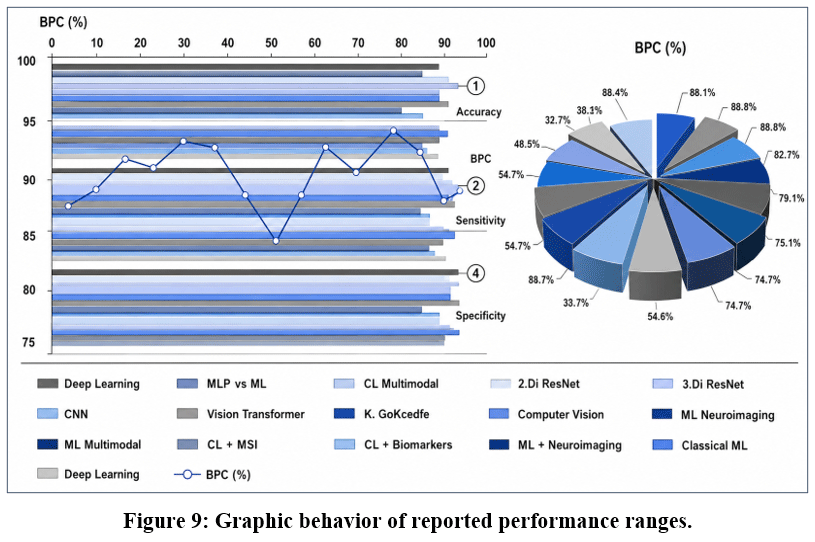 |
Figure 9: Graphic behavior of reported performance ranges. Click here to View Figure |
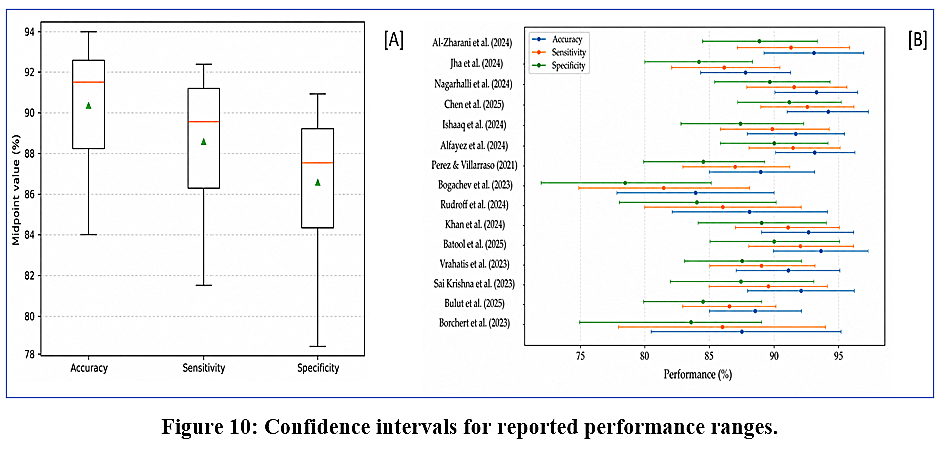 |
Figure 10: Confidence intervals for reported performance ranges. Click here to View Figure |
Analysis of the selected studies shows that AI models applied to AD achieve high performance, especially those based on deep learning and neuroimaging or multimodal data, with accuracy frequently exceeding 90%. However, a consistent pattern is observed in which sensitivity exceeds specificity, resulting in a high detection rate at the expense of increased false positives and reflecting shortcomings in clinical discrimination.
Furthermore, multimodal approaches demonstrate superior performance, supporting the multifactorial nature of the disease; however, their implementation is limited by challenges in data availability and integration. In contrast, behavioral and MEMs-based approaches are less accurate but offer considerable opportunities for developing translational frameworks.
Overall, despite significant progress, key challenges remain regarding generalizability, metric balancing, and clinical relevance, underscoring the need for more robust systems, particularly in experimental settings.
Limitations of Materials and Experimental Methods
The reviewed studies show substantial heterogeneity in experimental models, genetic backgrounds, disease-induction strategies, behavioral protocols, biomarkers, imaging procedures, and analytical endpoints. This variability limits comparability across studies and may cause AI models to capture experimental differences instead of disease-specific biological signals.
The frequent use of small, highly controlled datasets and limited standardization of experimental protocols also restrict reproducibility and external validity. Moreover, the predominance of unimodal measurements—behavioral, histopathological, biochemical, imaging, or electrophysiological—can prevent comprehensive characterization of AD’s multifactorial nature.
Limited cross-model and external validation, along with differences in biological correspondence among murine, other animal, and non-animal systems, constrain translational extrapolation. Future studies should prioritize standardized protocols, longitudinal and adequately powered datasets, harmonized endpoints, multimodal characterization, and independent validation to strengthen biological validity and translational relevance.
Systemic Limitations of AI in Preclinical AD Research
Despite the rapid advancement of AI in preclinical AD research, several systemic limitations constrain its reproducibility and translational impact. The lack of standardized datasets and experimental protocols, combined with the widespread use of small and highly controlled samples, limits model generalizability. In parallel, the predominance of unimodal approaches fails to capture the multifactorial nature of AD, while multimodal integration remains insufficiently developed.
Validation practices are frequently inadequate, with many studies reporting high performance without external validation or cross-species assessment, increasing the risk of overfitting and limiting translational reliability. Additionally, the black-box nature of advanced models restricts biological interpretability and clinical trust. These challenges are compounded by the inherent gap between MEMs and human pathology, which further hinders clinical translation.
Addressing these issues requires the development of standardized, multimodal, and interpretable AI frameworks supported by robust validation strategies and explicitly oriented toward translational applicability. These limitations reflect a broader lack of methodological convergence in AI-driven preclinical AD research.
Scope and Future perspectives
This SLR focuses on integrating AI into preclinical AD research, with an emphasis on MEMs given their relevance for modeling amyloid pathology, tau-related neurodegeneration, synaptic dysfunction, and cognitive decline. These models provide controlled, reproducible environments for evaluating AI-driven approaches across genetic, behavioral, biochemical, histopathological, and neuroimaging domains, supporting translational inference into human disease mechanisms.
Complementary evidence from other animal and non-animal models is incorporated for benchmarking and contextualization, enabling the identification of methodological gaps and cross-model limitations while maintaining murine systems as the analytical core. In addition, this review adopts a stage-aware perspective, aligning AI applications with the continuum of AD care from prevention to palliative stages.
Future research should prioritize the development of multimodal AI frameworks that integrate heterogeneous preclinical data into unified predictive architectures. The limited adoption of multimodal fusion, XAI, and real-time ES currently constrains model robustness, interpretability, and longitudinal monitoring capabilities. Moreover, the lack of standardized datasets, open data practices, and reproducible workflows restricts cross-study comparability and cumulative knowledge generation.
Advancing standardized, interpretable, and multimodal AI systems—supported by real-time monitoring and open, interoperable infrastructures—will be essential to enhance translational relevance and extend AI-assisted preclinical frameworks beyond AD to other neurodegenerative disorders.
Conclusion
This research highlights the relevance of analyzing pathological progression in preclinical models using adaptive AI systems. The integration of experimental techniques, standardized methodologies, and advanced measurement tools enables reliable and early disease monitoring, driven by evolutionary learning strategies geared toward predictive medicine. A total of 221 studies were reviewed, highlighting the value of utilizing open data and interdisciplinary approaches that integrate traditional methodologies with AI innovations.
This work emphasizes that the application of AI, through tools such as ML, ANN, NLP, CV, DL, EO, GM, and XAI, allows for the efficient modeling, prediction, and management of healthcare processes. However, this application extends to conditions such as Parkinson’s disease, amyotrophic lateral sclerosis, Lewy body dementia, and Huntington’s disease. Current research trends are driven by collaboration between AI and preclinical medical diagnosis to improve patient treatments in experimental models. Meanwhile, the SLR helps address methodological gaps and identify promising approaches by presenting key techniques and tools that meet essential requirements such as AI-assisted diagnosis, treatment, follow-up, and disease monitoring. The growing technological trend will enable us to generate translational validations in human patients in the short term. In addition, the most comprehensive research on the topic with open data was identified, where bibliographic reviews predominate because it is a trending topic with few technical applications.
This review not only provides a solid theoretical framework for developing strategies to address the disease but also lays the groundwork for future research aimed at improving any stage of its management. The findings highlight the importance of integrating emerging technologies to comprehensively address the challenges associated with this neurodegenerative disease worldwide.
Acknowledgement
The authors thank the Tecnológico Nacional de México, Orizaba Campus, for making the postdoctoral research possible. The authors express deep appreciation to the Industrial Engineering Master’s program for allowing them to use its laboratories.
Funding Sources
The authors gratefully acknowledge the Secretaría de Ciencia, Humanidades, Tecnología e Innovación (SECIHTI) for supporting the Postdoctoral Fellowship of Dr. Jonathan Josué Cid-Galiot under Grant SECIHTI/011/2025, which has significantly contributed to the advancement of the academic and research activities reported in this work.
We also extend our gratitude to the Secretaría de Educación, Ciencia, Tecnología e Innovación de la Ciudad de México (SECTEI) for funding the Postdoctoral Fellowship of Dr. Daniel Cuervo-Zanatta through Grant SECTEI/070/2024, whose support has been instrumental in enabling the scientific progress achieved in this study.
Furthermore, we acknowledge the Secretaría de Ciencia, Humanidades, Tecnología e Innovación (SECIHTI) for supporting the research of Dr. Ernesto Domínguez-Herrera under Grant CBF2023-2024-1721, which has fostered the continued development of this line of investigation.
Conflict of Interest
The authors do not have any conflict of interest.
Data Availability Statement
The data supporting the findings of this study are derived from previously published research articles and reviews indexed in the SCOPUS and Web of Science Core Collection databases. All datasets were obtained through systematic search queries combining the terms “Artificial Intelligence,” “Alzheimer’s Disease,” “Preclinical Frameworks,” and “Mouse Experimental Models.” No new datasets were generated or analyzed in this study. The full list of references used for data extraction and analysis is provided within the manuscript. For transparency and reproducibility, metadata and bibliographic records corresponding to the 221 selected studies are available upon reasonable request from the corresponding author.
Ethics Statement
This research did not involve human participants, animal subjects, or any material that requires ethical approval.
Informed Consent Statement
This study did not involve human participants, and therefore, informed consent was not required.
Clinical Trial Registration
This research does not involve any clinical trials.
Permission to reproduce material from other sources
Not Applicable.
Author Contributions
- Jonathan Josué Cid-Galiot: Conceptualization, Methodology, Software
- Alberto Alfonso Aguilar-Lasserre: Validation, Formal analysis, Investigation and Resources
- Daniel Cuervo-Zanatta: Data curation, Writing—original draft preparation, Writing—review and Editing
- Jose Ernesto Domínguez-Herrera: Visualization, Supervision and Project administration
- Armin Trujillo-Mata: Funding acquisition
References
- Alzheimer’s Research UK. Prevalence and incidence – Dementia Statistics Hub. Alzheimer’s Research UK. January 1, 2025. Accessed January 7, 2026. https://dementiastatistics.org/
- Li X, Feng X, Sun X, Hou N, Han F, Liu Y. Global, regional, and national burden of Alzheimer’s disease and other dementias, 1990–2019. Front Aging Neurosci. 2022;14. doi:10.3389/fnagi.2022.937486
CrossRef - Juarez-Cedillo T, Gonzelez-Figueroa E, Gutierez-Gutierez L, et al. Prevalence of Dementia and Main Subtypes in Mexico: The Study on Aging and Dementia in Mexico (SADEM). Journal of Alzheimer’s Disease. 2022;89(3). doi:10.3233/JAD-220012
CrossRef - scopus. Scopus busqueda AE 25. Published online January 22, 2026. Accessed January 21, 2026. https://www.scopus.com/results/results.uri?st1=Artificial+Intelligence+%2C+ Disease+Care%2C+Alzheimer %27 s%2C+Mouse+Experi-men-tal+Models.&st2=&s=TITLE-ABS-KEY%28%22Artificial+Intelligence%22+%22Alzheimer%27s%22+%22experimental%22%29&limit=10&origin=searchbasic&sort=plf-f&src=s&sot=b&sdt=b&sessionSearchId=18d20afd614726e75f6128544cb2c1f1
- Borchert RJ, Azevedo T, Badhwar AP, et al. Artificial intelligence for diagnostic and prognostic neuroimaging in dementia: A systematic review. Alzheimer’s and Dementia. 2023;19(12). doi:10.1002/alz.13412
CrossRef - Masuda A, Kobayashi Y, Itohara S. Automated, long-term behavioral assay for cognitive functions in multiple genetic models of alzheimer’s disease, using intellicage. Journal of Visualized Experiments. 2018;2018(138). doi:10.3791/58009
CrossRef - Martinez Cruz CS, Cid Galiot JJ, Badillo Márquez AE, Lasserre AAA. Techniques for Analyzing Soil Aggressiveness to Assess the Impact of Corrosion Using Artificial Intelligence on the Mechanical Integrity of Pipelines in the Oil and Gas Industry. J Press Vessel Technol. Published online 2026:1-15. doi:10.1115/1.4070691
CrossRef - Nguyen D, Uhlmann V, Planchette AL, et al. Supervised learning to quantify amyloidosis in whole brains of an Alzheimer’s disease mouse model acquired with optical projection tomography. Biomed Opt Express. 2019;10(6). doi:10.1364/boe.10.003041
CrossRef - Chabrier PE. Stratégies thérapeutiques et maladie d’Alzheimer : que peuvent apporter les modèles animaux ? Ann Pharm Fr. 2009;67(2). doi:10.1016/j.pharma.2008.11.002
CrossRef - Muskulus M, Scheenstra A, Braakman N, et al. Prospects for Early Detection of Alzheimers Disease from Serial MR Images in Transgenic Mouse Models. Curr Alzheimer Res. 2009;6(6). doi:10.2174/156720509790147089
CrossRef - Moon HS, Mahzarnia A, Stout J, et al. Predicting brain age and associated structural networks in mouse models with humanized APOE alleles using integrative and interpretable graph neural networks. In: 2024. doi:10.1117/12.3005695
CrossRef - Moon HS, Mahzarnia A, Stout J, et al. Feature attention graph neural network for estimating brain age and identifying important neural connections in mouse models of genetic risk for Alzheimer’s disease. Imaging Neuroscience. 2024;2. doi:10.1162/imag_a_00245
CrossRef - Perovic M, Ciric J, Matovic V, et al. The presymptomatic treatment with 3HFWC nanosubstance decreased plaque load in 5XFAD mouse model of Alzheimer’s disease. CNS Neurosci Ther. 2024;30(3). doi:10.1111/cns.14188
CrossRef - Bafana S. Exploring Novel Object Recognition and Spontaneous Location Recognition Machine Learning Analysis Techniques in Alzheimer’s Mice. Published online December 21, 2023. http://arxiv.org/abs/2312.06914
- Fadel L, Hipskind E, Ortiz C, et al. Modeling Behavior, Functional Connectomics, and Proteomics in a Mouse Model of Alzheimer’s Disease. In: 2024 ISMRM & ISMRT Annual Meeting. 2024. doi:10.58530/2024/4111
CrossRef - Miller SR, Luxem K, Lauderdale K, et al. Machine learning reveals prominent spontaneous behavioral changes and treatment efficacy in humanized and transgenic Alzheimer’s disease models. Cell Rep. 2024;43(11). doi:10.1016/j.celrep.2024.114870
CrossRef - Nisha A V., Rajasekaran MP, Rajeev SK, Wilson A, Sunil S, Soorya M. Advancements in Artificial Intelligence-Based Alzheimer’s Disease Classification Using Magnetic Resonance Imaging: A Comprehensive Review. In: 4th International Conference on Sustainable Expert Systems, ICSES 2024 – Proceedings. 2024. doi:10.1109/ICSES63445.2024.10763380
CrossRef - Kale M, Wankhede N, Pawar R, et al. AI-driven innovations in Alzheimer’s disease: Integrating early diagnosis, personalized treatment, and prognostic modelling. Ageing Res Rev. 2024;101. doi:10.1016/j.arr.2024.102497
CrossRef - Ünal C, Gökşen Y. INTEGRATING MACHINE LEARNING INTO ALZHEIMER’S RESEARCH: A CLINICAL DECISION SUPPORT SYSTEM APPROACH. Turk Geriatri Derg. 2025;28(2). doi:10.29400/tjgeri.2025.430
CrossRef - K Sai Krishna, Kangkan Jyoti Sarma, Kalyan Devappa Bamane, Jhakeshwar Prasad, Mohit Tiwari, T. Karthikeyan. Alzheimer Disease Detection using AI with Deep Learning based Features with Development and Validation based on Data Science. Journal of Advanced Zoology. 2023;44(S4). doi:10.17762/jaz.v44is4.2174
CrossRef - Babu B, Parvathy G, Mohideen Bawa FS, et al. Comparing the Artificial Intelligence Detection Models to Standard Diagnostic Methods and Alternative Models in Identifying Alzheimer’s Disease in At-Risk or Early Symptomatic Individuals: A Scoping Review. Cureus. Published online 2024. doi:10.7759/cureus.75389
CrossRef - Guo C, Chen Y, Ma C, Hao S, Song J. A Survey on AI-Driven Mouse Behavior Analysis Applications and Solutions. Bioengineering. 2024;11(11). doi:10.3390/bioengineering11111121
CrossRef - Wei M, Li Y, Liang M, Xi M, Tian H. Artificial Intelligence Approaches for Early Detection and Diagnosis of Alzheimer’s Disease: A Review. Academic Journal of Science and Technology. 2023;5(3). doi:10.54097/ajst.v5i3.8015
CrossRef - Song S, Li T, Lin W, Liu R, Zhang Y. Application of artificial intelligence in Alzheimer’s disease: a bibliometric analysis. Front Neurosci. 2025;19. doi:10.3389/fnins.2025.1511350
CrossRef - Zhao Q, Xu H, Li J, Rajput FA, Qiao L. The Application of Artificial Intelligence in Alzheimer’s Research. Tsinghua Sci Technol. 2024;29(1). doi:10.26599/TST.2023.9010037
CrossRef - Elghaieb I, Souid A, Zouinkhi A, Sakli H. Defeating Alzheimer’s: AI perspective from diagnostics to prognostics: Literature summary. In: Machine Learning and Deep Learning Techniques for Medical Image Recognition. 2023. doi:10.1201/9781003366249-14
CrossRef - Ghosh R, Cingreddy AR, Melapu V, Joginipelli S, Kar S. Application of Artificial Intelligence and Machine Learning Techniques in Classifying Extent of Dementia Across Alzheimer’s Image Data. International Journal of Quantitative Structure-Property Relationships. 2021;6(2). doi:10.4018/ijqspr.2021040103
CrossRef - Moridian P, Ghassemi N, Jafari M, et al. Automatic autism spectrum disorder detection using artificial intelligence methods with MRI neuroimaging: A review. Front Mol Neurosci. 2022;15. doi:10.3389/fnmol.2022.999605
CrossRef - Cheng F, Cummings J. Artificial Intelligence in Alzheimer’s Drug Discovery. In: Alzheimer’s Disease Drug Development. 2022. doi:10.1017/9781108975759.007
CrossRef - Wiltfang J, Esselmann H, Barnikol UB. The Use of Artificial Intelligence in Alzheimer’s Disease – Personalized Diagnostics and Therapy. Psychiatr Prax. 2021;48. doi:10.1055/a-1369-3133
CrossRef - Induchudan AK, Curran K. Machine learning strategies for predicting Alzheimer’s disease progression. Design+. 2025;2(3). doi:10.36922/dp025270031
CrossRef - Parvin S, Nimmy SF, Kamal MS. Convolutional neural network based data interpretable framework for Alzheimer’s treatment planning. Vis Comput Ind Biomed Art. 2024;7(1). doi:10.1186/s42492-024-00154-x
CrossRef - Khastehband S, Ghasempour Dabbaghi K, Khosravirad Z, et al. The Use of Artificial Intelligence in the Management of Neurodegenerative Disorders; Focus on Alzheimer’s Disease. Galen Medical Journal. 2023;12. doi:10.31661/gmj.v12i.3061
CrossRef - Silva-Spínola A, Baldeiras I, Arrais JP, Santana I. The Road to Personalized Medicine in Alzheimer’s Disease: The Use of Artificial Intelligence. Biomedicines. 2022;10(2). doi:10.3390/biomedicines10020315
CrossRef - Brabin DRD, Muralidharan J, Jagannathan SK, Kalangi RR. AI-enhanced drug discovery for Alzheimer’s. In: AI-Driven Alzheimer’s Disease Detection and Prediction. 2024. doi:10.4018/979-8-3693-3605-2.ch007
CrossRef - Bansal K, Goel S, Chauhan BC, Yadav S, Zehra MsFZ. Artificial Intelligence and Alzheimer’s Disease: Bridging Complexity with Precision Medicine. Journal Of Advanced Zoology. Published online 2024. doi:10.53555/jaz.v45i5.5206
CrossRef - Vrahatis AG, Skolariki K, Krokidis MG, Lazaros K, Exarchos TP, Vlamos P. Revolutionizing the Early Detection of Alzheimer’s Disease through Non-Invasive Biomarkers: The Role of Artificial Intelligence and Deep Learning. Sensors. 2023;23(9). doi:10.3390/s23094184
CrossRef - Batool Z, Hu S, Kamal MA, Greig NH, Shen B. Advancing Alzheimer’s Diagnosis with AI-Enhanced MRI: A Review of Challenges and Implications. Curr Neuropharmacol. 2025;23(14). doi:10.2174/011570159×353595250303064846
CrossRef - Gerasimov E, Karasev V, Umnov S, Chukanov V, Pchitskaya E. AI-Powered Mice Behavior Tracking and Its Application for Neuronal Manifold Analysis Based on Hippocampal Ensemble Activity in an Alzheimer’s Disease Mice Model. Int J Mol Sci. 2025;26(15). doi:10.3390/ijms26157180
CrossRef - Judd JM, Winslow W, McDonough I, Mistry F, Velazquez R. Modifying reaction time tasks parameters in the automated IntelliCage identifies heightened impulsivity and impaired attention in the 3xTg-AD model of Alzheimer’s disease. Front Aging Neurosci. 2024;16. doi:10.3389/fnagi.2024.1466415
CrossRef - Khan A, Zubair S, Shuaib M, Sheneamer A, Alam S, Assiri B. Development of a robust parallel and multi-composite machine learning model for improved diagnosis of Alzheimer’s disease: correlation with dementia-associated drug usage and AT(N) protein biomarkers. Front Neurosci. 2024;18. doi:10.3389/fnins.2024.1391465
CrossRef - Rudroff T, Rainio O, Klén R. AI for the prediction of early stages of Alzheimer’s disease from neuroimaging biomarkers – A narrative review of a growing field. Neurological Sciences. 2024;45(11). doi:10.1007/s10072-024-07649-8
CrossRef - Crețu OC, Cocu M, Popescu ER, Chiriță R. Artificial intelligence in Alzheimer’s diagnosis: A comprehensive review of biomarkers, neuroimaging, and machine learning applications. Bulletin of Integrative Psychiatry. 2024;103(4). doi:10.36219/bpi.2024.4.08
CrossRef - Bao K. Deep Learning Approaches for Early Alzheimer’s Detection Using Multimodal Imaging. MedScien. 2025;1(3). doi:10.61173/tsk47771
CrossRef - Christodoulou RC, Woodward A, Pitsillos R, Ibrahim R, Georgiou MF. Artificial Intelligence in Alzheimer’s Disease Diagnosis and Prognosis Using PET-MRI: A Narrative Review of High-Impact Literature Post-Tauvid Approval. J Clin Med. 2025;14(16). doi:10.3390/jcm14165913
CrossRef - Ganesh C, Harshavardhan G, Sri Keerthi NR, Veer Yabaji R, Yabaji R. Advancements in Alzheimer’s Disease Classification: Integrating Machine Learning, Neuroimaging, and Biomarkers. SCT Proceedings in Interdisciplinary Insights and Innovations. 2025;3. doi:10.56294/piii2025499
CrossRef - Quan L. AI neurotechnology compatibility with Alzheimers Disease Treatment: A Review. Theoretical and Natural Science. 2024;63(1). doi:10.54254/2753-8818/2024.17939
CrossRef - Neha Patwari, Sarvottam Dixit. Machine Learning Approaches in Alzheimer’s Disease: Early Diagnosis, Prognosis, and Treatment Optimization. Nanotechnol Percept. Published online 2024. doi:10.62441/nano-ntp.vi.3978
CrossRef - Bogachev M, Sinitca A, Grigarevichius K, et al. Video-based marker-free tracking and multi-scale analysis of mouse locomotor activity and behavioral aspects in an open field arena: A perspective approach to the quantification of complex gait disturbances associated with Alzheimer’s disease. Front Neuroinform. 2023;17. doi:10.3389/fninf.2023.1101112
CrossRef - Perez GA, Villarraso JC. Alzheimer identification through dna methylation and artificial intelligence techniques. Mathematics. 2021;9(19). doi:10.3390/math9192482
CrossRef - Aafiya, Jeyachidra. Advancing Alzheimer’s Disease Detection Harnessing Graph Convolutional Networks For Enhanced Early Identification. International Research Journal on Advanced Engineering Hub (IRJAEH). 2024;2(04). doi:10.47392/irjaeh.2024.0142
CrossRef - Olaoluwa M, Drira H, Abdallah I Ben, Harsan L, Mathis C. A Skeleton-based Geometric Deep Neural Network for Alzheimer’s Disease Mice Behavioral Analysis. In: 2025 IEEE 19th International Conference on Automatic Face and Gesture Recognition, FG 2025. 2025. doi:10.1109/FG61629.2025.11099128
CrossRef - Jullienne A, Noarbe BP, Keiser A, et al. Diffusion MRI alterations coincide with memory deficits in a novel hAβKI mouse model of Alzheimer’s Disease. Alzheimer’s & Dementia. 2022;18(S5). doi:10.1002/alz.062405
CrossRef - Hcini G, Jdey I, Dhahri H. Investigating Deep Learning for Early Detection and Decision-Making in Alzheimer’s Disease: A Comprehensive Review. Neural Process Lett. 2024;56(3). doi:10.1007/s11063-024-11600-5
CrossRef - Gu Z, Ge B, Wang Y, Gong Y, Qi M. Artificial intelligence technologies for enhancing neurofunctionalities: a comprehensive review with applications in Alzheimer’s disease research. Front Aging Neurosci. 2025;17. doi:10.3389/fnagi.2025.1609063
CrossRef - Subasi A. Use of artificial intelligence in Alzheimer’s disease detection. In: Artificial Intelligence in Precision Health: From Concept to Applications. 2020. doi:10.1016/B978-0-12-817133-2.00011-2
CrossRef - Garea-Llano E. Update on the Study of Alzheimer´s Disease Through Artificial Intelligence Techniques. Journal of Automation, Mobile Robotics and Intelligent Systems. Published online 2024. doi:10.14313//jamris/2-2023/15
CrossRef - Fabrizio C, Termine A, Caltagirone C, Sancesario G. Artificial intelligence for Alzheimer’s disease: Promise or challenge? Diagnostics. 2021;11(8). doi:10.3390/diagnostics11081473
CrossRef - Page MJ, McKenzie JE, Bossuyt PM, et al. The PRISMA 2020 statement: An updated guideline for reporting systematic reviews. BMJ. 2021;372. doi:10.1136/bmj.n71
CrossRef - Bulut N, Cakar T, Arslan I, Akinci ZK, Oner KS. Determination of Alzheimer’s Disease Stages by Artificial Learning Algorithms. Int J Stat Med Res. 2025;14. doi:10.6000/1929-6029.2025.14.50
CrossRef - Priya S, Sudhakar R, Patil KT, et al. Artificial Intelligence Based on Modelling for Prediction of Alzheimer’s Disease for Optimal Solution. International Journal of Basic and Applied Sciences. 2025;14(4). doi:10.14419/jabp2w78
CrossRef - Minal Abhijit Zope. AI-Based Techniques for Classifying Abnormalities Linked to Alzheimer’s Disease Progression. Journal of Information Systems Engineering and Management. 2025;10(23s). doi:10.52783/jisem.v10i23s.3715
CrossRef - Ali I, Manda VK. Artificial intelligence for predicting progression and personalizing healthcare to Alzheimer’s disease patients. In: AI-Driven Personalized Healthcare Solutions. 2025. doi:10.4018/979-8-3693-7858-8.ch006
CrossRef - Ismail Y, Vijaya Kumar Voleti. A Review on Usage of Artificial Intelligence for Early Detection and Management of Alzheimer’s Disease. Journal of Pharma Insights and Research. 2024;2(5). doi:10.69613/06tz7453
CrossRef - Vardhini KV, Vishnumolakala LD, Adithya Palanki SU, Yarramsetty M, Raja G. Alzheimer’s Research and Early Diagnosis Through Improved Deep Learning Models. In: 5th International Conference on Electronics and Sustainable Communication Systems, ICESC 2024 – Proceedings. 2024. doi:10.1109/ICESC60852.2024.10689869
CrossRef - Yang X, Xu X, Ying J. Research Trends in Application of Artificial Intelligence in Alzheimer’s Disease: Bibliometric and Visualization Analysis. In: 2024 IEEE 7th International Conference on Big Data and Artificial Intelligence, BDAI 2024. 2024. doi:10.1109/BDAI62182.2024.10692826
CrossRef - Samad A, Samet Aydı E. Rapid Alzheimer’s Disease Diagnosis Using Advanced Artificial Intelligence Algorithms. International Journal of Innovative Science and Research Technology (IJISRT). Published online 2024. doi:10.38124/ijisrt/ijisrt24jun1915
CrossRef - Sharma YK, Kumar R, Baig HA, Khatal SS. AI-powered paradigm shift: Non-invasive biomarkers for early detection of Alzheimer’s disease. In: AI-Driven Alzheimer’s Disease Detection and Prediction. 2024. doi:10.4018/979-8-3693-3605-2.ch006
CrossRef - Panwar D, Sharma P, Sharma S, Goyal M, Goyal K. Role of artificial intelligence in cognitive assessment and early detection of Alzheimer’s disease. In: AI-Driven Alzheimer’s Disease Detection and Prediction. 2024. doi:10.4018/979-8-3693-3605-2.ch013
CrossRef - Mathkunti NM, Rangaswamy S. Different smart diagnosis processes of Alzheimer’s brain disease using AI techniques. In: Smart Medical Imaging for Diagnosis and Treatment Planning. 2024. doi:10.1201/9781003464884-5
CrossRef - Kumari R, Ahmad T, Talaan A, Gola V, Das S, Singh RK. Advancing Early Diagnostic Accuracy for Alzheimer s Disease Through the Integration of Machine and Deep Learning Paradigms by Applying Multisource Datasets. Proceedings of International Conference on Intelligent Systems and New Applications. Published online 2024. doi:10.58190/icisna.2024.88
CrossRef - Subramanian K, Hajamohideen F, Viswan V, Shaffi N, Mahmud M. Exploring Intervention Techniques for Alzheimer’s Disease: Conventional Methods and the Role of AI in Advancing Care. Artificial Intelligence and Applications. 2024;2(2). doi:10.47852/bonviewAIA42022497
CrossRef - Kurmala LS, Devineni S, Kavuru T, Muvvala VV, Tokala S, Enduri MK. Cognitive Algorithms: Machine Learning’s Role in Alzheimer’s Early Detection. In: 2024 IEEE 9th International Conference for Convergence in Technology, I2CT 2024. 2024. doi:10.1109/I2CT61223.2024.10543850
CrossRef - Singh A, Maker M, Prakash J, Tandon R, Mitchell CS. What Threshold of Amyloid Reduction Is Necessary to Meaningfully Improve Cognitive Function in Transgenic Alzheimer’s Disease Mice? J Alzheimers Dis Rep. 2024;8(1). doi:10.3233/ADR-230174
CrossRef - Kaliappan S, Ali HM, Maranan R, Sunil G. Mining Healthcare Data for Predictive Modeling and Prognosis of Alzheimer’s Disease Progression with Artificial Intelligence. In: Proceedings of 2nd International Conference on Advancements in Smart, Secure and Intelligent Computing, ASSIC 2024. 2024. doi:10.1109/ASSIC60049.2024.10507808
CrossRef - Cherian I, Patil VC, Geeta, Adamuthe AC, Prasad KR, Vatsa M. Application of ANN and Machine Learning for the Detection of Alzheimer Disease (AD). In: Proceedings – 2024 International Conference on Healthcare Innovations, Software and Engineering Technologies, HISET 2024. 2024. doi:10.1109/HISET61796.2024.00066
CrossRef - Gambhir A, Bansal A, Rawat S, Sah A. Artificial intelligence and machine learning models for Alzheimer’s disease. In: Using Traditional Design Methods to Enhance AI-Driven Decision Making. 2024. doi:10.4018/979-8-3693-0639-0.ch004
CrossRef - Patwekar M, Patwekar F, Shaikh D, Fatema SR, Aher SJ, Sharma R. Receptor-based approaches and therapeutic targets in Alzheimer’s disease along with role of AI in drug designing: Unraveling pathologies and advancing treatment strategies. Applied Chemical Engineering. 2023;6(3). doi:10.24294/ace.v6i3.2338
CrossRef - Wang B, Cao S, Zhu X, et al. The application of artificial intelligence to Alzheimer45s disease: A new research hotspots and associated challenges. In: ACM International Conference Proceeding Series. 2023. doi:10.1145/3650215.3650394
CrossRef - Masarweh N, Darsey JA. Computational Modeling of New Drugs for the Treatment of Alzheimer’s Disease (AD) using Functional Correlations and Artificial Intelligence (AI). In: Challenges and Advances in Pharmaceutical Research Vol. 6. 2022. doi:10.9734/bpi/capr/v6/6555f
CrossRef - Subasi A, Kapadnis MN, Bulbul AK. Alzheimer’s disease detection using artificial intelligence. In: Augmenting Neurological Disorder Prediction and Rehabilitation Using Artificial Intelligence. 2022. doi:10.1016/B978-0-323-90037-9.00011-4
CrossRef - An Insight into the Role of Artificial Intelligence in the Early Diagnosis of Alzheimer’s Disease. Integrative Biomedical Research. 2025;9(1). doi:10.25163/biomedical.9110244
CrossRef - Mittal A, Tayal Y, Kansal S. Innovative Approach to Alzheimer Disease Detection. In: 2025 5th International Conference on Intelligent Technologies, CONIT 2025. 2025. doi:10.1109/CONIT65521.2025.11167783
CrossRef - Wang H. Research on an AI Model for Early Alzheimer’s Detection. Applied and Computational Engineering. 2025;116(1). doi:10.54254/2755-2721/2025.20588
CrossRef - Chen D, Yang H, Li H, He X, Mu H. MRI-based diagnostic model for Alzheimer’s disease using 3D-ResNet. Biomed Phys Eng Express. 2025;11(3). doi:10.1088/2057-1976/add73d
CrossRef - An X, He J, Bi B, et al. The application of artificial intelligence in diagnosis of Alzheimer’s disease: a bibliometric analysis. Front Neurol. 2024;15. doi:10.3389/fneur.2024.1510729
CrossRef - Nagarhalli TP, Patil S, Pande V, Aswalekar U, Patil P. A Novel Multimodal Framework for Early Detection of Alzheimer’s Disease Using Deep Learning. SSRG International Journal of Electronics and Communication Engineering. 2024;11(11). doi:10.14445/23488549/IJECE-V11I11P102
CrossRef - Govindarajan R, Sikamani TK, Kumar AK, Kumar KN. The Future of Neurodiagnostic: Deep Learning for Earlier Intervention. Journal of Machine and Computing. 2024;4(3). doi:10.53759/7669/jmc202404075
CrossRef - Ramani S, Madiajagan M, Maheshwari S, Saikia U. Unveiling Alzheimer’s early signs: AI-driven insights through neuroimaging and biomarkers. In: AI-Driven Alzheimer’s Disease Detection and Prediction. 2024. doi:10.4018/979-8-3693-3605-2.ch015
CrossRef - Jha SK, Vats S, Kaushik RS. Alzheimer’s Disease Detection: A Comparative Study of Machine Learning Models and Multilayer Perceptron. Applied Computer Systems. 2024;29(1). doi:10.2478/acss-2024-0012
CrossRef - Athira RS, Charles J. Alzheimer’s Disease Diagnosis – A Critical Appraisal of Technique. In: 2024 1st International Conference on Trends in Engineering Systems and Technologies, ICTEST 2024. 2024. doi:10.1109/ICTEST60614.2024.10576143
CrossRef - Ishaaq N, Nafis MT, Reyaz A. Leveraging deep learning for early diagnosis of Alzheimer’s using comparative analysis of convolutional neural network techniques. In: Driving Smart Medical Diagnosis Through AI-Powered Technologies and Applications. 2024. doi:10.4018/979-8-3693-3679-3.ch009
CrossRef - Al-Zharani M, Ansarullah SI, Al-Eissa MS, Dar GM, Alqahtani RA, Alkahtani S. Exploring the Efficacy of Deep Learning Techniques in Detecting and Diagnosing Alzheimer’s Disease: A Comparative Study. Journal of Disability Research. 2024;3(6). doi:10.57197/JDR-2024-0064
CrossRef - El-Sayed E. A Review of Machine Learning Techniques for Early Detection of Alzheimer’s disease. Metaheuristic Optimization Review. 2024;1(2). doi:10.54216/mor.010203
CrossRef - Zhang B, Fei Z, Zhou W, Fei M. A Systematic Review of Artificial Intelligence Techniques for Early Detection of Mild Cognitive Impairment in the Elderly. In: ACM International Conference Proceeding Series. 2023. doi:10.1145/3652628.3652808
CrossRef - Sharma S, Taggar T, Gupta MK. Early Detection of Alzheimer’s Disease Using Advanced Machine Learning Techniques: A Comprehensive Review. In: Smart Innovation, Systems and Technologies. Vol 364. 2024. doi:10.1007/978-981-99-5180-2_37
CrossRef - Ji Y. Deep learning-based artificial intelligence imaging probes for Alzheimers disease. Applied and Computational Engineering. 2023;17(1). doi:10.54254/2755-2721/17/20230901
CrossRef - Alfayez F, Rozov S, El-Tokhy MS. Accurate and Efficient Algorithm for Detection of Alzheimer Disability Based on Deep Learning. Cellular Physiology and Biochemistry. 2024;58(6). doi:10.33594/000000746
CrossRef - Ravi R, Sridevi TP, Devi NN, Mandadi S. Bridging the Gap: Integrating Machine Learning With Biomarkers for Enhanced Alzheimer’s Detection and Tracking. In: Deep Generative Models for Integrative Analysis of Alzheimer’s Biomarkers. 2024. doi:10.4018/979-8-3693-6442-0.ch001
CrossRef - Singh SG, Das D, Barman U, Saikia MJ. Early Alzheimer’s Disease Detection: A Review of Machine Learning Techniques for Forecasting Transition from Mild Cognitive Impairment. Diagnostics. 2024;14(16). doi:10.3390/diagnostics14161759
CrossRef
Accepted on: 22-09-2026
Second Review by: Dr. Ankur Vashi
Final Approval by: Dr. Eugene A. Silow