Recovery and Reuse of Deep Eutectic Solvents in Lignocellulosic Biomass Pretreatment: A Review in the Context of Circular Economy
 , Nathalia Saraiva Rios and Everaldo Silvino dos Santos*
 Department of Chemical Engineering, Federal University of Rio Grande do Norte, Natal, Brazil.
Corresponding Author E-mail: everaldo.santos@ufrn.br
DOI : http://dx.doi.org/10.13005/bbra/3443
Download this article as:

Lignocellulosic biomass, abundant and renewable, is a fundamental feedstock that can be explored for the production of bioproducts in a circular economy context, but its complex structure requires pretreatment to be valorized. Notably, conventional methods are generally limited by harsh conditions and the generation of toxic byproducts. Deep Eutectic Solvents (DES) emerge as a promising alternative, aligned with green chemistry, due to their ability to act selectively under mild conditions. They solubilize lignin and hemicellulose, exposing the cellulose for enzymatic saccharification. However, the large-scale viability of using DES critically depends on their recovery and reuse. This review article analyzes DES recovery strategies, discussing challenges such as their high viscosity and low volatility, aligned with the field of industrial biotechnology. Emphasis is given to methods such as antisolvent precipitation, membrane separation, and electrochemical techniques, highlighting that recovery is essential to reduce costs and enable circularity, consolidating DES as a key technology for a sustainable biorefinery.
KEYWORDS:Circular economy; DES (Deep eutectic solvents); Lignocellulosic biomass; Solvent recovery
Introduction
Lignocellulosic biomass, composed of agricultural, forestry, and agro-industrial residues, is one of the most abundant and underutilized raw materials on the planet. Its importance in the bioeconomy and renewable energy scenario is undeniable, as it represents a carbon-neutral and diversified source, capable of replacing fossil fuels and other petrochemical products.20 Unlike food crops such as corn and sugarcane, lignocellulosic biomass does not compete with food production, making it a more sustainable and ethical alternative for the production of second-generation biofuels, bioplastics, and a wide range of bioproducts.26
The transition to a circular and low-carbon economy requires the exploitation of renewable resources. In this context, lignocellulosic biomass stands out as a fundamental pillar. Its efficient use directly contributes to the reduction of greenhouse gas emissions, the valorization of waste, and the creation of new production chains.54 The use of this biomass is not limited to energy production; lignin, cellulose, and hemicellulose, its main components, can be fractionated and converted into high value-added products for the chemical, pharmaceutical, and materials industries, driving innovation and sustainable development.44
In Brazil, the relevance of lignocellulosic biomass is even more evident, given its vast availability in sectors such as sugarcane, forestry, and the pulp and paper industry.29 The search for more efficient and sustainable pretreatment technologies, such as the use of deep eutectic solvents, is key to unlocking the full potential of this biomass. By transforming waste into resources, the country can strengthen its position as a leader in the bioeconomy, generating jobs, promoting energy security, and contributing to the mitigation of climate change.10, 29
Although lignocellulosic biomass is an abundant resource, its complex and recalcitrant structure represents a major obstacle to its utilization. Cellulose, a glucose polymer, is organized into crystalline microfibrils and is encapsulated by an amorphous matrix of hemicellulose and, mainly, lignin.14 Lignin acts as a natural “glue,” providing rigidity and protection to the cellulose and hemicellulose fibers, but at the same time, it prevents enzymes or microorganisms from accessing the cellulose and converting it into fermentable sugars.36 This natural barrier is the main reason why pretreatment is such a fundamental step and often the bottleneck of the entire biorefinery process.54
To break down this intricate structure and release the biopolymers of interest, pretreatment is necessary. Conventional methods, such as acid hydrolysis, steam explosion, and ammonia treatment, are effective but have significant disadvantages.41 They often use extreme temperature and pressure conditions, which increase energy consumption and operating costs.3 In addition, many of these processes employ aggressive chemicals that, besides being hazardous, generate toxic byproducts, such as furans and phenolic compounds, which inhibit subsequent fermentation steps and negatively impact the environment.7
The complexity of biomass and the limitations of conventional methods highlight the urgency of seeking more efficient and sustainable alternatives. The search for a pretreatment that is capable of selectively disrupting biomass, with lower energy consumption and without generating inhibitors, is a critical challenge.32 Overcoming this bottleneck not only optimizes sugar yield, but also makes the process more economically viable and environmentally friendly, aligning bioproduct production with the principles of green chemistry.49
Given the limitations of conventional methods, a promising solution aligned with the principles of green chemistry has emerged in recent years: Deep Eutectic Solvents (DES). These represent an innovative class of solvents formed by mixing two or more solid components which, when combined in a specific proportion, create a mixture with a melting point much lower than that of its individual components.22,25 The “magic” behind this phenomenon lies in the intense hydrogen bonding interactions that occur between the molecules of the components, resulting in a new liquid phase under mild temperature and pressure conditions.41 The diagram in Figure 1 shows a general overview of the advantages and points to be considered when using DESs.
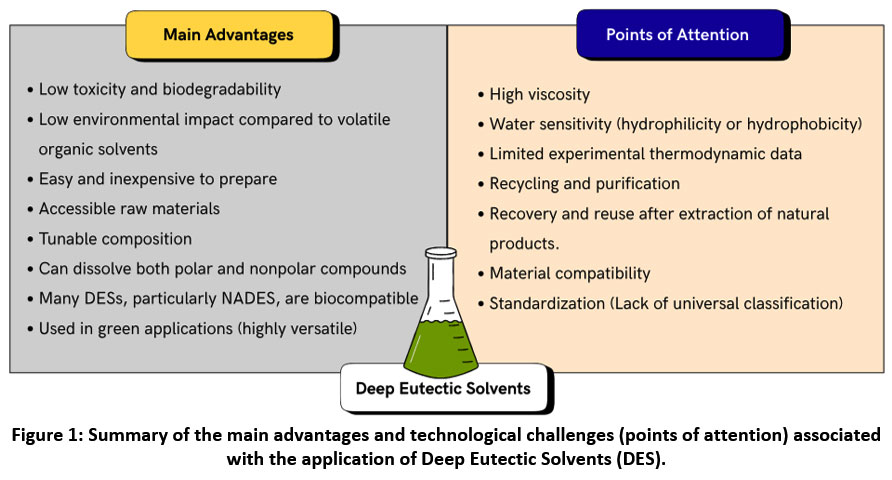 |
Figure 1: Summary of the main advantages and technological challenges (points of attention) associated with the application of Deep Eutectic Solvents (DES).Click here to view Figure |
The main advantage of DESs lies in their environmentally friendly nature. Unlike many traditional organic solvents, which are toxic and volatile, most DESs are composed of materials of natural origin, such as choline chloride, urea, citric acid, and glycerol.16 This composition gives them remarkable characteristics: they are biodegradable, have low toxicity, are renewable, and, in many cases, are low-cost. These properties position them as a sustainable and safe alternative for various industrial processes, including biomass pretreatment.38
The application of DESs in the pretreatment of lignocellulosic biomass is particularly attractive. Their ability to selectively dissolve lignin and hemicellulose, while preserving cellulose, simplifies subsequent steps and increases the efficiency of sugar production.22 The DES approach not only avoids the use of aggressive reagents and extreme conditions, but also offers a path to a cleaner and more efficient biorefinery.48 This technology represents an important step in creating industrial processes that not only seek productivity, but also environmental responsibility.
Despite the undeniable advantages, the large-scale adoption of DES faces a critical challenge: its long-term economic and sustainable viability. The cost of producing DES, although generally lower than that of many organic solvents, still represents a limiting factor if they are used in a disposable manner.2 The sustainability of a process is not measured only by the nature of its reagents, but by its entire life cycle. Therefore, for DES pretreatment technology to be truly aligned with the principles of the circular economy and bioeconomy, the solvent recovery and reuse step becomes not only desirable, but indispensable.24 This is the central thesis of this article: to demonstrate that efficiency in DES recycling is key to transforming a promising process into an industrially and environmentally viable solution.
This review article seeks to fill a gap in the scientific literature by consolidating and critically analyzing the recovery and reuse strategies of DESs in the context of lignocellulosic biomass pretreatment. Although the application of DESs for biomass deconstruction is a widely studied topic, in-depth discussion on the reuse of these solvents is still incipient and scattered. To achieve this objective, the work will address the fundamentals surrounding DESs, promising recovery strategies up to the year of writing this study, reuse evaluation and, above all, economic and environmental viability. Finally, it will identify the challenges and opportunities for research and development in the area, aiming at the scalability and optimization of recovery processes.
Fundamentals of DES Pretreatment
The main difference of DESs in the pretreatment of lignocellulosic biomass lies in their selective mechanism of action.6 This occurs at the molecular level, where the intense network of hydrogen bonds within the DES attacks the hydrogen bonds and intermolecular interactions of the biomass biopolymers. Lignin and hemicellulose, due to their more amorphous structure and richness in hydroxyl groups, are preferential targets.2 The components of DES, as hydrogen donors and acceptors, interact with the chains of these polymers, weakening and breaking the bonds that hold them together.6 This leads to their solubilization (lignin and hemicellulose), effectively removing them from the biomass matrix.
The selectivity of this process is what makes it so superior to conventional methods. Instead of simply degrading the entire biomass structure indiscriminately, DESs act as a “molecular tweezer,” removing the lignin and hemicellulose barriers that cover the cellulose.14 Cellulose, with its highly crystalline structure and microfibril organization, is less susceptible to these interactions, remaining in its solid, fibrous form.54 This targeted action not only facilitates the separation of components but also results in a cellulose-enriched solid residue, ready to be hydrolyzed.
The exposure of cellulose is key to the efficiency of the subsequent enzymatic saccharification step. With lignin and hemicellulose removed, cellulase enzymes have unimpeded access to the long cellulose chains.14 This dramatically increases the surface area available for enzymatic action, accelerating the conversion of cellulose into glucose. Compared to untreated biomass, material pretreated with DES exhibits significantly higher glucose yields, which optimizes the entire production process of biofuels and bioproducts.19
The ability to modulate the selectivity of DESs is another of their great advantages. By varying the components, such as choosing between choline chloride-urea, choline chloride-glycerol, or others, it is possible to optimize the pretreatment for different types of biomass and for different process objectives.18 For example, some DESs are more efficient at removing lignin, while others may be more suitable for hemicellulose. This flexibility allows biorefinery processes to be adjusted to maximize the yield of a specific product, whether it is glucose, xylose, or lignin.46
Thus, the mechanism of action of DESs is a clever combination of chemistry and engineering. It utilizes the unique properties of hydrogen bonds to selectively and efficiently overcome biomass recalcitrance.53 By dissolving lignin and hemicellulose, DESs transform biomass from a difficult-to-process material into a versatile platform for the production of a wide range of high value-added products, paving the way for a greener and more economically viable biorefinery.34
The diversity of DESs is one of their greatest advantages in biomass pretreatment. They are typically categorized based on their constituent components: a hydrogen bond acceptor (HBA), usually a quaternary ammonium salt such as choline chloride, and a hydrogen bond donor (HBD), which can be an amide (urea), an alcohol (glycerol), a carboxylic acid (citric acid), or a sugar 5, as illustrated in Figure 2. This modularity allows for the creation of a wide range of DESs with varying physicochemical properties and solubilization capabilities, making them ideal for different biomass types and process objectives.55
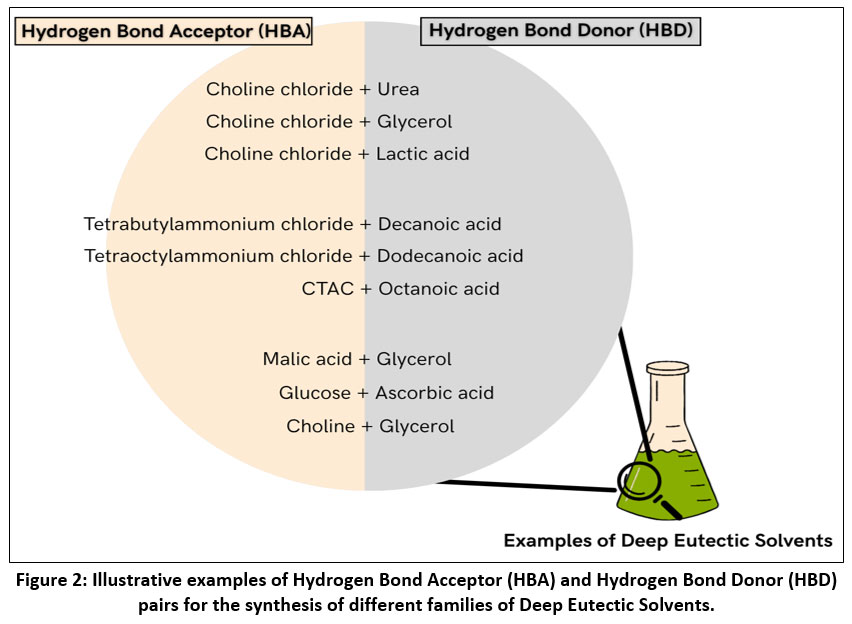 |
Figure 2: Illustrative examples of Hydrogen Bond Acceptor (HBA) and Hydrogen Bond Donor (HBD) pairs for the synthesis of different families of Deep Eutectic Solvents.Click here to view Figure |
The choice of DES directly impacts the outcome of the pretreatment, especially its selectivity. Choline chloride-based DESs combined with urea (ChCl-Urea) are among the most studied, as they are effective in lignin depolymerization.52 Their strong hydrogen interactions attack the bonds between lignin units, leading to significant solubilization. On the other hand, DES with HBDs containing hydroxyl groups, such as choline chloride-glycerol (ChCl-Glycerol), are more suitable for hemicellulose removal, as their hydroxyl groups interact efficiently with hemicellulose polymer chains.11
The ability of DES to selectively fractionate biomass is crucial for the success of the biorefinery. A more efficient DES in removing lignin, for example, will lead to a solid residue with a higher cellulose content, which can result in an increase in glucose yield in the enzymatic saccharification step.27 In addition, the recovered lignin can be a valuable product in itself, and choosing a DES with high selectivity for lignin facilitates this separation and subsequent valorization.52 Optimizing the DES composition is, therefore, a critical step to maximize the yield and economic viability of the entire process.
DES composition engineering is a powerful tool. It is not just about choosing a solvent, but about designing a system that maximizes pretreatment efficiency for the specific biomass in question. The wide range of HBA and HBD combinations allows researchers and engineers to adjust solvent properties to achieve specific goals, such as increased lignin removal, hemicellulose dissolution, or even the degradation of inhibitory compounds.39 This flexibility underscores the superiority of DES over conventional pretreatment methods, offering a more precise and efficient path to biomass valorization.
To achieve maximum efficiency in biomass pretreatment with DES, it is crucial to optimize process parameters. Three main factors exert a decisive influence: temperature, reaction time, and the solid-liquid ratio.57 Temperature, typically maintained in a mild range between 60°C and 120°C, is fundamental to increasing the fluidity of DES and accelerating hydrogen interactions, which facilitates the solubilization of lignin and hemicellulose.37 However, very high temperatures can lead to biomass degradation and the formation of undesirable compounds, such as inhibitory sugars, requiring careful balancing.57
Reaction time is another critical parameter that varies considerably. While some processes can be effective in a few hours, others may require days to achieve a satisfactory yield, depending on the recalcitrance of the biomass and the composition of the DES.1 A longer reaction time generally results in greater removal of lignin and hemicellulose, but it can also increase operating costs.11 Time optimization aims to find the balance between pretreatment efficiency and the economic viability of the process.
The solid-liquid ratio (the ratio of biomass to solvent) is crucial for process efficiency. A ratio with excess DES can increase solubilization, but it also raises costs and complexity in the recovery step.23 On the other hand, a ratio with too little solvent may not be sufficient to effectively deconstruct the biomass.18,39 Finding the ideal ratio is crucial to ensure that the DES has sufficient contact with the biomass to act, without incurring solvent waste.
When comparing pretreatment using DESs with conventional methods, the optimization of these parameters reveals the superiority of DESs. While acid hydrolysis and steam explosion often require extreme temperature conditions (above 180°C) and high pressures, DES pretreatment operates under much milder conditions.27 This gentler approach not only reduces energy consumption but also minimizes the degradation of biomass components, resulting in a purer, inhibitor-free material. The lower severity of the DES process makes it a safer and more environmentally friendly option.23
In summary, the ideal combination of temperature, time, and solid-liquid ratio is key to maximizing the potential of DESs as a biomass pretreatment technology. The ability to adjust these parameters for different feedstock types and specific biorefinery objectives demonstrates the flexibility and efficiency of DESs. By operating under milder conditions and offering superior control over selectivity, DES pretreatment establishes itself as a competitive and more sustainable alternative to traditional methods, paving the way for a new generation of biorefineries.
The Challenge of Recovery and Reuse and Strategies
The industrial-scale adoption of DESs in biomass pretreatment critically depends on a step that transcends the efficiency of the process itself: solvent recovery and reuse. Although DESs are praised for their “green” character, their disposal after a single use cycle would negate much of their advantages.30 From an economic standpoint, producing new batches of solvent for each treatment cycle is unsustainable.18 The cost of components, the energy consumed in synthesis, and the expenses for waste disposal make the process economically unviable on a large scale, transforming DES from a promising solution into a financial obstacle. The diagram in Figure 3 illustrates the common steps in the use of solvents in the pretreatment of lignocellulosic biomass to obtain bioproducts and focuses on the recovery and reuse of these solvents.
Beyond the financial aspect, the reasons for recovery are deeply rooted in environmental issues. The philosophy of green chemistry advocates reducing waste generation and using renewable raw materials. Discarding large volumes of DES after use, even if they are biodegradable, contradicts this philosophy and overburdens wastewater treatment systems. On the other hand, solvent recovery and reuse minimize the need to extract or synthesize new components, reducing the carbon footprint and environmental impact associated with the production and transportation of chemicals.4
However, recovering DES is not a simple task. Their unique physicochemical properties, which make them efficient for pretreatment, also create significant challenges in their recycling.42 One of the biggest difficulties is their low volatility, which makes separation techniques based on simple distillation unfeasible. They do not evaporate easily, requiring more complex and often more energy-intensive methods to be separated from solid and liquid biomass residues.8
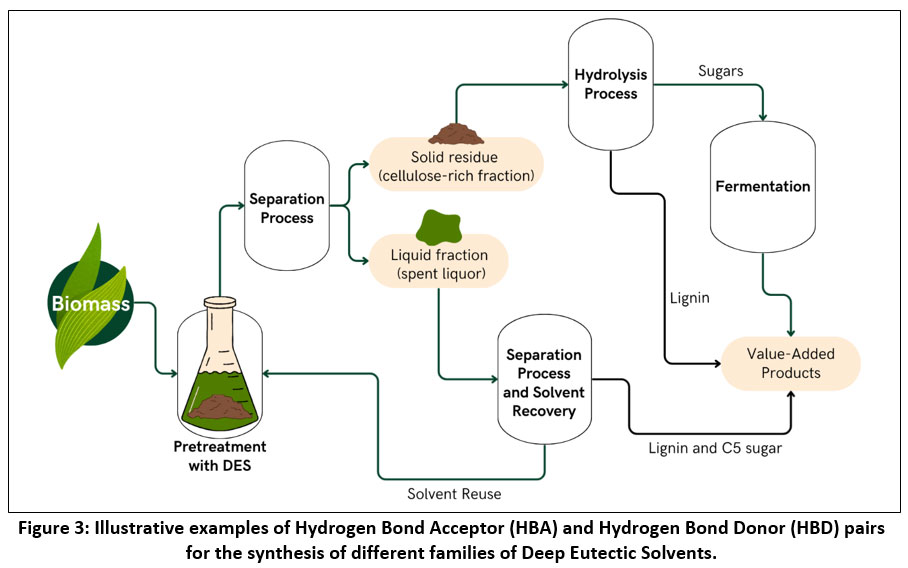 |
Figure 3: Illustrative examples of Hydrogen Bond Acceptor (HBA) and Hydrogen Bond Donor (HBD) pairs for the synthesis of different families of Deep Eutectic Solvents.Click here to view Figure |
Another challenge is the high viscosity of DES, which makes handling and pumping in filtration and separation systems difficult. Its thick consistency, especially at lower temperatures, can clog membranes and pipes, requiring the application of heat or dilution, which, in turn, adds another layer of complexity to the process.47 This viscosity also makes the separation of biomass residues (cellulose and lignin) from the solvent a slower and less efficient process.54
Finally, miscibility with water is an ambivalent property. Although water is often used as a medium to initiate pretreatment or to precipitate components, miscibility in some proportions makes the separation of DES from the aqueous phase a complex task.43 Removing water to recover pure solvent for reuse can require high-energy processes, such as vacuum distillation, or membrane separation techniques, which increases the costs and environmental footprint of the recovery cycle.56 It is for these reasons that the search for efficient recovery methods is so crucial for the viability of the process.
The implementation of a closed loop reduces reagent consumption, minimizes effluent generation, and significantly lowers the operating costs of the biorefinery process. Different strategies have been developed for this purpose, varying in operating principle, efficiency, and energy consumption. The choice of recovery method largely depends on the composition of the DES, the biomass used, and the products of interest. Among the most explored techniques are antisolvent recovery, membrane separation, and vacuum distillation, each with its own particularities and challenges (Table 1).
Table 1: Selected studies and their DES recovery/reuse methods.
| Biomass | DES | Reuse/Recovery Method | Yield and Cycles |
| eucalyptus wood chips 8 | Lactic acid and choline chloride (10:1 molar) 8 | Lignin and xylan recovered by precipitation in water; the solvent was regenerated by removing water through evaporation. 8 | 92.86% (in the 2-stage process), 86.34% (in the 3-stage process) 8 |
| Rice straw (RS) 31 | Choline chloride, p-toluenesulfonic acid, and ethylene glycol (1:0–2:9) 31 | Reuse and recyclability are mentioned, but the methods are not specified. 31 | The ternary DES showed good recyclability (85% w/w) after 2 reuses. 31 |
| Sugarcane bagasse 12 | Lactic acid and choline chloride 12 | Recovery via antisolvent using ethanol 12 | It could be reused 6 times: glucose and xylose yields from the pretreated biomass remained good, although lignin removal efficiency decreased. 12 |
| Radiata pine 45 | Benzyltrimethylammonium/formic acid 45 | Lignin precipitation; the solvent was concentrated using a rotary evaporator to remove water. 45 | Yield reported as lignin recovery (>60%) and enzymatic saccharification (>70%) after five reuse cycles. 45 |
| Poplar wood 13 | Glycerol, choline chloride, and sulfuric acid 13 | Lignin precipitation; solvent concentrated with a rotary evaporator to remove water. 13 | After five batches, cellulose yield remained above 70%. Also used as a substrate for Rhodotorula glutinis. 13 |
| Pineapple leaf residue 35 | Choline chloride and ethylene glycol (1:5) 35 | Recycled using a rotary evaporator and reused for five subsequent pretreatment cycles. 35 | About 50% cellulose yield after 5 reuses. 35 |
| Corncob 47 | Choline chloride and oxalic acid 47 | Ethanol addition, water addition, and filtration processes to recover and reuse the DES (3 different methods). 47 | After 10 recycles (method 3), good values were maintained: 66.23% digestibility and 64.43% glucose recovery, compared to 72.83% and 68.83% of the fresh DES. 47 |
| Poplar wood (Populus sp.) 53 | Glycerol + Choline chloride + Phosphoric acid 53 | Direct reuse of DES in fermentation and pretreatment 53 | ≥3 cycles without significant loss; Hydrolysis ~85%, Ethanol ~25 g/L, Lipids ~7 g/L. 53 |
| Hybrid Panicum 42 | Glycerol + Choline chloride + Iron(III) chloride 42 | Purification and reuse via extraction (ethyl acetate) 42 | 5 cycles with 99.5% enzymatic hydrolysis and 78.9% lignin removal. 42 |
| Air-dried birch (Betula pendula) 17 | Choline chloride and lactic acid (1:9) 17 | Comparison of membrane recovery with low solvent addition (DES:ethanol 1:0.7) vs. antisolvent + evaporation. 17 | Antisolvent (A) was more effective than membrane (M). Lignin extraction efficiency (LEE) for A dropped from 82% to 74% after 2 cycles; M dropped to 62%. Additional purification (more antisolvent) and lactic acid adjustment restored LEE to ~78%. 17 |
| Poplar chips 56 | Lactic acid and choline chloride (9:1) 56 | Purification of recycled DES (obtained via vacuum distillation) using activated carbon adsorption. 56 | DES recycled 5 times without purification had delignification drop from 90% to 76%. Purified recycled DES (R5) restored efficiency to 88%, close to fresh DES. 56 |
| Napier grass (Elephant grass) 28 | (1) Choline chloride + Lactic acid (2) Choline chloride + Glycerol (3) Choline chloride + Urea 28 |
Rotary evaporation to remove ethanol (from washing) and water; recovered DES reused directly. 28 | The simple recovery method (no purification) was not effective for any of the three DESs. 28 |
| Triarrhena lutarioriparia (TL) 50 | Choline chloride and oxalic acid dihydrate (with CO₂) 50 | Ethanol addition, vacuum filtration of solids (biomass), water addition to the concentrated solution to precipitate lignin. Filtration of lignin and vacuum evaporation of the final filtrate. 50 | DES was recycled five times. DES recovery remained high at 87.69% after the 5th cycle. Enzymatic digestibility remained excellent (81.10% in the 5th cycle vs. 83.71% fresh). DES structure remained stable. 50 |
| Eucalyptus (E. grandis × E. urophylla) 40 | Choline chloride, phenol, and formic acid (1:0.05:2 molar ratio) 40 | Ethanol removal (from washing) by evaporation. Lignin precipitation with deionized water. Lignin separation, water removal via rotary evaporator, and pH adjustment with formic acid. 40 | DES recycled 5 times maintained excellent performance. Glucose yield: 95.69% in the 5th cycle, close to 99.51% fresh. Lignin removal (75.39%) and hemicellulose removal (81.90%) also remained high. 40 |
| Rice straw 55 | Lactic acid and ethylene glycol (1:1 molar ratio) 55 | Controlled chemical methodology: Ultrafiltration (UF) to remove lignin/impurities, and Bipolar Membrane Electrodialysis (BMED) to separate lactic acid (migrates) from ethylene glycol (retained). 55 | DES recovery reached 97.6%. Regenerated DES was reused 4 times and maintained pretreatment performance comparable to fresh DES. Method shown to be economically viable. 55 |
The antisolvent recovery method is certainly the most common and widely reported in literature. The principle is based on the addition of a solvent, typically water or ethanol, in which the dissolved lignin is insoluble, while the DES components remain soluble. This induces selective precipitation of lignin, which can then be removed by physical processes such as centrifugation or filtration. Virtually all the analyzed studies that performed recycling employed this approach, using water 47, 50, 56 or ethanol/acetone solutions 42, 47 as an antisolvent. The popularity of this method lies in its simplicity and high efficiency in separating lignin, allowing DES to be reused in multiple cycles while maintaining a high pretreatment capacity.
Despite its effectiveness in lignin precipitation, the subsequent step of removing the antisolvent to regenerate DES presents a challenge. Commonly, the DES and antisolvent mixture is subjected to vacuum distillation or rotary evaporation to remove the most volatile component (water or ethanol). Although functional, this evaporation process is energy-intensive, as already mentioned, which can negatively impact the overall energy balance of the biorefinery. A notable gap in many studies is the predominant focus on the efficiency of pretreatment with recycled DES, to the detriment of a rigorous quantification of the solvent recovery yield itself. Works such as those by Sharma et al.35 and Panakkal et al.28 demonstrate the maintenance of delignification capacity for several cycles, but do not specify the mass percentage of DES recovered, crucial information for assessing the industrial scalability of the process.
To overcome the high energy demand of evaporation, membrane separation technologies emerge as a promising alternative. These methods, such as ultrafiltration, use membranes with pores of specific sizes to separate dissolved lignin and hemicellulose macromolecules from the low molecular weight components of DES. Wang et al.40 successfully demonstrated the application of ultrafiltration to purify a lactic acid and phenol-based DES, achieving a recovery rate greater than 95%. This approach not only avoids the phase change associated with evaporation, reducing energy consumption, but also allows for continuous and efficient separation, representing a significant technological advancement for DES recycling.
In an even more advanced line of innovation, electrochemical methods have been proposed for the controlled recovery of DES components. Zhang et al.55 developed a pioneering methodology using Bipolar Membrane Electrodialysis (BMED) to recover a DES composed of lactic acid and ethylene glycol. This system applies an electric field to selectively separate the acidic component (hydrogen bond donor) and the alcoholic component (hydrogen bond acceptor) with very high purity, achieving a recovery yield of 97.6%. The great advantage of this technique is the recovery of DES constituents separately and with low energy consumption, completely eliminating the need for water evaporation steps and solvent composition readjustment. 55
In conclusion, although precipitation with antisolvent followed by evaporation is the dominant strategy, its high energy cost and the lack of detailed data on recovery yields represent barriers to its large-scale application. Emerging technologies, such as membrane separation and electrodialysis, offer more sustainable and efficient pathways, with high recoveries and lower energy consumption. It is also noted that alternative strategies, such as valorizing effluent containing DES as a culture medium for fermentation53, can circumvent the need for recovery by integrating the solvent directly into a biorefinery process cascade. In this context, future research should therefore focus not only on optimizing pretreatment but also on the techno-economic and life cycle analysis of different recovery routes to determine the most viable solutions for the industrialization of DES-based processes.
Economic and Environmental Feasibility Analysis
The feasibility of any emerging technology, especially in an area as competitive as biorefineries, cannot be assessed solely by its technical efficiency.21 DESs are undoubtedly promising in biomass pretreatment, but their large-scale adoption depends on a favorable balance between cost and environmental benefit. The feasibility analysis must go beyond laboratory performance and consider the complete process cycle, including the solvent recovery and reuse step.47
From an economic standpoint, the implementation of a DES recovery step, while adding an initial operational cost, is absolutely crucial for the long-term financial sustainability of the process. Without recovery, the cost of disposable solvent would make the production of low-value-added biofuels and bioproducts unfeasible.50 The investment in separation equipment and the energy consumed in the recycling process are offset by savings on the continuous purchase of new batches of solvent, transforming a recurring expense into a reusable asset.
Cost optimization becomes evident as the number of reuse cycles increases. Research shows that, depending on the DES and biomass, it is possible to reuse the solvent for multiple cycles without significant loss of efficiency.40,55 Each additional reuse cycle dilutes the initial cost of the solvent and recovery infrastructure over a larger number of production batches. This means that, as the technology improves, the marginal cost of solvent per unit of biomass processed tends to zero, making production more competitive.
From an environmental perspective, the feasibility analysis of a process using DES should be guided by the concept of Life Cycle Assessment (LCA). LCA evaluates the environmental impact of a product or process from raw material extraction to its final disposal.33 When considering the complete life cycle, it becomes clear that the reuse of DES has a significant positive impact. Without recovery, the continuous production of new batches of DES, even from renewable sources, consumes energy and resources, generating a considerable carbon footprint.51
The reuse of DES directly impacts the carbon footprint of the process. The synthesis of new solvents, although based on components such as urea or choline, still requires energy and often transportation.28 By reusing the solvent, the need to produce new substances is drastically reduced, resulting in a substantial decrease in greenhouse gas emissions associated with chemical production. The energy savings in synthesis outweigh the energy consumption of the recovery step, which consolidates the process as a cleaner option.15
Another crucial environmental benefit of recovery is the reduction in the generation of liquid effluents. Conventional pretreatment methods often generate large volumes of liquid waste, which are expensive and complex to treat.53 DES recycling, especially when carried out by methods such as membrane separation or antisolvent extraction, minimizes the formation of contaminated effluents.17,56 The solid residue from the biomass is separated from the solvent, which is recovered, and the effluents that are generated have a more controllable composition.
Therefore, it is important to emphasize that the economic and environmental viability of DES pretreatment processes is intrinsically linked to their ability to operate in a closed loop. Investment in recovery and reuse is not an additional cost, but rather a fundamental step in transforming a promising technology into a sustainable and economically competitive solution. By adopting the circular economy, DES pretreatment not only improves process efficiency but also establishes a new standard for the biorefinery industry, where environmental responsibility and economic success go hand in hand.
Conclusion and Future Perspectives
The recovery and reuse of DESs are steps that transcend mere process optimization; they are the essence of the economic and environmental viability of large-scale biomass pretreatment. Investment in recycling technologies, while adding an initial operating cost, is quickly offset by savings in the purchase of new solvents, reduced waste generation, and a decreased carbon footprint of the process. The ability to reuse DES for multiple cycles without significant loss of efficiency consolidates the technology as a circular economy solution, where the solvent becomes a valuable asset, not a disposable consumable. Life cycle analysis (LCA) confirms that the reuse of DES is fundamental to positioning the technology as a superior alternative to conventional methods, which generate large volumes of effluent and consume more energy under harsh conditions.
Despite the advances, research and development in this field still face considerable challenges. The antisolvent precipitation method, widely used due to its simplicity, often requires an energy-intensive evaporation step for solvent regeneration, which can compromise the overall energy balance of the process. In addition, a gap in the literature is the lack of rigorous data on recovery yield in many studies, which hinders the assessment of industrial scalability. To overcome these barriers, it is essential that future research focuses not only on pretreatment efficiency but also on a detailed quantification of the recovered solvent mass and a techno-economic analysis of the entire cycle.
The future prospects for DES recovery are promising and lie in innovative technologies that minimize energy demand. Membrane separation, for example, has already proven to be a highly efficient and low-energy alternative, capable of purifying DES from dissolved components without the need for phase change. Most notably, electrochemical techniques, such as bipolar membrane electrodialysis (BMED), are emerging as a frontier of innovation, allowing for the selective recovery of individual DES components with very high purity and low energy consumption, eliminating the need for composition readjustment.
Future research should therefore focus on integrating advanced recovery methods with the pretreatment process. It is necessary to explore the combination of different techniques to create more efficient and robust systems, optimizing both solvent recovery and the valorization of biomass residues, such as lignin. In addition, strategies that explore the use of effluent containing DES directly in subsequent steps, such as fermentation, can circumvent the need for recovery, integrating the solvent into a cascade of biorefinery processes. The journey towards the industrialization of DES is a journey of continuous innovation, where each advance in recovery and reuse consolidates the role of technology as a pillar for the sustainable production of biofuels and bioproducts.
Acknowledgement
The authors gratefully acknowledge Federal University Of Rio Grande do Norte (Brazil) for all the support
Funding Sources
The author(s) received no financial support for the research, authorship, and/or publication of this article.
Conflict of Interest
The authors do not have any conflict of interest.
Data Availability Statement
This statement does not apply to this article.
Ethics Statement
This research did not involve human participants, animal subjects, or any material that requires ethical approval.
Informed Consent Statement
This study did not involve human participants, and therefore, informed consent was not required.
Clinical Trial Registration
This research does not involve any clinical trials.
Permission to reproduce material from other sources
Not Applicable
Author Contributions
Leonardo G. de Medeiros: Conceptualization, Visualization, Methodology, Writing;
Nathalia S. Rios: Visualization, Supervision, Review.
Everaldo S. dos Santos: Visualization, Supervision, Review.
Reference
- Amesho K. T., Lin Y. C., Mohan S. V., Halder S., Ponnusamy V. K., Jhang S. R. Deep eutectic solvents in the transformation of biomass into biofuels and fine chemicals: a review. Environmental Chemistry Letters. 2023;21(1):183-230. DOI: https://link.springer.com/article/10.1007/S10311-022-01521-X.
CrossRef - Bajpai P. Deep eutectic solvents for pretreatment of lignocellulosic biomass. 2021;2191-5318. Singapore: Springer. DOI: https://link.springer.com/book/10.1007/978-981-16-4013-1.
CrossRef - Beluhan S., Mihajlovski K., Šantek B., Ivančić Šantek M. The production of bioethanol from lignocellulosic biomass: Pretreatment methods, fermentation, and downstream processing. Energies. 2023;16(19):7003. DOI: https://doi.org/10.3390/en16197003.
CrossRef - Bhagwat P., Amobonye A., Singh S., Pillai S. Deep eutectic solvents in the pretreatment of feedstock for efficient fractionation of polysaccharides: current status and future prospects. Biomass Conversion and Biorefinery. 2022;12(Suppl 1):171-195. DOI: https://link.springer.com/article/10.1007/ s13399-021-01745-x.
CrossRef - Bjelić A., Hočevar B., Grilc M., Novak U., Likozar B. A review of sustainable lignocellulose biorefining applying (natural) deep eutectic solvents (DESs) for separations, catalysis and enzymatic biotransformation processes. Reviews in Chemical Engineering. 2022;38(3),243-272. DOI: https://www.degruyterbrill.com/document/doi/10.1515/revce-2019-0077/html.
CrossRef - Cai J., Xue J., Li Y., Wei L., Lin N., Zha, X. Research progress on high-value-added application of lignocellulosic biomass based on deep eutectic solvent pretreatment. Biomass Conversion and Biorefinery. 2024;14(24):30913-30928. DOI: https://link.springer.com/article/10.1007/s13399-023-04972-6.
CrossRef - Chakraborty P., Kumar R., Chakrabortty S. et al. Technological advancements in the pretreatment of lignocellulosic biomass for effective valorization: A review of challenges and prospects. Journal of Industrial and Engineering Chemistry. 2024;137:29-60. DOI: https://doi.org/10.1016/ j.jiec.2024.03.025.
CrossRef - Chen Y., Shen K., He Z., et al. Deep eutectic solvent recycling to prepare high purity dissolving pulp. Cellulose. 2021;28(16):11503–11517. DOI: https://doi.org/10.1007/s10570-021-04188-9.
CrossRef - Chen Z., Wang Y., Cheng H., Zhou H. Hemicellulose degradation: An overlooked issue in acidic deep eutectic solvents pretreatment of lignocellulosic biomass. Industrial Crops and Products. 2022; 187:115335. DOI: https://doi.org/10.1016/j.indcrop.2022.115335.
CrossRef - Das N., Jena P. K., Padhi D., Kumar M. M., Sahoo G. A comprehensive review of characterization, pretreatment and its applications on different lignocellulosic biomass for bioethanol production. Biomass conversion and biorefinery. 2023;13(2):1503-1527. DOI: https://doi.org/10.1007/s13399-021-01294-3.
CrossRef - Gundupalli M. P., Sahithi S. A., Jayex E. P. et al. Combined effect of hot water and deep eutectic solvent (DES) pretreatment on a lignocellulosic biomass mixture for improved saccharification efficiency. Bioresource Technology Reports. 2022;17:100986. DOI: https://doi.org/10.1016/j.biteb.2022.100986.
CrossRef - Haokok C., Lunprom S., Salakkam A. Delignification of sugarcane bagasse using deep eutectic solvent (DES) for efficient saccharification: Efficiency and reusability of DES. Journal of Environmental Chemical Engineering. 2025;13(5):118292. DOI: https://doi.org/10.1016/j.jece.2024.118292.
CrossRef - He C., Zhang L., Zhao X. et al. Pretreatment of multiple lignocellulosic batches with recoverable and fermentable deep eutectic solvent (FDES) for co-production of sugar, lignin and lipid. Renewable Energy, 2024;229:120745. DOI: https://doi.org/10.1016/j.renene.2024.120745.
CrossRef - Huang C., Liu J., Geng W., Tang W., Yong Q. A review of lignocellulosic biomass pretreatment technologies. Paper and Biomaterials. 2021;6(3);61-76. DOI: https://doi.org/10.1213/j.issn.2096-2355.2021.03.007.
- Huang R., Han Q., Bi H. et al. Sustainable lipid recovery from microalgae via hydrothermal pretreatment with natural deep eutectic solvents: Molecular design, mechanistic insights, and life cycle assessment. ACS Sustainable Chemistry & Engineering. 2025; 13(23):8805–8816. DOI: https://doi.org/10.1021/acssuschemeng.5c03419.
CrossRef - Hussain M., Ashraf H. T., Vasudev V. et al. Deep eutectic solvents in biomass pretreatment for green approach: a comprehensive review. Polymer Bulletin. 2025;82:10513–10552. DOI: https://doi.org/10.1007/s00289-025-05955-5.
CrossRef - Ippolitov V., Anugwom I., Mänttäri M., Kallioinen-Mänttäri M. Comparison between membrane filtration and antisolvent addition methods for the recovery and recycling of a deep eutectic solvent after biomass pretreatment. Industrial Crops and Products. 2025;226:120755. DOI: https://doi.org/10.1016/j.indcrop.2025.120755.
CrossRef - Isci A., Kaltschmitt M. Recovery and recycling of deep eutectic solvents in biomass conversions: A review. Biomass Conversion and Biorefinery. 2022;12(Suppl 1):197-226. DOI: https://link.springer.com/article/10.1007/s13399-021-01860-9.
CrossRef - Jančíková V., Jablonský M. Exploiting deep eutectic solvent-like mixtures for fractionation biomass, and the mechanism removal of lignin: a review. Sustainability. 2024;16(2):504. DOI: https://doi.org/10.3390/su16020504.
CrossRef - Kumar R., Kumar N., Saini S., Singh C., Barnwal P., Panghal A. Ethanol from lignocellulosic biomass: pretreatment challenges and opportunities in sustainable waste management and energy Production. Biofuels, Bioproducts and Biorefining. 2025;19(6):2712-2738. DOI: https://doi.org/10.1002/bbb.70039.
CrossRef - Kumar A. K., Sharma S., Dixit G., Shah E., Patel A., Boczkaj G. Techno‐economic evaluation of a natural deep eutectic solvent‐based biorefinery: Exploring different design scenarios. Biofuels, Bioproducts and Biorefining. 2020;14(4):746-763. DOI: https://doi.org/10.1002/bbb.2110.
CrossRef - Li P., Yang C., Jiang Z., Jin Y., Wu W. Lignocellulose pretreatment by deep eutectic solvents and related technologies: A review. Journal of Bioresources and Bioproducts. 2023;8(1):33-44. DOI: https://doi.org/10.1016/j.jobab.2022.11.004.
CrossRef - Liu J., Jiang X., Li Z., Li N., Li T. Parametric studies on pretreatment of lignocellulosic biomass via deep eutectic solvents: Enhancing densified pellet quality. Industrial Crops and Products. 2024;208:117850. DOI: https://doi.org/10.1016/j.indcrop.2023.117850.
CrossRef - Mehta J. P., Metre A. V., Bhakhar M. S., Vetal A. S. Comparative study of alkaline, acidic, and deep eutectic solvent pretreatments on lignocellulosic biomass for enhanced enzymatic hydrolysis. Biomass Conversion and Biorefinery. 2025;15(9):14619-14631. DOI: https://doi.org/10.1007/s13399-024-06342-2.
CrossRef - Muhammad G., Xu J., Li Z., Zhao L., Zhang X.. Current progress and future perspective of microalgae biomass pretreatment using deep eutectic solvents. Science of the Total Environment. 2024;924:171547. DOI: https://doi.org/10.1016/j.scitotenv.2024.171547.
CrossRef - Ntunka M. G., Khumalo S. M., Makhathini T. P., Mtsweni S., Tshibang, M. M., Bwapwa J. K. Valorization of lignocellulosic biomass to biofuel: A systematic review. ChemEngineering. 2025;9(3):58. DOI: https://doi.org/10.3390/chemengineering9030058.
CrossRef - Olugbemide A. D., Oberlintner A., Novak U., Likozar B. Lignocellulosic corn stover biomass pre-treatment by deep eutectic solvents (DES) for biomethane production process by bioresource anaerobic digestion. Sustainability. 2021;13(19):10504. DOI: https://doi.org/10.3390/su131910504.
CrossRef - Panakkal E. J., Cheenkachorn K., Chuetor S. et al. A comparative study on effectiveness and recyclability of three different deep eutectic solvents for biomass fractionation. Biomass Conversion and Biorefinery. 2025;15:13393–13407. DOI: https://doi.org/10.1007/s13399-024-06007-0.
CrossRef - Pardo O. H. C., Rosas C. A., Romanelli G. P. Valorization of residual lignocellulosic biomass in South America: a review. Environmental Science and Pollution Research. 2024;31(32):44575-44607. DOI: https://doi.org/10.1007/s11356-024-33968-6.
CrossRef - Perna F. M., Vitale P., Capriati V. Deep eutectic solvents and their applications as green solvents. Current Opinion in Green and Sustainable Chemistry. 2020;21:27-33. DOI: https://doi.org/10.1016/j.cogsc.2019.09.004.
CrossRef - Poy H., Lladosa E., Arcís A., Gabaldón C., Loras S. Microwave-assisted ternary deep eutectic solvent pretreatment for improved rice straw saccharification under mild pretreatment conditions. Industrial Crops & Products. 2023;206:117639. DOI: https://doi.org/10.1016/j.indcrop.2023.117639.
CrossRef - Prasad B. R., Padhi R. K., Ghosh G. A review on key pretreatment approaches for lignocellulosic biomass to produce biofuel and value-added products. International Journal of Environmental Science and Technology. 2023;20(6):6929-6944. DOI: https://doi.org/10.1007/s13762-022-04252-2.
CrossRef - Samani P. Synergies and gaps between circularity assessment and Life Cycle Assessment (LCA). Science of The Total Environment. 2023;903:166611. DOI: https://doi.org/10.1016/ j.scitotenv.2023.166611.
CrossRef - Scelsi E., Angelini A., Pastore C. Deep eutectic solvents for the valorisation of lignocellulosic biomasses towards fine chemicals. Biomass. 2021;1(1):29-59. DOI: https://doi.org/10.3390/ biomass1010003.
CrossRef - Sharma D., Tsai M.-L., Dong C.-D. et al. An innovative recyclable deep eutectic solvent-ultrasound pretreatment of pineapple leaf waste biomass for enhanced bioethanol production. Biomass Conversion and Biorefinery. 2024;15:29027–29040. DOI: https://doi.org/10.1007/s13399-024-06223-8.
CrossRef - Sidana A., Yadav S. K. Recent developments in lignocellulosic biomass pretreatment with a focus on eco-friendly, non-conventional methods. Journal of Cleaner Production. 2022;335:130286. DOI: https://doi.org/10.1016/j.jclepro.2021.130286.
CrossRef - Sun S. C., Xu Y., Ma C. Y. et al. Green and efficient fractionation of bamboo biomass via synergistic hydrothermal-alkaline deep eutectic solvents pretreatment: Valorization of carbohydrates. Renewable Energy. 2023;217:119175. DOI: https://doi.org/10.1016/j.renene.2023.119175.
CrossRef - Sumiati T., Suryadi H., Harmita S. Comparison of the deep euteutic solvent (DES) solvent for extracting lignin from the lignocellulosic material of pineapple leaves. Pharmacognosy Journal. 2021;13(6s):1702-1709. DOI: http://dx.doi.org/10.5530/pj.2021.13.219.
CrossRef - Wang Q., Cao K., Yan F., Duan X., Shi J. Alkaline deep eutectic solvent for separation and extraction of lignin from lignocellulose biomass. Biomass Conversion and Biorefinery. 2025;15(1):1-18. DOI: https://link.springer.com/article/10.1007/s13399-023-05108-6.
CrossRef - Wang, D., Hong, S., Chen, Z. et al. Sustainable recycling of phenol-assisted deep eutectic solvent for efficient lignocellulose fractionation and enzymatic hydrolysis. Industrial Crops & Products. 2025;223:120173. DOI: https://doi.org/10.1016/j.indcrop.2024.120173.
CrossRef - Wang W., Lee D. J. Lignocellulosic biomass pretreatment by deep eutectic solvents on lignin extraction and saccharification enhancement: A review. Bioresource Technology. 2021;339:125587. DOI: https://doi.org/10.1016/j.biortech.2021.125587.
CrossRef - Wang Z.-K., Li H., Lin X.-C. et al. Novel recyclable deep eutectic solvent boost biomass pretreatment for enzymatic hydrolysis. Bioresource Technology. 2020;307:123237. DOI: https://doi.org/10.1016/j.biortech.2020.123237.
CrossRef - Wang H., Li J., Zeng X. et al. Extraction of cellulose nanocrystals using a recyclable deep eutectic solvent. Cellulose. 2020;27(3):1301-1314. DOI: https://doi.org/10.1007/s10570-019-02867-2.
CrossRef - Woźniak A., Kuligowski K., Świerczek L., Cenian A. Review of lignocellulosic biomass pretreatment using physical, thermal and chemical methods for higher yields in bioethanol production. Sustainability. 2025;17(1):287. DOI: https://doi.org/10.3390/su17010287.
CrossRef - Xie J., Chen J., Cheng Z., Zhu S., Xu J. Pretreatment of pine lignocelluloses by recyclable deep eutectic solvent for elevated enzymatic saccharification and lignin nanoparticles extraction. Carbohydrate Polymers. 2021;269:118321. DOI: https://doi.org/10.1016/j.carbpol.2021.118321.
CrossRef - Xu H., Kong Y., Peng J. et al. Comprehensive analysis of important parameters of choline chloride-based deep eutectic solvent pretreatment of lignocellulosic biomass. Bioresource Technology. 2021;319:124209. DOI: https://doi.org/10.1016/j.biortech.2020.124209.
CrossRef - Yan G., Zhou Y., Zhao L. et al. Recycling of deep eutectic solvent for sustainable and efficient pretreatment of corncob. Industrial Crops & Products. 2022;183:115005. DOI: https://doi.org/10.1016/j.indcrop.2022.115005.
CrossRef - Yao Z., Chong G., Guo H. Deep eutectic solvent pretreatment and green separation of lignocellulose. Applied Sciences. 2024;14(17):7662. DOI: https://doi.org/10.3390/app14177662.
CrossRef - Yiin C. L., Yap K. L., Ku A. Z. E. et al. Recent advances in green solvents for lignocellulosic biomass pretreatment: Potential of choline chloride (ChCl) based solvents. Bioresource Technology. 2021;333:125195. DOI: https://doi.org/10.1016/j.biortech.2021.125195.
CrossRef - Yu Y., Wang D., Chen L. et al. Recyclable choline chloride-based deep eutectic solvent pretreatment for accelerated enzymatic digestibility of Triarrhena lutarioriparia. Industrial Crops & Products. 2022;187:115542. DOI: https://doi.org/10.1016/j.indcrop.2022.115542.
CrossRef - Zaib Q., Eckelman M. J., Yang Y., Kyung D. Are deep eutectic solvents really green?: A life-cycle perspective. Green Chemistry. 2022;24(20):7924-7930. DOI: https://doi.org/10.1039/D2GC01752K.
CrossRef - Zhang L., Zhang C., Ma Y., Zhao X., Zhang X. Lignocellulose pretreatment by Deep eutectic solvent and water binary system for enhancement of lignin extraction and cellulose saccharification. Industrial Crops and Products. 2024;211:118257. DOI: https://doi.org/10.1016/j.indcrop.2024.118257.
CrossRef - Zhang L., Zhao X., Chen L., Zhang X. Pretreatment with fermentable and recyclable deep eutectic solvent (DES) for improving resource utilization of biomass. Industrial Crops and Products. 2022;190:115868. DOI: https://doi.org/10.1016/j.indcrop.2022.115868.
CrossRef - Zhang X., Liu A., Li X. et al. Research progress of deep eutectic solvents in lignocellulosic biomass pretreatment. Cellulose. 2025;32:4637–4650. DOI: https://doi.org/10.1007/s10570-025-06553-4.
CrossRef - Zhang Y., Zhang Z., Guo K., Liang X. Controllable recovery and recycling of carboxylic acid-polyalcohol deep eutectic solvent for biomass pretreatment with electronically-controlled chemical methodology. Bioresource Technology. 2022;365:128175. DOI: https://doi.org/10.1016/j.biortech.2022.128175.
CrossRef - Zhang Q., Zhu E., Zhang C. et al. Deep eutectic solvents recycling for efficient and sustainable lignocellulosic biomass processing and the impact of recycling on resultant lignin and cellulose products. ACS Sustainable Chemistry & Engineering. 2025;13(37):14400–14410. DOI: https://doi.org/10.1021/acssuschemeng.4c04423.
CrossRef - Zhou M., Lv M., Cai S., Tian X. Effects of enzymatic hydrolysis and physicochemical properties of lignocellulose waste through different choline based deep eutectic solvents (DESs) pretreatment. Industrial Crops and Products. 2023;195:116435. DOI: https://doi.org/10.1016/j.indcrop.2023.116435.
CrossRef
 PlumX:
 Views: 591 Views
  PDF Downloads:
209
PDF Downloads:
209 Accepted on: 05-12-2025
Second Review by: Dr. Ranjan Singh
Final Approval by: Dr. Wagih Ghannam