Emerging Formulations and Clinical Applications of Topical Salicylic Acid in Acne management

Department of Pharmacognosy, College of pharmacy, University of Mosul, Iraq.
Corresponding Author E-mail: sura.maan@uomosul.edu.iq
DOI : http://dx.doi.org/10.13005/bbra/3446
Download this article as:

A commonly utilized beta-hydroxy acid, salicylic acid is essential in dermatology, especially for treating acne. Its medicinal and pharmacological characteristics, methods of action, and efficacy in controlling certain skin disorders are investigated in this article. Salicylic acid is quite powerful against inflammatory and non-inflammatory acne as it acts as a keratolytic and comedolytic agent, stimulates exfoliation, and lowers sebum production, as a result, clearing blocked pores. Its anti-inflammatory and antibacterial properties are also investigated in this article, thereby stressing its capacity to control Cutibacterium acnes spread and lower inflammation. Along with its ideal concentrations and treatment times, salicylic acid's practical uses—including its inclusion into cleansers, peels, and gels—are examined. The outcome underlines the therapeutic relevance of salicylic acid as a safe, efficient, flexible topical therapy providing significant advantages with minimum adverse effects for different skin types.
KEYWORDS:Acne; Anti-inflammatory; Exfoliation; Salicylic acid; Skincare
Introduction
Topically applied salicylic acid (SA) has been used for more than two millennia to treat different skin conditions. Early in the 19th century, Buchner, Brugnatelle, and Fontana separated salicin—a natural source of salicylic acid—from willow bark and discovered it in other plants like meadowsweet (Spirea spp.), which Leroux subsequently improved. German physician Paul Gerson Unna confirmed his claim for characterizing SA’s features and uses when he found in the 1860s SA’s capacity to soften and exfoliate the stratum corneum. As a comedolytic agent, SA is extensively utilized in acne treatments also improving the penetration of other topical drugs .1
Commonly included in over-the-counter cleansers, salicylic acid is appropriate as first treatment for moderate acne or as part of more general regimens because of its anti-inflammatory and modest comedolytic properties. Treatments for human diseases have long come from plants; one of the first medicinal molecules taken from them came from the bark of willow trees (Salix). Later on, salicin was found to have both an aromatic and a sugar component, spirsaure, therefore known as salicylic acid for its connection with Salix and Spirea.2
First synthesized manufactured in 1852, its chemical composition was 2-hydroxybenzoic acid. Natural salicin was utilized as an analgesic and antipyretic in the 19th century; although its use sometimes produced gastrointestinal trouble, this restriction leaded to manufacture a less irritating acetyl-SA derivative, eventually used as a medicine. Bayer registered acetylsalicylic acid as Aspirin in 1899, therefore signifying early expansion in the pharmaceutical business. Naturally occurring from the bark of white willow, birch leaves, and certain savoy tree species, SA is an organic substance utilized in chemical industry and medicine.3
SA derivatives are found mostly in medicine applications for treating rheumatic and cardiovascular problems. Among the most often used drugs generated from SA is acetylsalicylic acid, the active component of aspirin. In dermatology, SA also refers to skin disorders and lesions. In cosmetic surgery, chemical peels use SA’s keratolytic and antibacterial qualities as well as exfoliating action. SA is a preservative as well as an active component in cosmetic products.4
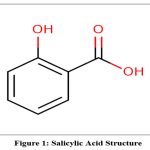 |
Figure 1: Salicylic Acid Structure |
Chemical — Physical Properties of Salicylic Acid
Classed as a beta-hydroxy acid (BHA), salicylic acid (C₆H₆O₃) is a white crystalline chemical molecule with lipophilic monohydroxybenzoic character. Found in plants naturally, it possesses fungicidal, bacteriostatic, and keratolytic action. Often used in anti-acne treatments, it is a phytohormone in plants that promotes pathogen defense, stress resistance, and growth. Its structure allows reactions as both an acid and an alcohol by including a hydroxyl (-OH) and carboxyl (-COOH) group.1, 5
From wintergreen oil, salicylic acid is industrially synthesised via the Kolbe-Schmitt process or green chemistry. Well-known for its intramolecular hydrogen bonding, its safety and potency make it a WHO Essential Medicine. Salicylates, its salts and esters, also find use in many other fields.6
Table 1: Chemical – Physical Properties of SA.
| Property | Value |
| Appearance | Colorless, odorless, needle-shaped crystals |
| Taste | Acrid |
| Boiling Point | 211°C |
| Melting Point | 315°C |
| Solubility in Water | 1.8 g/L at 25°C |
| Solubility in Organic Solvents | Soluble in carbon tetrachloride, benzene, propanol, ethanol, and acetone |
| Density | 1.44 at 20°C |
| Vapor Pressure | 8.2×10⁵ mmHg at 25°C |
| Sensitivity to Sunlight | Photochemical degradation emitting irritating fumes and acrid-smelling smoke |
| Heat of Combustion | 3.026 MJ/mole at 25°C |
| pH (Saturated Solution) | 2.4 |
| pKa (Dissociation Constant) | 2.97 |
Therapeutic Aspects of Salicylic Acid
Salicylates have always drawn a lot of interest. Up until acetylsalicylic acid, a new medicine based on a salicylic acid derivative, was created in 1897, they were the topic of extensive research. Mostly used as an analgesic, antipyretic, antithrombotic (including antiplatelet), and anti-inflammatory drug, aspirin is also Salicylic acid is most often utilized in medicine to treat skin disorders and lesions needing enough exfoliation and dead epidermal cell elimination.7 Psoriasis is a common example whereby scales are removed by salicylic acid treatments. Apart from treating calluses, corns, knuckle nodules, and warts, keratolytic medicines including salicylic acid are also utilized in the topical treatment of seborrhoecolic dermatitis and dandruff. Apart from these features, salicylic acid performs other purposes. Its effect can include anesthetic, anti-inflammatory, photoprotective, antiseptic, antifungal, and antibacterial ones.8
Cosmetic effects
A lipophilic molecule, salicylic acid breaks down intercellular cement and ionic connections in corneocytes, therefore acting superficially from the stratum corneum to the stratum spinosum. It also penetrates the epidermis and dissolves fat. Found in OTC products at 0.5–2%, it lowers sebum, and encourages exfoliation, therefore supporting collagen formation and skin regeneration.9
These effects address photodamage, freckles, and lentigines; they also increase hydration, lessen wrinkles, scars, and hyperpigmentation. It improves the absorption of several other active skincare products as well.10
Overview of Acne
Commonly affecting teenagers and occasionally adults, acne vulgaris is a chronic inflammatory disease of the pilosebaceous units. Its development consists of elevated sebum production, follicular hyperkeratinization, Cutibacterium acnes proliferation, and an inflammatory immunological response producing both non-inflammatory (comedones) and inflammatory lesions (papules, pustules, and nodules).11
The primary line of therapy for mild to severe acne is topical one. Because of its keratolytic and comedolytic actions, salicylic acid is a main agent. It exfoliates the skin, unclogs pores, and lowers irritation; its lipophilic character helps it to efficiently reach regions rich in sebum. This makes it very helpful for avoiding new lesions as well as for treating already existing ones.12
Systemic therapy include antibiotics or isotretinoin may be required for moderate to severe instances; hormonal medications work well for women with hormonally driven acne. Incorporating both physical therapy and mental well-being assistance, acne care should also address its psychological impact.13
Pathophysiology of Acne
Mostly affecting regions with sebaceous (oil) glands, which are attached to hair follicles containing fine hairs, acne is an inflammatory skin condition. Under healthy skin, sebaceous glands create sebum that leaves via pores—openings in the hair follicles—onto the surface of the skin. Usually rising to the skin’s surface when old cells are removed, keratinocytes are a kind of skin cell found lining the follicle. In acne, hair, sebum, and keratinocytes bind together within the pore to stop keratinocyte normal shedding and trap sebum inside.14, 18
Normally living on the skin, this buildup lets bacteria such Cutibacterium acnes multiply inside the blocked follicles, causing inflammation marked by swelling, redness, heat, and discomfort. Ruptures in the follicular wall cause germs, skin cells, and sebum to leak into the surrounding skin and create lesions, or pimples.15
Mechanism of Action of Salicylic acid in Acne Treatment
Dermatology makes extensive use of topical salicylic acid because of its several ways of action in treating acne. Its therapeutic effectiveness results from its capacity to target several pathogenic elements causing acne and reach thoroughly into the lipid layers of the skin (16). The system of action consists in:
Keratolytic Action
Salicylic acid disturbs the intercellular cement, mostly made of desmosomes, therefore encouraging the desquamation of keratinocytes in the stratum corneum. This action helps dead skin cells to exfoliate, therefore unclogging pores and stopping the development of new comedones.
Comedolytic Effect
Salicylic acid efficiently removes current comedones—both blackheads and whiteheads—by increasing epidermal turnover, therefore preventing the growth of new ones. Its lipophilic character enables it to enter sebaceous glands, therefore focusing on particularly acne-prone regions.
Anti-Inflammatory Properties
By blocking cyclooxygenase (COX) enzymes and hence lowering the synthesis of pro-inflammatory prostaglandins, salicylic acid alters inflammatory pathways. This system helps with redness, swelling, and irritation usually linked with inflammatory acne.
Antimicrobial Activity
Salicylic acid has bacteriostatic action, especially against Cutibacterium acnes (previously Propionibacterium acnes), a bacterium linked to acne etiology. Reducing bacterial count lowers the inflammation and infection risk.
Sebum Regulation
Salicylic acid helps break down and lower sebum collection in the pores, therefore avoiding pore blockage. This control of sebum output helps much more to lower the severity of acne.
Exfoliation and Skin Renewal
Salicylic acid encourages skin regeneration by means of its exfoliative properties, therefore enhancing skin texture and lowering post-inflammatory hyperpigmentation related with acne lesions.
Contraindications to Exfoliation with Salicylic Acid
Salicylic acid exfoliation should be used carefully or may not be appropriate for those with several diseases or lifestyle choices including:
Among skin disorders, rosacea and atopic dermatitis.
Reduced or atrophy of sebaceous glands.
Unusual sunlight exposure.
Recent skin treatments perhaps incompatible with a chemical peel.
Some seasons, especially spring and summer, are more likely to cause sunburn or hyperpigmentation from greater acid concentrations utilized.17
Topical Applications of Salicylic Acid
Available in several forms and doses catered to certain therapies, salicylic acid is a flexible topical medication used to treat a range of skin disorders18. The main uses of it are summed here:
Cleansers and Wipes
Applied to cure acne, these products exfoliate skin and assist to clean pores, but they may dry up skin therefore careful use is advised.
Gels and Liquids
Great for lower concentration acne treatments and wart removal. Because of their potency, high-concentration wart treatments are not appropriate for other skin disorders.
Moisturizers and Lotions
Use salicylic acid as an exfoliation; usually paired with moisturizing components to avoid skin dryness.
Face Peels
Applied for thorough exfoliation to treat disorders like sun damage, melasma, and acne, they are best done under expert direction for safety.
These several uses show the potency of salicylic acid in certain skin disorders; particular usage rely on the treatment requirements and product composition.19, 27
Benefits of Salicylic Acid
Because salicylic acid lowers sebum generation and encourages surface exfoliation of the skin, it is a good topical therapy for mild to severe acne. Targeting acne lesions directly, available in over-the-counter (OTC) medicines in concentrations ranging from 0.5% to 2%, it speeds healing with least scarring. Salicylic acid also lowers tyrosinase activity, therefore controlling melanin generation and aiding in the reduction of post-acne hyperpigmentation (9, 20). For people with darker skin tones especially, this is very helpful as it reduces the likelihood of producing post-inflammatory hyperpigmentation unlike some other acne treatments. Studies confirm the use of salicylic acid both as a stand-alone agent in chemical peels and in conjunction with other treatments, including oral isotretinoin, can considerably enhance skin look by properly reducing post-acne pigment.21
Recommended Concentrations and Treatment Durations of SA
Designed to guide efficient therapeutic methods, the following table offers a succinct summary of the ideal concentrations, forms, and durations for salicylic acid administration in acne therapy.22
Table 2: Con. and Duration of SA.
| Indication | Concentration | Dosage Form | Route of Administration | Duration of Treatment |
| Acne | 5% | Cream | Topical | 6 days – 12 weeks |
| 2% | Gel | 8 weeks | ||
| 2 – 3% | Lotion | 12 weeks | ||
| 20 – 30% | Peel | 8 – 20 weeks |
Side Effects of Salicylic Acid
Although salicylic acid applied topically in doses up to 2% is usually well-tolerated, it can occasionally produce minor adverse effects. Usually they consist of moderate stinging, dryness, minor burning, irritation, skin redness, and peeling. Common and typically minor, these responses are expected as part of the effect of the therapy to encourage exfoliation and cell turnover.17, 23
Additionally are transient symptoms including flushing or a feeling of warmth. Although these side effects are usually controllable and anticipated to go away on their own in a few days, they show the acid’s action on the skin in killing dead cells and cleaning pores.24
More severe side effects occasionally can arise. Though rare at low dosages, users may have more noticeable redness, peeling, or pain. Users should closely follow application instructions and restrict usage if significant dryness or irritation arises to help to prevent aggravation of these symptoms.25,27
Minimizing hazards depends on following correct instructions. For over-the-counter salicylic acid preparations, this usually involves using the product no more than twice daily and making sure the skin is not unduly exposed to other irritants or treatments that can raise sensitivity. Correct usage maximizes benefits and lowers the possibility of negative effects.26
Conclusion
This article emphasizes the important part salicylic acid plays in treating acne and in more general dermatological uses. Its great efficiency and safety profile are attributed in part to its many mechanisms: keratolytic action, anti-inflammatory capabilities, and antibacterial activity. The adaptability of salicylic acid is shown by its application in many forms, therefore addressing different therapy requirements. Previous studies emphasize how effective it is at lowering acne lesions, lessening post-inflammatory hyperpigmentation, and smoothing out skin. Although commonly tolerated, minimizing negative effects depends on following advised doses and uses recommendations. In the end, salicylic acid is still the pillar of dermatological treatment as it provides a good way to control acne and presents a future direction for therapeutic developments.
Acknowledgement
The author would like to thank University of Mosul for granting this article. The Department of Pharmacognosy, College of Pharmacy, is highly appreciated for allowing this work. The author is also profoundly grateful to the members of pharmacognosy department for their guidance during data collection and arrangement.
Funding Sources
The author(s) received no financial support for the research, authorship, and/or publication of this article.
Conflict of Interest
The authors do not have any conflict of interest.
Data Availability Statement
This statement does not apply to this article.
Ethics Statement
This research did not involve human participants, animal subjects, or any material that requires ethical approval.
Informed Consent Statement
This study did not involve human participants, and therefore, informed consent was not required.
Clinical Trial Registration
This research does not involve any clinical trials.
Permission to reproduce material from other sources
Not Applicable
Author Contribution
The sole author was responsible for the conceptualization, methodology, data collection, analysis, writing, and final approval of the manuscript
References
- Almeman, A. A. Evaluating the Efficacy and Safety of Alpha-Hydroxy Acids in Dermatological Practice: A Comprehensive Clinical and Legal Review. Clinical, Cosmetic and Investigational Dermatology. 2024; 17, 1661–1685. https://doi.org/10.2147/CCID.S453243.
CrossRef - El-Shiekh, R.A., Merghany, R.M., Fayez, N.Phytochemicals as emerging therapeutics for acne vulgaris: a comprehensive review. Futur J Pharm Sci. 2025; 11, 91. https://doi.org/10.1186/s43094-025-00842-2
CrossRef - Madison KC. Barrier Function of the Skin: “La Raison d’Être” of the Epidermis. J Invest Dermatol. 2003;121(2):231-241. https://doi.org/10.1046/j.1523-1747.2003.12359.x
CrossRef - Arif, T. Salicylic acid as a peeling agent: a comprehensive review. Clinical, Cosmetic and Investigational Dermatology. 2015; 8, 455–461. https://doi.org/10.2147/CCID.S84765
CrossRef - Tan, J.K.L., Bhate, K. A global perspective on the epidemiology of acne, British Journal of Dermatology. 2015; 172(1): 3–12, https://doi.org/10.1111/bjd.13462
CrossRef - Barbieri, J. S., Fulton, R., Neergaard, R., Nelson, M. N., Barg, F. K., Margolis, D. J. Patient Perspectives on the Lived Experience of Acne and Its Treatment Among Adult Women With Acne: A Qualitative Study. JAMA Dermatol. 2021;157(9):1040–1046. doi:10.1001/jamadermatol.2021.2185
CrossRef - Tuchayi, S., Makrantonaki, E., Ganceviciene, R. Acne vulgaris. Nat Rev Dis Primers. 2015; 1, 15029. https://doi.org/10.1038/nrdp.2015.29
CrossRef - Sorg, A., Mendoza, J., Liu, H., Roy, K., Gorman, Z., Tieman, D.M., McKenzie, C., Basset, G.J. and Block, A.K. A herbivore-induced salicylic acid carboxyl methyl transferase produces methyl salicylate in tomato to mediate defense signaling and deter pests. Plant and Cell Physiology. 2025; 66(8):1192-1204. https://doi.org/10.1093/pcp/pcaf066
CrossRef - Zheng, Y., Yin, S., Xia, Y., Chen, J., Ye, C., Zeng, Q., Lai, W. Efficacy and safety of 2% supramolecular salicylic acid compared with 5% benzoyl peroxide/0.1% adapalene in the acne treatment: a randomized, split-face, open-label, single-center study. Cutaneous and ocular toxicology. 2019; 38(1): 48-54. https://doi.org/10.1080/15569527.2018.1518329
CrossRef - Lu, J., Cong, T., Wen, X., Li, X., Du, D., He, G., Jiang, X. Salicylic acid treats acne vulgaris by suppressing AMPK/SREBP 1 pathway in sebocytes. Experimental dermatology. 2019; 28(7): 786-794. https://doi.org/10.1111/exd.13934
CrossRef - Hadisoebroto, G., Budiman, S. Determination of Salicylic Acid in Anti Acne Cream which Circulated Around Bandung City Using Ultra Violet Spectrophotometry Method. Jurnal Kartika Kimia. 2019; 2(1): 51-56. https://doi.org/10.26874/jkk.v2i1.20
CrossRef - Lekakh, O., Mahoney, A. M., Novice, K., Kamalpour, J., Sadeghian, A., Mondo, D., Tung, R. Treatment of acne vulgaris with salicylic acid chemical peel and pulsed dye laser: a split face, rater-blinded, randomized controlled trial. Journal of lasers in medical sciences. 2015; 6(4): 167. doi: 15171/jlms.2015.13
CrossRef - Bano, K., Kumar, B., Alyemeni, M. N., Ahmad, P. Exogenously-sourced salicylic acid imparts resilience towards arsenic stress by modulating photosynthesis, antioxidant potential and arsenic sequestration in Brassica napus plants. Antioxidants. 2022; 11(10), 2010. https://doi.org/10.3390/antiox11102010
CrossRef - Singh, S. Salicylic acid elicitation improves antioxidant activity of spinach leaves by increasing phenolic content and enzyme levels. Food Chemistry Advances. 2023; 2: 100156. https://doi.org/10.1016/j.focha.2022.100156
CrossRef - Calvisi, L. Efficacy of a combined chemical peel and topical salicylic acid‐based gel combination in the treatment of active acne. Journal of Cosmetic Dermatology. 2021; 20, 2-6. https://doi.org/10.1111/jocd.14281
CrossRef - Liu, H., Yu, H., Xia, J., Liu, L., Liu, G., Sang, H., Peinemann, F. Evidence‐based topical treatments (azelaic acid, salicylic acid, nicotinamide, sulfur, zinc, and fruit acid) for acne: an abridged version of a Cochrane systematic review. Journal of Evidence‐Based Medicine. 2020; 13(4): 275-283. https://doi.org/10.1111/jebm.12411
CrossRef - Wiegmann, D., & Haddad, L. Two is better than one: The combined effects of glycolic acid and salicylic acid on acne‐related disorders. Journal of cosmetic dermatology. 2020; 19(9): 2349-2351. https://doi.org/10.1111/jocd.13387
CrossRef - Draelos, Z., Lewis, J., McHugh, L., Pellegrino, A., Popescu, L. Novel retinoid ester in combination with salicylic acid for the treatment of acne. Journal of Cosmetic Dermatology. 2016; 15(1): 36-42. https://doi.org/10.1111/jocd.12190
CrossRef - Araviiskaia, E., & Dréno, B. The role of topical dermocosmetics in acne vulgaris. Journal of the European Academy of Dermatology and Venereology. 2016; 30(6): 926-935. https://doi.org/10.1111/jdv.13579
CrossRef - Liu, Y., Dan, Y., Yang, J., He, X., Liu, J., Yi, Y., Ai, Y. Clinical Efficacy of a Salicylic Acid–Containing Gel on Acne Management and Skin Barrier Function: A 21‐Day Prospective Study. Journal of Cosmetic Dermatology. 2025; 24(7): e70353. https://doi.org/10.1111/jocd.70353
CrossRef - Zheng, Y., Wan, M., Chen, H., Ye, C., Zhao, Y., Yi, J., Lai, W. Clinical evidence on the efficacy and safety of an antioxidant optimized 1.5% salicylic acid (SA) cream in the treatment of facial acne: an open, baseline‐controlled clinical study. Skin Research and Technology. 2013; 19(2): 125-130. https://doi.org/10.1111/srt.12022
CrossRef - Gollnick, H. P., & Krautheim, A. Topical treatment in acne: current status and future aspects. Dermatology. 2003; 206(1): 29-36. https://doi.org/10.1159/000067820
CrossRef - Dayal, S., Kalra, K. D., Sahu, P. Comparative study of efficacy and safety of 45% mandelic acid versus 30% salicylic acid peels in mild‐to‐moderate acne vulgaris. Journal of cosmetic dermatology. 2020; 19(2): 393-399. https://doi.org/10.1111/jocd.13168
CrossRef - Li, S., He, X., Zhang, Z., Zhang, X., Niu, Y., Steel, A., Wang, H. Efficacy and safety of a facial serum and a mask containing salicylic acid and lipohydroxy acid in acne management: A randomized controlled trial. Journal of Cosmetic Dermatology. 2023; 22(9): 2502-2511. https://doi.org/10.1111/jocd.15746
CrossRef - Saoji, V., & Madke, B. (2021). Efficacy of salicylic acid peel in dermatophytosis. Indian Journal of Dermatology, Venereology and Leprology, 87(5), 671-675. doi:10.4103/ijdvl.IJDVL_853_18
CrossRef - Arif, T. Salicylic acid as a peeling agent: a comprehensive review. Clinical, cosmetic and investigational dermatology. 2015; 455-461. https://doi.org/10.2147/CCID.S84765
CrossRef - Yeoh, S. C., Goh, C. F. Topical delivery of salicylates. Drug delivery and translational research. 2022; 12(5): 981-1001. https://doi.org/10.1007/s13346-021-00988-5
CrossRef
 PlumX:
 Views: 2249 Views
  PDF Downloads:
298
PDF Downloads:
298 Accepted on: 10-10- 2025
Second Review by: Dr. Hany Akeel
Final Approval by: Dr. Wagih Ghannam