Evaluation of Antioxidant and Antimicrobial activities of Termitomyces clypeatus R. Hiem collected from Forest fringe areas of Jalpaiguri, West Bengal, India
 and Deepmala Pathak
Department of Botany, Mansarovar Global University, Sehore, India
Corresponding Author’s E-mail: mallika.flk@gmail.com
Download this article as:
ABSTRACT:Wild macrofungal species are somewhat less renowned, despite their utilisation in traditional medicine and the recognition of its therapeutic potential for ages. Determining the antimicrobial activity and antioxidative activity of wild macro-fungi is critical for the development of monographs to facilitate the incorporation of fungi in traditional medicine into modern health care systems. This study investigated the efficiency of methanolic extracts of Termitomyces clypeatus R. Hiem sourced from forest patches in Jalpaiguri, West Bengal, India, for antimicrobial activity and antioxidative activity. Antioxidant activities include ABTS Radical Scavenging Activity, DPPH Activity, Hydroxy Free Radical Scavenging Activity, Reactive Nitrogen Oxide Scavenging Activity, Super Oxide Anion Radical Scavenging Activity, FRAP activity and CUPRAC Activity. The extracts of the species were evaluated against three Gram-positive bacteria, three Gram-negative bacteria, and four fungus strains. The results suggested that the examined macrofungi demonstrated antimicrobial activity against multiple microorganisms. These data substantiate that studied ferns generate a range of active compounds.
KEYWORDS:Antmicrobial activity; Antioxidant activities; Macrofungi; Positive control; Radical Scavenging Activity; Termitomyces clypeatus
Introduction
Edible macrofungal species are now extensively consumed globally, with consumption levels significantly rising due to their palatability, accessibility, and appeal as functional foods. They are low in calories, sodium, fat, and cholesterol, while being rich in protein, carbohydrates, fibre, vitamins, and essential amino acids.1 Nonetheless, wild edible macrofungal species are infrequently incorporated into the valuation of tropical forests, which has historically relied predominantly on a financial assessment of timber resources. Both mycelium and fruiting bodies possess chemicals exhibiting extensive antioxidant and antibacterial properties.2,3 The phenolic constituents of methanolic extracts of mushrooms have demonstrated antioxidative and free radical scavenging capabilities, indicating potential protective functions of these compounds through their metal-binding, lipoxygenase-inhibiting, and free radical-scavenging abilities. While certain mushrooms are esteemed as a seasonal delicacy, there is presently an absence of standardised or commercially feasible cultivation methods for their production. Termitomyces clypeatus R. Heim is such an edible fungus often encountered in the wild and has not been extensively grown for fruit body production. It develops naturally beside termite colonies, particularly in the rainy season. In the wild, termites construct fungus combs using partially decomposed plant matter, creating an optimal habitat for fungal growth and development. As of now, there exists no standardised or commercially feasible cultivation method for T. clypeatus. The species is traditionally endorsed by numerous healers for the treatment of various conditions, including measles, yellow fever, and some gastrointestinal infections.4 It is an obligatory symbiotic fungus that develops in conjunction with termites, primarily those belonging to the subfamily Macrotermitinae. Its life cycle is contingent upon termite fungus gardens, rendering artificial cultivation exceedingly challenging.
T. clypeatus is widely spotted in the forest edge areas of Jalpaiguri during the rainy season. The tribal people of the study sites have been consumed it as food.5 Globally the species is now utilized as food as well as medicines.6 The fungal species is recognised for their antioxidant characteristics and can be utilised for evaluating antibacterial efficacy against bacteria and fungi. Till date, there has been no comprehensive research published regarding the antioxidant and antibacterial properties of T. clypeatus sourced from Jalpaiguri District, West Bengal. The objective of the current investigation is to ascertain the antioxidant activity, reduction potential, free radical inhibition, and antibacterial efficacy of methanolic extract of T. clypeatus. Methanol is particularly effective at extracting phenolic compounds, which are widely recognized for their potent antioxidant properties. Phenolic compounds and flavonoids are the primary contributors to the antioxidant activity of macrofungal species. Consequently, methanolic extracts generally exhibit high antioxidant capacity due to their rich content of these bioactive constituents.7
Materials and Methods
The fresh fruit bodies of T. clypeatus were collected from humic soil bed of different forest patches of Jalpaiguri District, West Bengal Standard microscopic and chemical procedures, along with relevant literature, is used to make taxonomic identification. The mushroom sample was further washed to exclude extraneous material and dehydrated in a hot air oven at 40-50 °C for 48 hours until a stable weight was achieved.8 Samples have been cleaned and then air-dried in the oven at 40°C. Dried specimens were pulverized into a fine powder and extracted by agitation with 80% (v/v) methanol in an ultrasonic bath for 30 minutes at 4ºC, followed by centrifugation at 12,000 rpm for 15 minutes. Supernatants were utilized to assess the antimicrobial capability of the samples. The organic solvent in the extracts was evaporated to complete dryness under vacuum conditions. The evaluated extracts were solubilized in 10% (v/v) DMSO in sterile water. A solvent control test was conducted to examine the impact of DMSO on microbial growth. The test confirmed that DMSO exhibited no inhibitory impact on the organisms evaluated. The methanolic extract of T. clypeatus was subjected to preliminary qualitative phytochemical screening for alkaloids, anthraquinones, flavonoids, proteins, phlobatannins, starch, steroids, tannins and terpenoids.
In this study DPPH activity, ABTS activity, FRAP activity, Super Oxide Anion Radical Scavenging activity, Free Radical Scavenging activity and CUPRAC activity were determined. DPPH activity was determined followed by the protocol of Baliyan et al.9 For ABTS activity methodology was adopted from the work of Cao and Prior10 and the study of Gupta et al.11 The FRAP activity was determined by the protocol adopted from the work Benzie and Strain.12 Super Oxide Anion Radical Scavenging Assay was performed followed by the methodology of Noda et al.,13 with slight modification. Free Radical Scavenging Activity was evaluated as per the protocol used by Fernando and Soysa.14 For Nitric oxide scavenging assay methodology of Sreejayan et al.,15 was used. Protocol for CUPRAC assay was adopted from the work of Apak et al.,16 and the study of Rubio et al.17 All data were expressed as mean ± standard deviation and were done in triplicate independent analyses. Data were analyzed using one-way ANOVA using SPSS version 20 (SPSS Inc., Chicago, Illinois,USA). For all cases IC50 was calculated using Software Graph Pad Prism 6.
Antimicrobial activities of methanol extract were tested against three Gram Positive Bacteria, three Gram-negative bacteria and four fungal strains. The tested microorganisms are Bacillus subtilis, MTCC 1133; Enterococcus faecalis, MTCC 429; Staphylococcus aureus, MTCC96; Serratia marcescens, MTCC-86; Pseudomonas aeruginosa, MTCC3541; Escherichia coli, MTCC- 452; Candida albicans, MTCC 854; Aspergillus niger, MTCC 281; Candida tropicalis, MTCC 1000; Trichoderma asperellum, MTCC 4347. Microbial suspension was generated for each test microorganism, using the direct colony technique. The turbidity of the initial suspension was calibrated against the 0.5 McFarland standard.18 The first suspension comprised approximately 108 colony-forming units (CFU)/mL. Furthermore, 1:100 dilutions of the initial solution were formulated in sterile 0.9% saline. The Antimicrobial activity was checked by following Zone Inhibition Method (Kirby-Bauer method).19 The MHA plates were inoculated by spreading with 100 µl of Bacterial culture, (Inoculum was prepared by adjusting 0.5 McFarland Unit – Approx cell density (1.5 X 10⁸ CFU/mL from Mueller- Hinton Broth) and followed by placing the discs containing 5 µl of different concentrations (0 to 200 mg/ml). One disc in each plate was loaded with solvent alone which served as vehicle control and Ciprofloxacin disc (3µg) was taken as positive control. The plates of test microorganisms were incubated (Basil Scientific Corp. India- Incubator) at 37 °C for 24 hrs. The clear zones created around the disc were measured and recorded.
Results
Several significant biochemical components were found in the methanolic extract, according to preliminary phytochemical screening. Alkaloids, anthraquinones, phlobatannins, steroids, and terpenoids were discovered to be absent from the nine classes of substances that were evaluated, while flavonoids, proteins, starch, and tannins were found to be present. The existence of phenolic chemicals that could enhance the extract’s antioxidant capacity is indicated by the positive result for flavonoids. Additionally, proteins were found, indicating that the methanolic extract contains proteinaceous components. While tannins show the presence of polyphenolic chemicals with possible biological action, starch indicates the presence of carbohydrate reserves. On the other hand, the methanolic extract did not contain anthraquinones or alkaloids. There were no phlobatannins. In the initial assays, terpenoids and steroids also exhibited unfavourable reactions. Overall, the findings show that flavonoids, proteins, starch, and tannins are the primary characteristics of the methanolic extract (Table 1); the other chemical groups that were investigated were not found under the experimental conditions.
Table 1: Secondary metabolites detected in methanolic extract of Termitomyces clypeatus.
|
Compounds |
Methanolic Extract |
| Alkaloids |
Absent |
|
Anthraquinones |
Absent |
| Flavonoids |
Present |
|
Proteins |
Present |
| Phlobatannins |
Absent |
|
Starch |
Present |
| Steroids |
Absent |
|
Tannin |
Present |
| Terpenoid |
Absent |
The antioxidant efficacy of methanolic extract of T. clypeatus was examined utilising several in vitro methodologies, including ABTS, DPPH, hydroxyl radical, reactive nitrogen oxide, superoxide anion radical scavenging, FRAP, and CUPRAC assays. The IC₅₀ metrics and reduction potentials are presented in table 2. The extract had subpar ABTS and DPPH radical scavenging efficacy, recording IC₅₀ values above 1000 µg/mL, in contrast to the robust activity of the standard antioxidant ascorbic acid, which had IC₅₀ values of 5.951 ± 0.01 µg/mL and 10.69 ± 0.016 µg/mL, respectively. These observations imply that the extract exhibits a constrained potential to donate hydrogen atoms or electrons for the stabilisation of ABTS and DPPH free radicals. On the other hand, the extract of T. clypeatus shown outstanding hydroxyl radical scavenging performance, with an IC₅₀ value of 6.078 ± 0.11 µg/mL, which is markedly less than that of the standard gallic acid (63.43 ± 0.02 µg/mL). This implies a significant proficiency of the macrofungal extract in neutralising highly reactive hydroxyl radicals, which are considered some of the most detrimental reactive oxygen species. The extract also showed outstanding effectiveness in scavenging superoxide anion radicals, with an IC₅₀ value of 3.639 ± 0.61 µg/mL, exceeding the performance of gallic acid (24.99 ± 0.02 µg/mL). This implies that T. clypeatus is remarkably adept at neutralising superoxide radicals, thereby perhaps averting the emergence of more reactive oxygen species through radical chain reactions.
The extract revealed a trivial capacity for reactive nitrogen oxide scavenging, shown by an IC₅₀ value greater than 1000 µg/mL, in contrast to gallic acid, which showed pronounced activity (IC₅₀ = 10.98 ± 0.017 µg/mL). This implies that the bioactive elements contained in the extract are not as potent against reactive nitrogen species. The extract’s ability to reduce was further examined by FRAP and CUPRAC assays. The FRAP value recorded was 2.022 µg Trolox equivalents/mL, reflecting a quite limited capacity for ferric reduction of antioxidants. On the other hand, the CUPRAC value measured at 2037.61 µg Trolox equivalents/mL, showcasing a remarkably elevated capacity for lowering cupric ions. The significant variation in FRAP and CUPRAC values may be linked to the differing redox processes and pH settings of the experiments, implying that the antioxidant elements of T. clypeatus favour the reduction of Cu²⁺ over Fe³⁺ ions.
Antimicrobial activity of methanolic extract of T. clypeatus was assessed against six bacterial (Fig 2) and four fungal species (Fig 3) by the agar well diffusion technique and juxtaposed with established antimicrobial treatments. The extract shown antibacterial efficacy against Bacillus subtilis, Staphylococcus aureus, Pseudomonas aeruginosa, and Escherichia coli among the bacterial strains evaluated (Table 3). The minimal effective concentration was 62.5 µg, resulting in inhibition zones of 7 mm for B. subtilis, 7 mm for S. aureus, and 6.5 mm for P. aeruginosa. E. coli exhibited lower susceptibility, necessitating a greater concentration of 250 µg to achieve a 4 mm inhibition zone. No suppressive effect was detected against Enterococcus faecalis or Serratia marcescens at the evaluated concentrations. No antifungal activity of T. clypeatus extract was detected against Candida albicans, Candida tropicalis, Aspergillus niger, and Trichoderma asperellum.
Table 2: Antioxidant activity of methanolic extract of Termitomyces clypeatus
|
Antioxidant Activity |
IC50 value (Mean ± SEM)
µg/ml |
|
| Activity | Ascorbic Acid |
Termitomyces clypeatus |
|
ABTS Radical Scavenging Activity |
5.951±0.01 | > 1000 |
| DPPH Radical Scavenging Activity | 10.69±0.016 |
> 1000 |
|
Activity |
Gallic Acid |
Termitomyces |
|
Hydroxy Free Radical Scavenging Activity |
63.43±0.02 | 6.078±0.11 |
| Reactive Nitrogen Oxide Scavenging Activity | 10.98±0.017 |
> 1000 |
|
Super Oxide Anion Radical Scavenging Activity |
24.99±0.02 | 3.639±0.61 |
| Activity |
Termitomyces clypeatus |
|
|
FRAP assay |
2.021935484 | |
| CUPRAC Assay |
2037.606838 |
|
Table 3: Antimicrobial activity of methanolic extract of Termitomyces clypeatus
|
Tested Microorganisms |
Compound used as Positive Control | Positive Control | Termitomyces clypeatus | ||
| Effective Amount | Average Zone at Effective amount | Effective Amount |
Average Zone at Effective amount |
||
|
Bacillus subtilis |
Ciprofloxacin | 3µg | 22mm | 62.5µg | 7mm |
| Enterococcus faecalis | Ciprofloxacin | 3µg | 24 mm | – |
– |
|
Staphylococcus aureus |
Ciprofloxacin | 3µg | 24 mm | 62.5 µg | 7mm |
| Serratia marcescens | Ciprofloxacin | 3µg | 24 mm | – |
– |
|
Pseudomonas aeruginosa |
Ciprofloxacin | 7µg | 25 mm | 62.5µg | 6.5 mm |
| Escherichia coli | Ciprofloxacin | 8µg | 28 mm | 250µg |
4 mm |
|
Candida albicans |
Fluconazole | 20µg | 17 mm | – | – |
| Candida tropicalis | Fluconazole | 20µg | 17 mm | – |
– |
|
Aspergillus niger |
Amphotericin B | 100µg | 20mm | – | – |
| Trichoderma asperellum | Amphotericin B | 120µg | 8 mm | – |
– |
Discussion
This study shows that the methanolic extract of Termitomyces clypeatus R. Heim from Jalpaiguri, forest-fringe areas of has a unique profile of phytochemical and biochemical components. Alkaloids, anthraquinones, phlobatannins, steroids, and terpenoids were not found under the experimental conditions used, however preliminary screening indicated the existence of flavonoids, proteins, carbohydrates, and tannins. Given that polyphenolic compounds are commonly acknowledged as significant bioactive components of edible and medicinal macrofungi, the presence of flavonoids and tannins is especially pertinent to the antioxidant and antibacterial properties of the mushroom. Several previous results corroborate the current conclusion that flavonoid-containing fractions might be a significant part of T. clypeatus antioxidant system.
The methanolic fraction of T. clypeatus demonstrated promising antioxidant and antibacterial properties against several microbes. In general, T. clypeatus shown preferential antioxidant properties. Despite exhibiting limited scavenging efficacy against ABTS, DPPH, and reactive nitrogen oxide radicals, it had remarkably potent scavenging capabilities for hydroxyl and superoxide radicals (Table 2). The behaviour of antioxidants is too complicated; different antioxidant tests show distinct modes of action. Due to their ease of use, rapidity, and widespread acceptance for assessing total radical scavenging capacity, DPPH and ABTS are commonly used as general screening assays among free-radical assays.20 However, as hydroxyl radicals are highly reactive and harmful in biological systems, the capacity to scavenge them is often considered essential if the goal is to understand biological significance. Similarly, as superoxide is a precursor to numerous reactive oxygen species, superoxide scavenging has biological relevance. The most significant antioxidative properties of an edible mushroom are often those that demonstrate its capacity to function as a safe dietary antioxidant and shield the organism from oxidative stress following ingestion. Instead of depending just on one test in this situation, researchers typically opt to assess both biologically relevant radical scavenging activity and overall antioxidant capacity.
In these antioxidant tests, the extract’s ability to neutralise free radicals is evaluated at different concentrations. The results are commonly expressed as IC50, which indicates the concentration required to block 50% of the radicals. Even at the greatest concentration used in the experiment, the extract was unable to achieve 50% radical scavenging activity, as indicated by the phrase “> 1000”. As a result, the IC50value is higher than the highest measured values. Since the extract failed to produce 50% inhibition at the maximum tested concentration of 1000 µg/mL in the current communication, the IC50 would be considered to be more than 1000 µg/mL. This suggests that, within the examined concentration range, the methanolic extract of T. clypeatus exhibits low to moderate ABTS radical scavenging activity, DPPH activity, and reactive nitrogen oxide scavenging activity (Fig 1). The extract may have antioxidant properties, although higher concentrations may be required for significant effects, or it may perform less well in certain tests than stronger antioxidants as Trolox or ascorbic acid. Mitra et al.,21 reported that ethanolic extract of the macrofungi showed DPPH radical scavenging activity and the IC50 value was determined as 0.33 ± 0.01 mg/mL. In another study it was found that free radical DPPH was efficiently neutralised by T. clypeatus extracts, with the IC50 values for the ethanol and aqueous extracts recorded at 86.84 and 27.59 µg/mL, respectively, indicating superior scavenging efficacy of the aqueous extract compared to the ethanol extract.22 These findings suggest that the antioxidant efficacy of T. clypeatus is contingent upon its mechanisms and may be linked to particular phytochemicals or bioactive compounds from mushrooms that selectively engage specific reactive oxygen species instead of functioning as general free radical scavengers. These specific antioxidant characteristics may enhance the mushroom’s prospective medicinal uses in addressing illnesses linked to oxidative stress.
The findings indicate that the methanolic extract of T. clypeatus exhibits significant antioxidant ability and effectively neutralizes hydroxyl radicals, which are highly reactive oxygen species implicated in oxidative damage within biological systems (Fig 1). The methanolic extract of T. clypeatus also exhibited superoxide anion radical scavenging activity with an IC₅₀ value of 3.639±0.61 µg/mL, which was much than that of the standard gallic acid (24.99 ± 0.02 µg/mL), indicating comparatively higher scavenging efficiency of the extract under the tested conditions (Table 2). On the other hand, the extract also exhibited Hydroxy Free Radical Scavenging Activity with an IC₅₀ value of 6.078±0.11µg/mL, which was much than that of the standard gallic acid (63.43±0.02 µg/mL), indicating comparatively higher scavenging efficiency of the extract under the tested conditions. The biological importance of hydroxyl radical scavenging ability is critical, considering that hydroxyl radicals are extremely reactive and can cause considerable harm to lipids, proteins, and DNA. The notable hydroxyl radical scavenging ability found in the edible mushroom T. clypeatus suggests a strong defensive mechanism against oxidative harm in living entities. The scavenging activity of superoxide anions is crucial since superoxide radicals act as precursors to more harmful reactive oxygen species. The reactive nitrogen oxide scavenging assay demonstrated that the extract possessed weak scavenging activity with an IC₅₀ value of >1000 µg/mL, indicating negligible reactive nitrogen oxide scavenging activity within the tested concentration range. The significantly diminished IC₅₀ value of the test specimen indicates an enhanced antioxidant capacity, since a reduced IC₅₀ signifies superior free radical neutralisation efficacy. This notable phenomenon might be ascribed to the existence of bioactive phytochemicals, especially phenolic compounds and flavonoids, which are recognised for their ability to neutralise reactive nitrogen species by the donation of electrons or hydrogen atoms, consequently alleviating oxidative and nitrosative stress.
Both FRAP and CUPRAC rely on electron transfer processes and assess the reducing ability of bioactive constituents found in the extract. The elevated CUPRAC value signifies a considerable capacity for electron donation to cupric ions, but the comparatively low FRAP value implies a restricted ability to reduce ferric ions. The FRAP assay assesses the capacity of the sample to reduce ferric ions, while the CUPRAC assay examines the reduction of cupric ions. FRAP and CUPRAC tests aids in positioning the edible mushroom as a potential natural reservoir of antioxidants. The antioxidant potential of T. clypeatus exhibited significant variation across the FRAP and CUPRAC tests. The FRAP assay resulted in a Trolox equivalent antioxidant capacity of 2.02 µg/mL, but the CUPRAC assay generated a significantly elevated value of 2037.61 µg/mL (Table 2). This notable disparity illustrates the divergent response processes that underpin the two assays. The FRAP assay evaluates the capacity of antioxidants to convert ferric (Fe³⁺) ions into ferrous (Fe²⁺) ions in acidic environments and mainly identifies substances with significant electron-donating potential. Conversely, the CUPRAC assay assesses the reduction of cupric (Cu²⁺) ions to cuprous (Cu⁺) ions at about neutral pH, thereby accommodating a wider range of antioxidant substances, encompassing both hydrophilic and lipophilic antioxidants. The remarkably high Trolox equivalent value found in the CUPRAC assay indicates that T. clypeatus possesses antioxidant components that the CUPRAC approach detects more successfully than the FRAP assay. As different antioxidant chemicals react differently depending on the assay chemistry, similar variances between FRAP and CUPRAC assays have been documented in natural products. Consequently, the combination of the two assays offers a more thorough evaluation of antioxidant potential of T. clypeatus, showing that despite its relatively low ferric reducing ability, it has a strong cupric ion-reducing capacity, which is indicative of significant antioxidant potential.
The current research also assessed the antibacterial efficacy of T. clypeatus against a selection of clinically significant bacterial and fungal pathogens. The findings indicated that the mushroom extract exhibits specific antibacterial properties while showing no measurable antifungal effects under the investigated conditions (Table 3 and Fig 2). Despite the inhibitory impact being less pronounced than that of conventional antimicrobial drugs, the results indicate that T. clypeatus possesses bioactive compounds with antibacterial characteristics.23 Mahamat et al.,4 have reported the antimicrobial activity of aqueous extract of T. clypeatus significantly inhibit S. aureus, E. coli, S. thyphimurium, E. aerogenes, C. albicans and C. glabrata at different ratios. However, in our study the methanolic extract of T. clypeatus showed activity on Bacillus subtilis, Staphylococcus aureus, Pseudomonas aeruginosa and Escherichia coli (4-7 mm). Kuete et al.,24 reported that T. clypeatus has significant antibacterial activity against several multi drug resistant bacteria. The considerable disparity in inhibition magnitude among the microbial species may stem from the varied metabolic processes employed by the pathogen. Among the bacterial species, Bacillus subtilis and Staphylococcus aureus demonstrated the highest susceptibility to the extract, each showing a 7 mm zone of inhibition at a dosage of 62.5 µg. Pseudomonas aeruginosa exhibited a moderate level of susceptibility, demonstrating a 6.5 mm inhibitory zone at the identical concentration. Conversely, Escherichia coli necessitated a greater dose (250 µg) to yield merely a 4 mm inhibitory zone, signifying comparatively diminished sensitivity. No inhibitory effect was detected against Enterococcus faecalis or Serratia marcescens, indicating that the antibacterial range of T. clypeatus is selective rather than extensive. Oyetayo (2009) showed that ethanolic extract of T. clypeatus showed minimum inhibitory concentration against Staphylococcus aureus (100 mg/ml), Bacillus subtilis (100 mg/ml), and Candida albicans (50 mg/ml).25
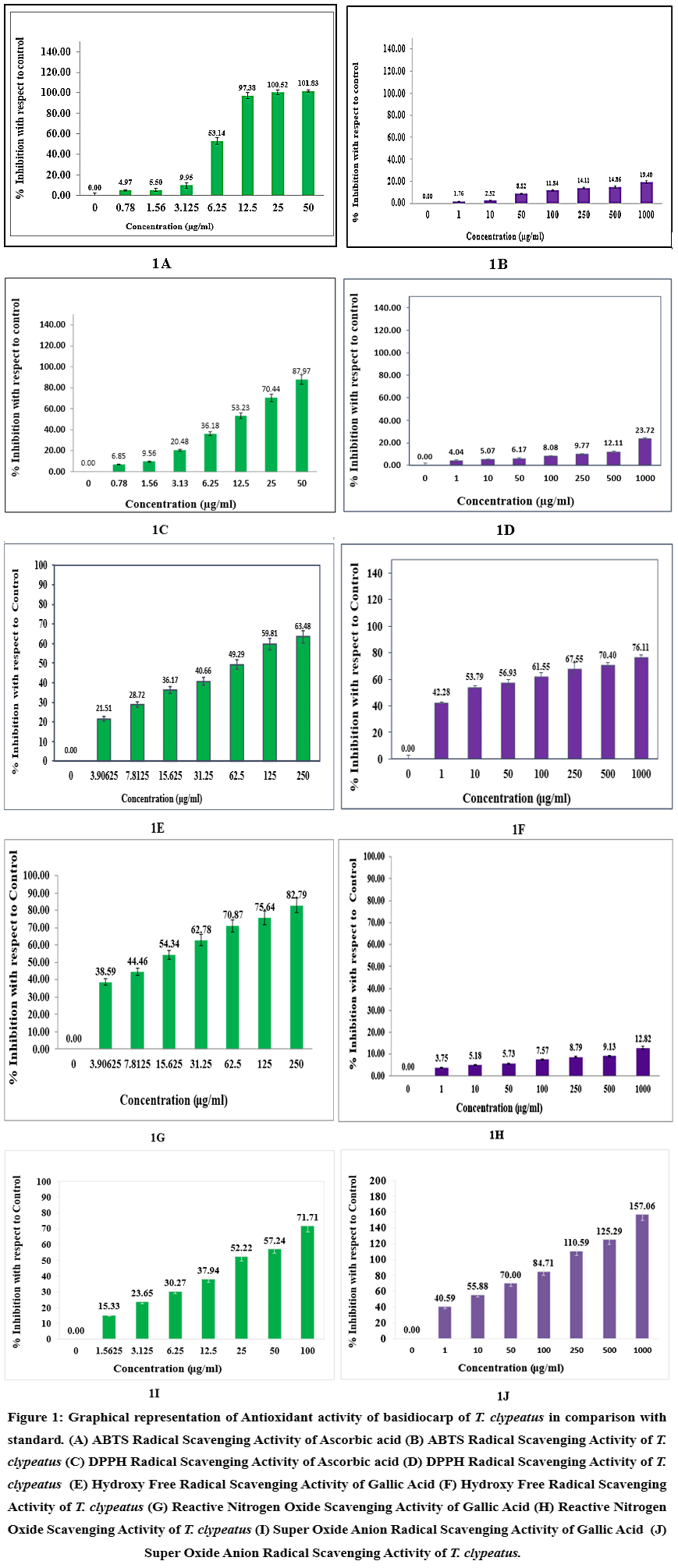 |
Figure 1: Graphical representation of Antioxidant activity of basidiocarp of T. clypeatus in comparison with standard. (A) ABTS Radical Scavenging Activity of Ascorbic acid (B) ABTS Radical Scavenging Activity of T. clypeatus (C) DPPH Radical Scavenging Activity of Ascorbic acid (D) DPPH Radical Scavenging Activity of T. clypeatus |
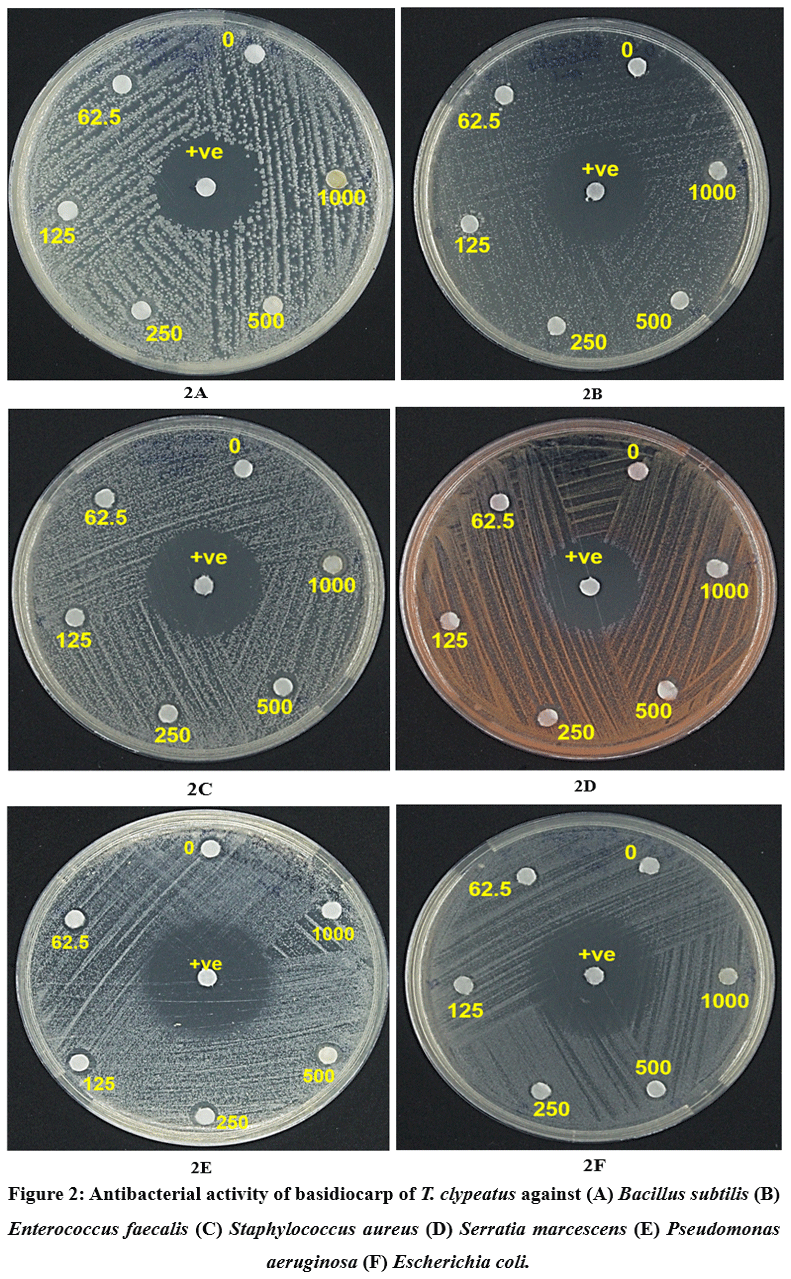 |
Figure 2: Antibacterial activity of basidiocarp of T. clypeatus against (A) Bacillus subtilis (B) Enterococcus faecalis (C) Staphylococcus aureus (D) Serratia marcescens (E) Pseudomonas aeruginosa (F) Escherichia coli. |
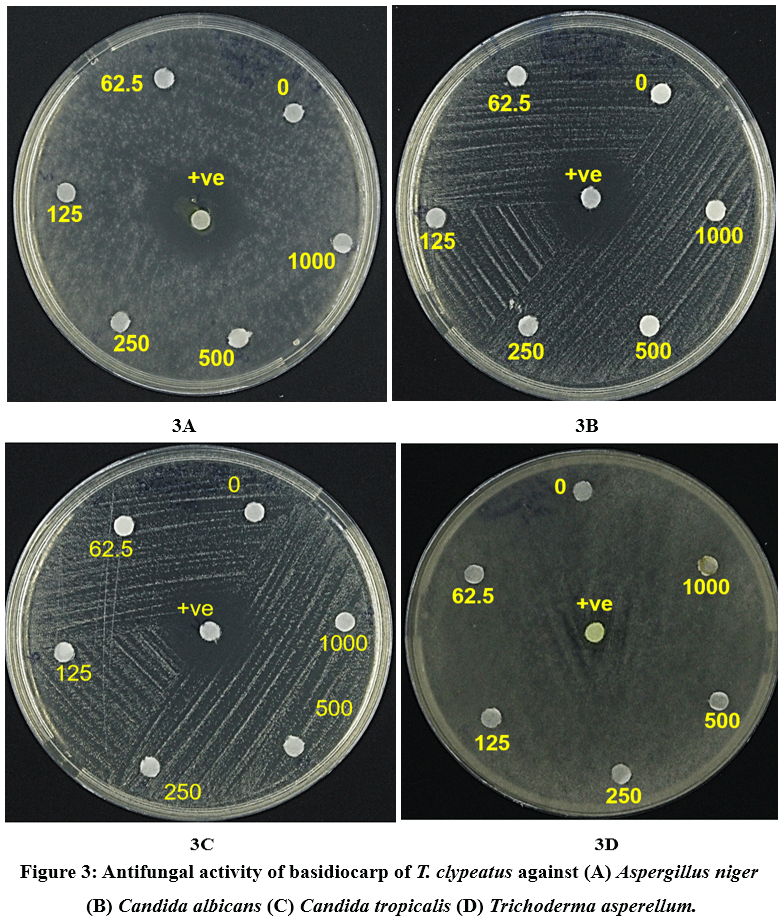 |
Figure 3: Antifungal activity of basidiocarp of T. clypeatus against (A) Aspergillus niger (B) Candida albicans (C) Candida tropicalis (D) Trichoderma asperellum. |
Conclusion
The results of the present study reveal promising antioxidant and antibacterial properties linked methanolic extract of the fungus, T. clypeatus. The findings established that bacteria shown heightened sensitivity to the methanolic extract obtained from the basidiocarp T. clypeatus in contrast to fungi. The exhibition of the antibacterial effectiveness of methanol extracts from T. clypeatus against several prevalent bacteria suggests that these extracts could serve as natural food preservatives to prevent the growth of rotting bacteria in food items. Future investigations ought to focus on chromatographic analysis and the extraction of bioactive compounds, as well as elucidating the mechanisms of action of particular phytochemicals.
Acknowledgement
The author would like to thank Department of Botany, Dukhulal Nibaran Chandra College, Murshidabad, West Bengal for allowing microbiological work.
Funding Sources
The author(s) received no financial support for the research, authorship, and/or publication of this article.
Conflict of Interest
The authors do not have any conflict of interest.
Data Availability Statement
This statement does not apply to this article.
Ethics Statement
This research did not involve human participants, animal subjects, or any material that requires ethical approval.
Informed Consent Statement
This study did not involve human participants, and therefore, informed consent was not required.
Clinical Trial Registration
This research does not involve any clinical trials.
Permission to reproduce material from other sources
Not Applicable.
Author Contributions
- Mallika Mazumder: Conceptualization, Methodology, Writing – Original Draft
- Deepmala Pathak: Conceptualization, Methodology, Writing – Original Draft, Supervision
References
- Mazumder M, Sarkar AK. Potential Therapeutics of Cultivated and Wild Mushrooms Against Diabetes. In Goyal MR, Malik JA, Kumari A (Eds) The Functional Foods. Apple Academic Press. 2024;151-186.
CrossRef - Oyetayo VO, Dong CH, Yao YJ. Antioxidant and Antimicrobial Properties of Aqueous Extract from Dictyophra indusiata. The Open Mycology Journal. 2009;3:20-26
CrossRef - Mazumder M, Sarkar AK. Mushrooms as a source of Enzyme Inhibitor. In Goyal M.R. and Malik J.A. (Eds.) Enzyme Inactivation in food processing: Technologies, Materials and Applications. Apple Academic Press. 2023;339-360.
CrossRef - Mahamat O, Andre-Ledoux N, Chrisopher T, Mbifu AA, Albert K. Assessment of Antimicrobial and Immunomodulatory Activities of Termite Associated Fungi, Termitomyces clypeatus R. Heim (Lyophyllaceae, Basidiomycota). Clin. Phytosci. 2018;4:28
CrossRef - Mazumder M, Pathak D. Exploration of Ethnomycological Knowledge on Wild Edible Mushrooms in Jalpaiguri District of West Bengal, India. Int. J. Agriworld. 2026;7(1):44-43.
- Nhi NTN, Dung TN. Biomass production of fungus Termitomyces clypeatus in a stirred-tank bioreactor. Academia Journal of Biology. 2021;43(2):9–17. https://doi.org/10.15625/15950
CrossRef - Xiang Z, Liu L, Xu Z, et al. Solvent Effects on the Phenolic Compounds and Antioxidant Activity Associated with Camellia polyodonta Flower Extracts. ACS Omega. 2024;9(25):27192–27203. https://doi.org/10.1021/acsomega.4c01321
CrossRef - Kosanic M, Rankovic B, Dasic M. Mushrooms as possible antioxidant and antimicrobial agents. Iranian journal of pharmaceutical research. 2012;11(4):1095–1102.
- Baliyan S, Mukherjee R, Priyadarshini A, et al. Determination of Antioxidants by DPPH Radical Scavenging Activity and Quantitative Phytochemical Analysis of Ficus religiosa. Molecules. 2022;27(4):1326.
CrossRef - Cao G, Prior RL. Comparison of different analytical methods for assessing total antioxidant capacity of human serum. Clinical Chemistry. 1998;44(6):1309–1315. https://doi.org/10.1093/clinchem/44.6.1309
CrossRef - Gupta R, Sharma M, Lakshmy R, Prabhakaran D, Reddy KS. Improved method of total antioxidant assay. Indian J Biochem & Biophy. 2009;46:126-129.
- Benzie IFF, Strain JJ. The Ferric Reducing Ability of Plasma (FRAP) as a measure of “Antioxidant Power”: The FRAP assay. Analytical Biochemistry. 1996;239(1):70-76.
CrossRef - Noda Y, Anzai K, Mori A, Kohno M, Shinmei M, Packer L. Hydroxyl, and superoxide anion radical scavenging activities of natural source antioxidants using the computerized JES-FR30 ESR spectrometer system. Biochem Mol Biol Int. 1997;42(1):35-44. https://doi.org/10.1080/15216549700202411.
CrossRef - Fernando CD, Soysa P. Optimized enzymatic colorimetric assay for determination of hydrogen peroxide (H2O2) scavenging activity of plant extracts. Methods X. 2015;2:283-291.
CrossRef - Shreejayan Rao MN. Nitric oxide scavenging by curcuminoids. Journal of Pharmacy and Pharmacology. 1997;49(1):105-107.
CrossRef - Apak R, Guclu K, Demirata B, et al. Comparative Evaluation of Various Total Antioxidant Capacity Assays Applied to Phenolic Compounds with the CUPRAC Assay. Molecules. 2007; 12:1496-1547. https://doi.org/10.3390/12071496
CrossRef - Rubio CP, Hernandez-Ruiz J, Martinez-Subiela S, et al. Spectrophotometric assays for total antioxidant capacity (TAC) in dog serum: an update. BMC Vet Res.2016;12:166. https://doi.org/10.1186/s12917-016-0792-7
CrossRef - Andrews JM. For the BSAC Working Party on Susceptibility Testing, BSAC standardized disc susceptibility testing method (version 4). Journal of Antimicrobial Chemotherapy. 2005;56(1):60-76. https://doi.org/10.1093/jac/dki124
CrossRef - Mehmood MD, Sabir S, Ghani MU, Anwar ul-Haq H, Khalid R, Sharif N. An assessment of various disinfectants using the Kirby-Bauer Method with disc diffusion to determine their effectiveness against locally isolated pathogens. Journal of Drug Delivery and Therapeutics. 2024; 14(6):143-149. http://dx.doi.org/10.22270/jddt.v14i6.6612
CrossRef - Pooja S, Modi HA. Comparative Study of DPPH, ABTS and FRAP Assays for Determination of Antioxidant Activity. International Journal for Research in Applied Science & Engineering Technology. 2020;3(vi):636-641.
- Mitra P, Mandal NC, Acharya K. Antioxidative Activity, Mycochemical, and Phenolic Profile of Termitomyces clypeatus, a Wild Edible Mushroom from the Lateritic Zone of West Bengal. Journal of Herbs, Spices & Medicinal Plants. 2017;23(1):1-8. https://doi.org/ 10.1080/10496475.2016.1225621
CrossRef - Mondal A, Banerjee D, Majumder R, Maity TK, Khowala S. Evaluation of in vitro antioxidant, anticancer and in vivo antitumour activity of Termitomyces clypeatus MTCC 5091. Pharmaceutical biology. 2016;54(11):2536–2546. https://doi.org/10.3109/13880209.2016.1168854
CrossRef - Roy DN, Azad AK, Sultana F, Anisuzzaman AS. In-vitro antimicrobial activity of ethyl acetate extract of two common edible mushrooms. Aust J Pharm. 2016;5:79–82.
CrossRef - Kuete JRN, Kuete JBT, Baier J, et al. Antibacterial Activity of Extract, Fractions, and Compounds from Termitomyces clypeatus R. Heim (Lyophyllaceae) Against Multidrug-Resistant Bacteria Overexpressing Efflux Pumps. Pharmaceuticals (Basel, Switzerland. 2026;19(5):737. https://doi.org/10.3390/ph19050737
CrossRef - Oyetayo VO. Free radical scavenging and antimicrobial properties of extracts of wild mushrooms. Brazilian Journal of Microbiology. 2009;40:380-386.
CrossRef
Accepted on: 06-09-2026
Second Review by: Dr. Mohammed Faisal Ansari
Final Approval by: Dr. Ali Mohamed Elshafei