Association of the CAT rs1001179 (−262C>T) Variant with Polycystic Ovary Syndrome Risk: An Updated Meta-Analysis
 , Ankush Bala3, Bashir Ahmad Sheikh4, Srishty Sudershan5, , 3and Parvinder Kumar1, 3*
1Institute of Human Genetics, University of Jammu, Jammu, India
2Department of Human Genetics, Cluster University Srinagar, Sri Pratap College, Srinagar, India
3Department of Zoology, University of Jammu, Jammu, India
4Department of Zoology, Government Degree College, Pulwama, India
5Department of Zoology, Central University of Jammu, Samba, India
Corresponding author’s E-mail:parvinderkb2003@gmail.com
Download this article as:
ABSTRACT:Polycystic ovary syndrome (PCOS) is a common endocrine–metabolic disorder characterized by ovulatory dysfunction, hyperandrogenism, and polycystic ovarian morphology. Growing evidence suggests that oxidative stress plays an important role in the pathogenesis of PCOS, and genetic variations in antioxidant enzymes, particularly catalase (CAT), may influence individual susceptibility to the disorderThis meta-analysis was conducted to examine whether the CAT −262C>T polymorphism (rs1001179) is associated with the risk of developing PCOS. A detailed search of PubMed, Google Scholar, and Semantic Scholar was performed following the PRISMA guidelines. Peer-reviewed case–control studies that provided genotype frequency data were included in the analysis. The quality of the selected studies was assessed using the Newcastle–Ottawa Scale (NOS). Odds ratios (ORs) with 95% confidence intervals (CIs) were calculated under different genetic models. Depending on the level of heterogeneity among the studies, either fixed- or random-effects models were applied. Publication bias was assessed using Begg’s and Egger’s tests. Four studies comprising 1847 participants (cases: 824 and controls: 1023) met the inclusion criteria. No significant association was observed between the CAT −262C>T polymorphism and PCOS risk under allele, dominant, recessive, or over-dominant genetic models (all p > 0.05). Subgroup analyses by ethnicity similarly showed no significant associations. The current evidence does not support a significant role for the CAT −262C>T polymorphism in modifying PCOS risk. Further well-powered studies with diverse populations are necessary to validate these findings and explore potential gene–environment interactions.
KEYWORDS:262C>T; CAT rs1001179; Catalase; Genetic polymorphism; Meta-analysis; Oxidative stress
Introduction
Polycystic ovary syndrome (PCOS) is a multifactorial and complex disorder affecting women during their reproductive years, typified by elevated androgen levels, ovulatory irregularities, and polycystic ovarian morphology.1 A growing body of evidence implicates Overproduction of reactive oxygen species (ROS) in comparison to antioxidant capability causing oxidative stress which is a critical factor in the etiology of PCOS.2 Excess generation of reactive oxygen species (ROS) may disrupt the body’s oxidative balance, leading to damage to cells and surrounding tissues. This oxidative imbalance can interfere with normal ovarian follicle maturation and may worsen metabolic disturbances such as insulin resistance and elevated androgen levels. Because these abnormalities can influence each other, they may create a continuous harmful cycle that promotes both the development and progression of PCOS.3
An important gene involved in the oxidative stress pathway is the CAT gene, located on chromosome 11 (Figure 1A).4 It is a relatively long gene comprising 13 exons (Figure 1B) and contains a key upstream promoter variant (Figure 1C) that can influence gene expression5. This variant affects the transcriptional regulation of the gene (Figure 1E) and may alter the activity of catalase, the critical antioxidant enzyme encoded by CAT.5
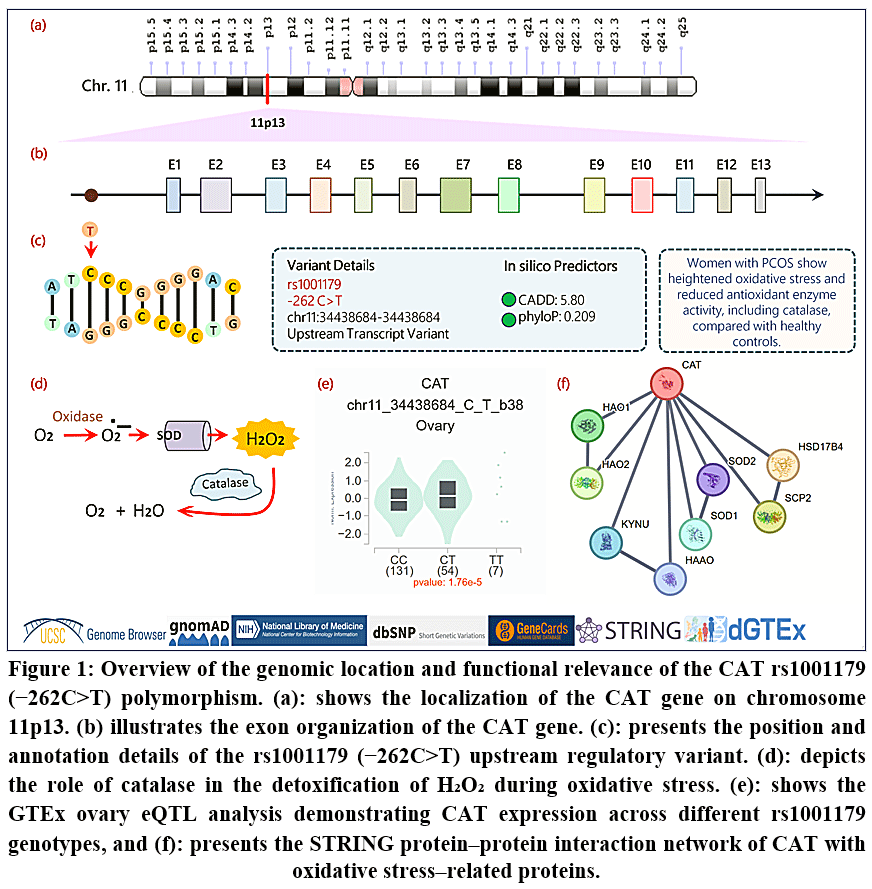 |
Figure 1: Overview of the genomic location and functional relevance of the CAT rs1001179 (−262C>T) polymorphism. (a): shows the localization of the CAT gene on chromosome 11p13. (b) illustrates the exon organization of the CAT gene. |
The CAT protein also interacts with several other oxidative stress-related proteins, including SOD1, SOD2, HAO1, HAO2, and HSD17B4, highlighting its role within a broader antioxidant network (Figure 1F). By converting hydrogen peroxide into water and oxygen, catalase plays a crucial part in cellular defense by shielding cellular components from oxidative damage (Figure 1D).6-8 Different research studies across varied populations have investigated CAT gene polymorphisms; however, their findings have been variable,9-12 with some reporting significant associations with disease susceptibility while others observed no clear relationship. These inconsistencies may be due to ethnic diversity, sample size differences, environmental exposures, or methodological variations.
Since earlier investigations have reported inconsistent associations, this study was undertaken to provide a more comprehensive understanding of the relationship between CAT polymorphisms and the risk of PCOS. To our knowledge, this is the first pooled analysis conducted specifically for this gene. By integrating data from multiple sources and applying a rigorous analytical approach, this study seeks to offer clearer evidence and bridge the gaps left by earlier individual studies.
Method
Literature survey
This study aimed to investigate whether the CAT rs1001179 (−262C>T) polymorphism is linked to susceptibility to PCOS. To identify relevant studies, we carried out a detailed search of several electronic sources, including PubMed-NCBI, Google Scholar, and Semantic Scholar. The selection process involved searching, screening, assessing eligibility, and including studies according to internationally accepted PRISMA recommendations, which helped maintain a clear, consistent, and reproducible methodology.37
A structured set of targeted keywords and Boolean combinations was used to identify all relevant studies assessing the CAT −262C>T variant and PCOS risk. Search terms included: “CAT gene polymorphism and PCOS,” “CAT rs1001179 and PCOS,” “CAT −262C>T variant,” “catalase gene polymorphism and polycystic ovary syndrome,” and “CAT promoter polymorphism and PCOS susceptibility.” Non-peer-reviewed sources, including conference abstracts, book chapters, dissertations, and preprints, were eliminated in order to reduce reporting bias. Only full-text, peer-reviewed case–control studies published in English with clearly reported genotype or allele distributions were included, ensuring high-quality evidence and robust pooled estimates.
Inclusion and Exclusion Criteria, Data Extraction, and Quality Assessment
To improve the reliability of this meta-analysis, clear inclusion and exclusion criteria were established (Table 1) so that only relevant and sufficiently detailed studies were included. Each selected study was carefully reviewed for its study design, participant characteristics, and overall methodological quality. Data extraction and quality assessment were performed systematically to ensure the accuracy and consistency of the collected information.
Table 1: Inclusion and Exclusion Criteria for the Present Study
|
Feature |
Inclusion Criteria | Exclusion Criteria |
| Study Design | Original peer-reviewed case–control or cohort investigations reporting primary data. |
Family-based (pedigree) studies, genome-wide association studies (GWAS), review articles, conference abstracts, or any study design not appropriate for quantitative meta-analysis. |
|
Case Definition |
Participants diagnosed with polycystic ovary syndrome (PCOS) using recognized clinical or diagnostic guidelines, such as the Rotterdam criteria. | Studies lacking a confirmed diagnosis of PCOS or including participants with other endocrine disorders or significant co-existing diseases. |
| Genetic Polymorphism | Investigation of the catalase (CAT) rs1001179 (−262C>T) polymorphism with clearly specified genotype information. |
Studies that did not evaluate the rs1001179 variant or failed to clearly identify the genetic polymorphism examined. |
|
Genotype Data |
Availability of genotype and/or allele distribution data for both PCOS cases and control subjects. | Publications that did not provide sufficient genotype or allele frequency information for analysis. |
| Hardy–Weinberg Equilibrium (HWE) | Control population demonstrating genotype distributions consistent with Hardy–Weinberg equilibrium. |
Studies in which the control group significantly deviated from Hardy–Weinberg equilibrium. |
|
Effect Size Estimation |
Data adequate to derive odds ratios (ORs) and corresponding 95% confidence intervals (CIs). | Studies with insufficient information to estimate genetic association measures. |
| Methodological Quality | Studies achieving a Newcastle–Ottawa Scale (NOS) score of 5 or higher, indicating acceptable methodological quality. |
Studies rated as low quality with an NOS score below 5. |
Numerical data were systematically extracted, and missing or unclear information was supplemented using previous meta-analyses, related publications, or by contacting study authors when necessary. Three researchers independently extracted the data, and the corresponding author verified its accuracy. Any differences in assessment were resolved by the corresponding author.13
Statistical Analysis
Genotype data from all eligible studies were extracted and analyzed to obtain pooled genotype and allele frequencies using GeneRiskCalc.14 This helped standardize the genetic estimates and improve comparability among the included studies. The Chi-square test was applied to evaluate Hardy–Weinberg equilibrium (HWE) in the control groups, and p > 0.05 was considered consistent with equilibrium. The association between the CAT rs1001179 (−262C>T) polymorphism and PCOS risk was assessed by calculating odds ratios (ORs) with 95% confidence intervals (CIs) under different genetic models. Cochran’s Q test and the I² statistic were used to examine heterogeneity among studies. A random-effects model was used when substantial heterogeneity was observed (I² > 55%); otherwise, a fixed-effect model was applied. Potential publication bias was evaluated using Begg’s rank correlation test and Egger’s regression test. Sensitivity analysis was performed by removing one study at a time to determine the stability of the pooled results. All statistical analyses were conducted using the Meta-Genyo online platform for genetic association meta-analysis.15 All statistical tests were two-sided, and a P value < 0.05 was considered statistically significant throughout the analyses.
Results
Characteristics of Included Studies
After the stepwise exclusion of the retrieved literature (Figure 2), a total of four eligible case–control studies (Table 2), comprising 1,847 participants (1023 PCOS cases and 824 healthy controls), met the predefined inclusion criteria and were included in the meta-analysis to investigate the association between the CAT −262C>T polymorphism and susceptibility to PCOS. These studies encompassed populations from diverse ethnic backgrounds, including Asian (Iranian and Chinese), European (Slovenian), and Russian cohorts. All studies employed hospital-based sampling and utilized established genotyping techniques such as PCR-RFLP, RT-PCR, and KASPar assays. PCOS diagnosis was uniformly based on the Rotterdam criteria, with one study additionally applying the ESHRE/ASRM consensus guidelines.
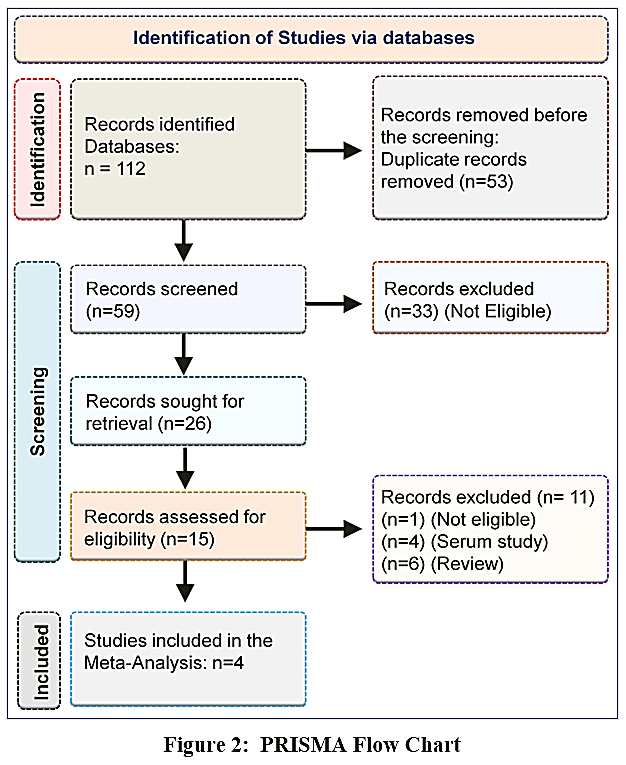 |
Figure 2: PRISMA Flow Chart Click here to View Figure |
Sample sizes varied, ranging from 26 to 654 cases and 33 to 535 controls. Complete genotype data were reported for all studies, and Hardy–Weinberg equilibrium was confirmed in the control groups (p > 0.05). Quality assessment using the NOS yielded scores of 6 for all studies, indicating acceptable methodological quality (Table 2). Detailed study characteristics, including country, ethnicity, genotyping method, diagnostic criteria, sample sizes, genotype distributions, HWE results, and quality scores, are summarized in Table 2.
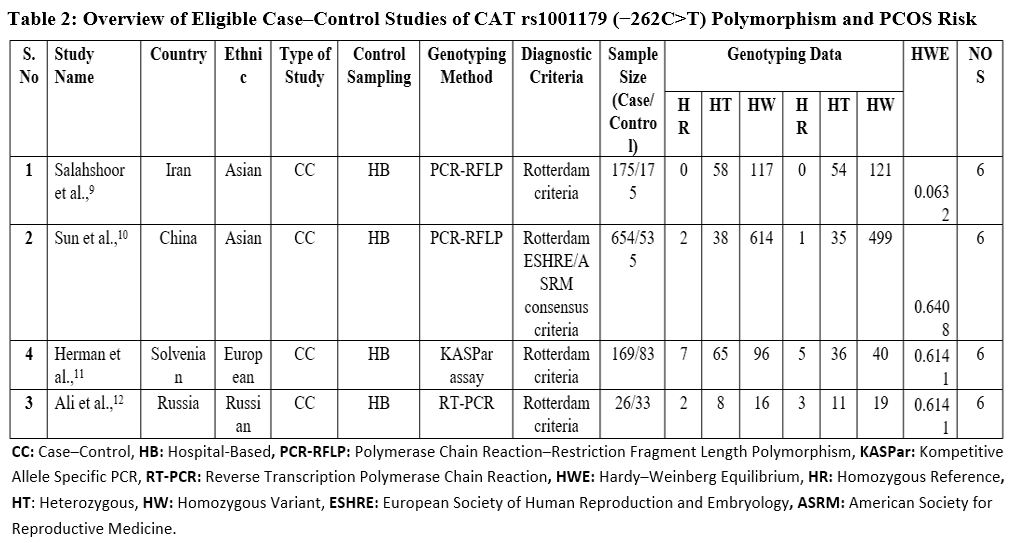 |
Table 2: Overview of Eligible Case–Control Studies of CAT rs1001179 (−262C>T) Polymorphism and PCOS Risk Click here to View Table |
Genetic Association
No significant relationship was observed between the CAT rs1001179 (−262C>T) polymorphism and PCOS risk across all genetic models. For the allele model, the OR was 0.92 (95% CI: 0.73–1.17; p = 0.50) (Figure 3A). The recessive model showed an OR of 0.80 (95% CI: 0.32–2.01; p = 0.63), while the dominant model had an OR of 0.92 (95% CI: 0.70–1.20; p = 0.53). The over-dominant model yielded an OR of 0.93 (95% CI: 0.71–1.22; p = 0.61). Genotype comparisons indicated no significant associations: HR vs HW (OR = 0.73, 95% CI: 0.29–1.88; p = 0.52), HR vs HT (OR = 0.92, 95% CI: 0.35–2.40; p = 0.86), and HT vs HW (OR = 0.92, 95% CI: 0.70–1.21; p = 0.56) (Table 3).
Heterogeneity was low across all analyses, with I² values of 0% and non-significant Cochran’s Q tests, justifying the use of fixed-effect models. Egger’s tests for publication bias (Figure 3B) were non-significant in all models (p-values ranged from 0.24 to 0.80), indicating no evidence of small-study effects (Table 3). These findings suggest that the CAT −262C>T polymorphism is not significantly associated with PCOS susceptibility in the studied populations.The pooled effect estimate remained largely unchanged when each study was removed one at a time, suggesting that no individual study had a major influence on the overall results. This indicates that the findings of the meta-analysis were stable and reliable (Figure 4).
Table 3: Pooled Effect Estimates for CAT rs1001179 (−262C>T) Polymorphism Under Different Genetic Models for overall population
|
Model |
Test of association | Test of heterogeneity | Publication bias p-val (Egger’s test) | ||||
| OR | 95% CI | p-val | Model | p-val |
I^2 |
||
|
Allele |
0.92 | 0.7279-1.1663 | 0.495897 | Fixed | 0.726 | 0 | 0.7983 |
| Recessive | 0.80 | 0.3180-2.0073 | 0.633003 | Fixed | 0.8008 | 0 |
0.2791 |
|
Dominant |
0.92 | 0.7025-1.1987 | 0.52853 | Fixed | 0.7018 | 0 | 0.6645 |
| OD | 0.93 | 0.7114-1.2215 | 0.610664 | Fixed | 0.7972 | 0 |
0.7141 |
|
HR vs HW |
0.73 | 0.2873-1.8764 | 0.518655 | Fixed | 0.7536 | 0 | 0.2394 |
| HR vs HT | 0.92 | 0.3530-2.3977 | 0.864545 | Fixed | 0.8246 | 0 |
0.4128 |
|
HT vs HW |
0.92 | 0.7024-1.2106 | 0.559305 | Fixed | 0.7452 | 0 |
0.669 |
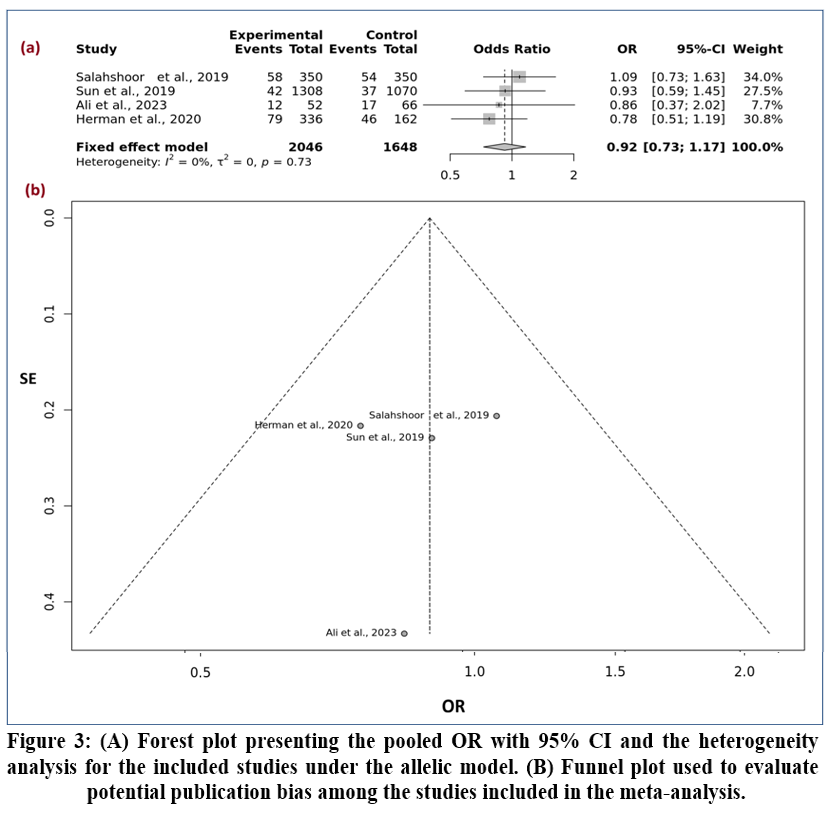 |
Figure 3: (A) Forest plot presenting the pooled OR with 95% CI and the heterogeneity analysis for the included studies under the allelic model. (B) Funnel plot used to evaluate potential publication bias among the studies included in the meta-analysis. |
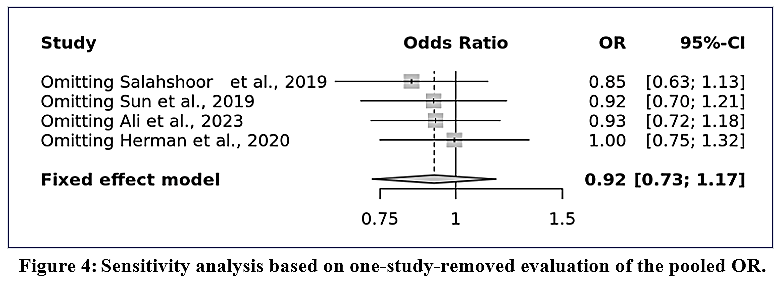 |
Figure 4: Sensitivity analysis based on one-study-removed evaluation of the pooled OR. Click here to View Figure |
The subgroup analysis according to ethnicity did not identify any significant association between CAT −262C>T and PCOS risk in any genetic model (Table 4). In Asians, allele model OR was 0.99 (95% CI: 0.74–1.34; p = 0.96), Europeans 0.78 (95% CI: 0.51–1.19; p = 0.24), and Russians 0.86 (95% CI: 0.37–2.02; p = 0.74). Other models showed similar non-significant results across ethnicities. Heterogeneity was low (I² = 0%) in Asians; heterogeneity and publication bias were not assessed for other groups due to limited studies. These results suggest no significant ethnic-specific effect of CAT −262C>T on PCOS risk.
Table 4: Ethnicity-Stratified Meta-Analysis of CAT rs1001179 (−262C>T) Polymorphism Across Genetic Models
|
Model |
Ethnicity | #Studies | Test of association | Test of heterogeneity | Publication bias p-val (Egger’s test) | ||||
| OR | 95% CI | p-val | Model | p-val |
I^2 |
||||
|
Allele |
Asian |
2 | 0.99 | 0.73-1.33 | 0.9641 | F | 0.6835 | 0 | NA |
| Europeans | 1 | 0.78 | 0.50-1.18 | 0.2396 | F | NA | NA |
NA |
|
|
Russian |
1 | 0.86 | 0.37-2.02 | 0.7371 | F | NA | NA | NA | |
| Recessive | Asian | 2 | 0.92 | 0.13-6.32 | 0.9359 | F | 0.4362 | 0 |
NA |
|
Europeans |
1 | 0.66 | 0.20-2.14 | 0.4913 | F | NA | NA | NA | |
| Russian | 1 | 0.83 | 0.12-5.39 | 0.8483 | F | NA | NA |
NA |
|
|
Dominant |
Asian | 2 | 1.00 | 0.72-1.37 | 0.9805 | F | 0.5669 | 0 | NA |
| Europeans | 1 | 0.73 | 0.42-1.24 | 0.2499 | F | NA | NA |
NA |
|
|
Russian |
1 | 0.85 | 0.29-2.42 | 0.7584 | F | NA | NA | NA | |
| Over-dominant | Asian | 2 | 1.00 | 0.72-1.38 | 0.9997 | F | 0.4719 | 0 |
NA |
|
Europeans |
1 | 0.79 | 0.46-1.34 | 0.3867 | F | NA | NA | NA | |
| Russian | 1 | 0.89 | 0.29-2.67 | 0.8343 | F | NA | NA |
NA |
|
|
HR vs HW |
Asian |
2 | 0.93 | 0.13-6.37 | 0.9422 | F | 0.4485 | 0 | NA |
| Europeans | 1 | 0.58 | 0.17-1.94 | 0.3808 | F | NA | NA |
NA |
|
| Russian | 1 | 0.79 | 0.11-5.33 | 0.8104 | F | NA | NA |
NA |
|
|
HR vs HT |
Asian |
2 | 0.96 | 0.13-6.73 | 0.9684 | F | 0.3882 | 0 | NA |
| Europeans | 1 | 0.78 | 0.22-2.62 | 0.6822 | F | NA | NA |
NA |
|
|
Russian |
1 | 0.92 | 0.12-6.82 | 0.9323 | F | NA | NA | NA | |
| HT vs HW | Asian | 2 | 1.00 | 0.71-1.38 | 0.9814 | F | 0.4897 | 0 |
NA |
|
Europeans |
1 | 0.75 | 0.43-1.30 | 0.3100 | F | NA | NA | NA | |
| Russian | 1 | 0.86 | 0.27-2.66 | 0.7989 | F | NA | NA |
NA |
|
HW: Homozygous Recessive, HT: Heterozygous, HR: Homozygous Recessive, OR: Odds Ratio, NA: Not Applicable, F: Fixed
Discussion
Catalase, a key antioxidant enzyme responsible for the detoxification of hydrogen peroxide and maintenance of cellular redox homeostasis, is encoded by the CAT gene.16–19 By catalyzing the conversion of hydrogen peroxide into water and oxygen, catalase protects cells from oxidative damage and prevents the accumulation of ROS, which are known to impair cellular integrity and metabolic functions. Functional polymorphisms within the CAT gene, particularly those located in promoter or regulatory regions, may alter transcriptional activity and enzyme expression, thereby increasing susceptibility to oxidative stress–related disorders.7,20 Among these variants, the CAT -262C>T polymorphism has attracted considerable attention because of its potential influence on catalase activity and oxidative balance.
Oxidative stress has been widely recognized as a central contributor to the pathogenesis of PCOS.21-25 Elevated ROS levels and impaired antioxidant defense systems have been consistently reported in women with PCOS, suggesting that oxidative imbalance may contribute to both the initiation and progression of the disorder. Excessive ROS production can disrupt ovarian steroidogenesis, impair follicular maturation, induce chronic low-grade inflammation, and aggravate insulin resistance, all of which are key pathological features of PCOS.26 Moreover, oxidative stress may influence reproductive outcomes by negatively affecting oocyte quality and endocrine signaling pathways, further emphasizing the importance of antioxidant-related genes in PCOS susceptibility. Given the role of catalase in antioxidant defense, this systematic review examined the association between the CAT −262C>T polymorphism and susceptibility to PCOS. To our knowledge, this is the first comprehensive meta-analysis focused on this association.
The pooled analysis demonstrated no statistically significant association between the CAT -262C>T variant and PCOS susceptibility under any of the evaluated genetic models (Table 3). Similar findings were observed across allelic, dominant, recessive, homozygous, and heterozygous comparisons, indicating that the variant does not appear to exert a major independent effect on disease risk. Importantly, the meta-analysis revealed low inter-study heterogeneity across most genetic comparisons, suggesting strong consistency among the included studies. Additionally, publication bias analyses showed no significant asymmetry, indicating that the pooled findings were unlikely to be influenced by selective reporting or small-study effects (Table 3). These observations strengthen the reliability and robustness of the current results. The findings are also in agreement with previously published individual case–control studies conducted in different populations which similarly failed to identify a significant relationship between the CAT -262C>T polymorphism and PCOS susceptibility.9,10,12 Furthermore, ethnicity-based subgroup analyses did not reveal any statistically significant association in either Asian or non-Asian populations (Table 4), suggesting that the lack of association is unlikely to be population-specific. This indicates that the CAT -262C>T polymorphism may not play a substantial role in determining genetic susceptibility to PCOS across diverse ethnic backgrounds.
Crucially, these findings do not indicate that catalase activity or the CAT gene lacks relevance in the pathogenesis of PCOS. The absence of an association for the -262C>T variant cannot be generalized to the entire gene or its biological function, as the present analysis evaluated only a single promoter polymorphism. Substantial functional evidence supports the involvement of CAT in ovarian physiology and PCOS-related processes. Several studies have reported reduced catalase activity in women with PCOS, reflecting impaired antioxidant defense and increased oxidative stress.27–29 Similarly, another studyobserved decreased CAT activity along with elevated malondialdehyde (MDA) levels, indicating enhanced lipid peroxidation and oxidative imbalance in PCOS patients.30
In contrast, some studies have reported increased CAT activity in PCOS, which has been interpreted as a compensatory antioxidant response to elevated reactive oxygen species. Multiple study group demonstrated enhanced CAT activity in PCOS models associated with oxidative stress and inflammation.31,32 Additionally, another studyreported altered oxidative stress markers, including CAT and MDA, in a letrozole-induced PCOS model, while L-carnitine treatment improved antioxidant status and ovarian function.33 Collectively, these findings suggest that oxidative stress dysregulation and altered catalase activity play important roles in PCOS pathophysiology, although the direction of CAT activity changes may vary depending on disease stage, metabolic condition, and compensatory antioxidant responses.In addition, oxidative stress imbalance and altered catalase activity have been observed in the follicular fluid of PCOS patients, further supporting a role for CAT in the ovarian microenvironment.12 Notably, catalase activity appears to be influenced by metabolic status and clinical heterogeneity within PCOS. Bausenwein et al.,34 reported significantly higher catalase activity in the follicular fluid of obese women as compared with non-obese women with and without PCOS, suggesting a compensatory antioxidant response to obesity-related oxidative stress. Further, it has been observed that women with PCOS and insulin resistance have been shown to exhibit reduced catalase activity, highlighting the interaction between oxidative stress, metabolic dysfunction, and antioxidant defense mechanisms.35 Notably, antioxidant supplementation has been shown to restore and enhance catalase activity in PCOS patients who initially exhibit reduced antioxidant capacity.36
Collectively, these findings suggest that while the CAT -262C>T polymorphism alone may not influence PCOS susceptibility, catalase activity is dynamically regulated by genetic, metabolic, and environmental factors and likely contributes to PCOS pathophysiology through oxidative stress–related pathways. Future investigations incorporating multiple CAT variants, functional analyses, and metabolic stratification are required to fully elucidate the gene’s role in PCOS.
Strengths, Limitations and Future Perspective
This meta-analysis rigorously synthesized data from multiple peer-reviewed case–control studies, increasing statistical power to detect associations between the CAT -262C>T polymorphism and PCOS risk. The use of standardized quality assessment tools and adherence to PRISMA guidelines ensured methodological rigor and transparency. Subgroup analyses by ethnicity further enhanced the interpretability of results across diverse populations. Despite these strengths, limitations exist. The relatively small number of available studies and modest sample sizes limited the ability to detect subtle genetic effects. Heterogeneity in study designs, diagnostic criteria, and genotyping methods may have introduced variability. Additionally,the absence of comprehensive individual-level data prevented the investigation of any gene–gene and gene–environment interactions.
Future research should focus on large-scale, well-designed multicenter studies incorporating standardized diagnostic criteria and genotyping protocols. Investigations into combined effects of multiple oxidative stress-related gene polymorphisms and environmental factors are warranted to better understand the complex pathophysiology of PCOS. Functional studies elucidating the biological impact of CAT variants will also provide mechanistic insights.
Conclusion
This meta-analysis reported no significant association between the CAT rs1001179 (−262C>T) polymorphism and susceptibility to PCOS across multiple genetic models and ethnic groups. While oxidative stress remains a critical factor in PCOS pathogenesis, this particular genetic variant does not appear to substantially influence disease risk. Continued research incorporating larger cohorts and integrative approaches is necessary to clarify the genetic architecture underlying PCOS and its oxidative stress components.
Acknowledgment
The author would like to acknowledge the Institute of Human Genetics, University of Jammu, Jammu, for its academic support and research facilities that contributed to this systematic review and meta-analysis.
Funding Sources
The author(s) received no financial support for the research, authorship, and/or publication of this article.
Conflict of Interest
The authors do not have any conflict of interest.
Data Availability Statement
This statement does not apply to this article.
Ethics Statement
This research did not involve human participants, animal subjects, or any material that requires ethical approval.
Informed Consent Statement
This study did not involve human participants, and therefore, informed consent was not required.
Clinical Trial Registration
This research does not involve any clinical trials.
Permission to reproduce material from other sources
Not Applicable.
Author Contributions
- Amrit Sudershan: Data Curation, Formal Analysis, Investigation, Writing – Original Draft, Visualization
- Ankush Bala: Data Curation, Formal Analysis, Investigation, Writing – Original Draft
- Bashir Ahmad Sheikh: Formal Analysis, Investigation.
- Srishty Sudershan: Data Curation, Formal Analysis, Investigation, Writing – Original Draft
- Mohd Younis: Conceptualization, Supervision, Visualization, Writing – Review & Editing
- Parvinder Kumar: Conceptualization, Supervision, Writing – Review & Editing, Project Administration
References
- Su P, Chen C, Sun Y. Physiopathology of polycystic ovary syndrome in endocrinology, metabolism and inflammation. J Ovarian Res. 2025;18(1):34.
CrossRef - Mohammadi M. Oxidative stress and polycystic ovary syndrome: A brief review. Int J Prev Med. 2019;10(1):86.
CrossRef - Liu H, Jin L, Wang X, et al. Reactive oxygen species in polycystic ovary syndrome: Mechanistic insights into pathogenesis and therapeutic opportunities. Redox Biol. 2025;85:103776. doi:10.1016/j.redox.2025.103776
CrossRef - Ershova OA, Bairova TA, Kolesnikov SI, Kalyuzhnaya OV, Darenskaya MA, Kolesnikova LI. Oxidative stress and catalase gene. Bull Exp Biol Med. 2016;161(3):400-403.
CrossRef - Forsberg L, Lyrenäs L, Morgenstern R, de Faire U. A common functional C/T substitution polymorphism in the promoter region of the human catalase gene influences transcription factor binding, reporter gene transcription, and is correlated with blood catalase levels. Free Radic Biol Med. 2001;30(5):500-505.
CrossRef - Saify K. Genetic polymorphisms in the promoter region of the catalase gene create new potential PAX-6 and STAT4 response elements. Mol Biol Res Commun. 2016;5(2):97-100.
- Nandi A, Yan LJ, Jana CK, Das N. Role of catalase in oxidative stress- and age-associated degenerative diseases. Oxid Med Cell Longev. 2019;2019:9613090. doi:10.1155/2019/9613090
CrossRef - Baker A, Lin CC, Lett C, Karpinska B, Wright MH, Foyer CH. Catalase: A critical node in the regulation of cell fate. Free Radic Biol Med. 2023;199:56-66.
CrossRef - Salahshoor MR, Sohrabi M, Jalili F, et al. No evidence for a major effect of three common polymorphisms of the GPx1, MnSOD, and CAT genes on PCOS susceptibility. J Cell Biochem. 2019;120(2):2362-2369.
CrossRef - Sun Y, Li S, Liu H, et al. Association of GPx1 P198L and CAT C-262T genetic variations with polycystic ovary syndrome in Chinese women. Front Endocrinol (Lausanne). 2019;10:771.
doi:10.3389/fendo.2019.00771
CrossRef - Herman R, Jensterle M, Janež A, Goričar K, Dolžan V. Genetic variability in antioxidative and inflammatory pathways modifies the risk for PCOS and influences the metabolic profile of the syndrome. 2020;10(11):439.
CrossRef - Ali RM, Lomteva SV, Aleksandrova AA, et al. Effect of polymorphisms CYP17 (rs743572), SOD2 (rs4880), and CAT (rs1001179) on hormonal profile and redox status of blood serum and follicular fluid in patients with polycystic ovary syndrome. Gene Rep. 2023;33:101817.
CrossRef - Sudershan A, Ganie MA, Fayaz M, Jan J, Pushap AC, Bashir M. PON1 genetic polymorphisms and susceptibility to polycystic ovary syndrome: A comprehensive updated meta-analysis. Hum Gene. 2026;201554.
CrossRef - Sudershan A, Singh K, Kumar P. GeneRiskCalc: A web-based tool for genetic risk association analysis in case-control studies. BMC Bioinformatics. 2025;26(1):213.
CrossRef - Martorell-Marugan J, Toro-Dominguez D, Alarcon-Riquelme ME, Carmona-Saez P. MetaGenyo: A web tool for meta-analysis of genetic association studies. BMC Bioinformatics. 2017;18(1):563. doi:10.1186/s12859-017-1990-4
CrossRef - Gaetani GF, Galiano S, Canepa L, Ferraris AM, Kirkman HN. Catalase and glutathione peroxidase are equally active in detoxification of hydrogen peroxide in human erythrocytes. 1989;73(1):334-339.
CrossRef - Zamocky M, Furtmüller PG, Obinger C. Evolution of catalases from bacteria to humans. Antioxid Redox Signal. 2008;10(9):1527-1548.
CrossRef - Ighodaro OM, Akinloye OA. First-line defence antioxidants—superoxide dismutase (SOD), catalase (CAT), and glutathione peroxidase (GPX): Their fundamental role in the entire antioxidant defence grid. Alexandria J Med. 2018;54(4):287-293.
CrossRef - Rasheed Z. Therapeutic potentials of catalase: Mechanisms, applications, and future perspectives. Int J Health Sci. 2024;18(2):1.
- Eras N, Türkoz G, Tombak A, et al. An investigation of the relation between catalase C262T gene polymorphism and catalase enzyme activity in leukemia patients. Arch Med Sci. 2019;17(4):928-934.
CrossRef - Rosenfield RL, Ehrmann DA. The pathogenesis of polycystic ovary syndrome (PCOS): The hypothesis of PCOS as functional ovarian hyperandrogenism revisited. Endocr Rev. 2016;37(5):467-520. doi:10.1210/er.2015-1104
CrossRef - Harada M. Pathophysiology of polycystic ovary syndrome revisited: Current understanding and perspectives regarding future research. Reprod Med Biol. 2022;21(1):e12487. doi:10.1002/rmb2.12487
CrossRef - Armanini D, Boscaro M, Bordin L, Sabbadin C. Controversies in the pathogenesis, diagnosis, and treatment of PCOS: Focus on insulin resistance, inflammation, and hyperandrogenism. Int J Mol Sci. 2022;23(8):4110.
CrossRef - Awonuga AO, Camp OG, Abu-Soud HM. A review of nitric oxide and oxidative stress in typical ovulatory women and in the pathogenesis of ovulatory dysfunction in PCOS. Reprod Biol Endocrinol. 2023;21(1):111.
CrossRef - Dong J, Rees DA. Polycystic ovary syndrome: Pathophysiology and therapeutic opportunities. BMJ Med. 2023;2(1):e000548.
CrossRef - Zeber-Lubecka N, Ciebiera M, Hennig EE. Polycystic ovary syndrome and oxidative stress—from bench to bedside. Int J Mol Sci. 2023;24(18):14126. doi:10.3390/ijms241814126
CrossRef - Abbasian M, Delvarianzadeh M, Ebrahimi H, Khosravi F, Nourozi P. Relationship between serum levels of oxidative stress and metabolic syndrome components. Diabetes Metab Syndr. 2018;12(4):497-500.
CrossRef - Oyebanji OG, Asaolu MF. Assessment of antioxidant status of women with polycystic ovarian syndrome. Asian Pac J Reprod. 2020;9(1):9-15.
CrossRef - Hadi ZK, Al-Maamori JAI. Evaluation of some oxidants and enzymatic endogenous antioxidant status among women with polycystic ovary syndrome. In: AIP Conf Proc. Vol 2290. AIP Publishing LLC; 2020:030002.
CrossRef - Jawad Hassan R, Mohammad Hasson Al-Husseini A. Estimation of catalase activity and malondialdehyde levels in ABO blood groups of patients with PCOS. In: J Phys Conf Ser. Vol 1294. IOP Publishing; 2019:062100.
CrossRef - Nawrocka-Rutkowska J, Szydłowska I, Jakubowska K, Olszewska M, Chlubek D, Rył A. Assessment of the parameters of oxidative stress depending on metabolic and anthropometric status indicators in women with PCOS. Life (Basel). 2022;12(2):225. doi:10.3390/life12020225
CrossRef - Wang F, Wang S, Zhang Z, et al. Activation of NLRP3 inflammasome in the ovaries during the development and treatment of polycystic ovary syndrome. Int J Clin Exp Pathol. 2017;10:5022-5030.
- Elmosalamy SH, Elleithy EM, Ahmed ZSO, Rashad MM, Ali GE, Hassan NH. Dysregulation of intraovarian redox status and steroidogenesis pathway in a letrozole-induced PCOS rat model: A possible modulatory role of L-carnitine. Beni Suef Univ J Basic Appl Sci. 2022;11(1):146.
CrossRef - Bausenwein J, Serke H, Eberle K, et al. Elevated levels of oxidized low-density lipoprotein and catalase activity in follicular fluid of obese women. Mol Hum Reprod. 2009;16(2):117-124.
CrossRef - Özer A, Bakacak M, Kıran H, et al. Increased oxidative stress is associated with insulin resistance and infertility in polycystic ovary syndrome. Ginekol Pol. 2016;87(11):733-738.
CrossRef - Panti AA, Shehu CE, Saidu Y, et al. Oxidative stress and outcome of antioxidant supplementation in patients with polycystic ovarian syndrome (PCOS). Int J Reprod Contracept Obstet Gynecol. 2018;7(5):1667-1672.
CrossRef - Page MJ, McKenzie JE, Bossuyt PM, et al. The PRISMA 2020 statement: an updated guideline for reporting systematic reviews. BMJ. 2021;372:n71.
CrossRef
Abbreviations
PCOS: Polycystic Ovary Syndrome
CAT: Catalase
ROS: Reactive Oxygen Species
HWE: Hardy–Weinberg Equilibrium
NOS: Newcastle–Ottawa Scale
OR: Odds Ratio
CI: Confidence Interval
PRISMA: Preferred Reporting Items for Systematic Reviews and Meta-Analyses
HB: Hospital-Based
CC: Case–Control
PCR-RFLP: Polymerase Chain Reaction–Restriction Fragment Length Polymorphism
RT-PCR: Real-Time Polymerase Chain Reaction
GTEx: Genotype-Tissue Expression
eQTL: espression Quantitative Trait Locus
STRING: Search Tool for the Retrieval of Interacting Genes/Proteins
GWAS: Genome-Wide Association Studies
KASP: Kompetitive Allele-Specific PCR
Accepted on: 04-09-2026
Second Review by: Dr. Randa Salah Gomaa Mahmoud
Final Approval by: Dr. Eugene A. Silow