Study of Soil Health in Irrigated and Non-Irrigated Bt Cotton in North Maharashtra Region of India
 and Amanulla Khan2
 1Department of Botany, G. T. Patil Arts, Commerce and Science College, Nandurbar, Maharashtra, India
2Department of Botany Anjuman Islam Janjira Degree College of Science, Murud Janjira Raigad, Maharashtra, India.
Corresponding Author E-mail: sandipmarathe4u@gmail.com
DOI : http://dx.doi.org/10.13005/bbra/3494
Download this article as:

Soil health plays a pivotal role in sustaining agricultural productivity, particularly in the context of genetically modified crops such as Bt cotton. This study assesses soil fertility and physical parameters under irrigated and non-irrigated Bt cotton cultivation systems in North Maharashtra, India, spanning Jalgaon, Dhule, and Nandurbar districts. Using 210 soil samples collected over six years (2017-2023), key indicators including pH, electrical conductivity (EC), organic carbon (OC), and calcium carbonate (CaCO₃) were analyzed. Results reveal minimal variations between irrigated and non-irrigated soils but indicate low organic carbon and slightly alkaline soil conditions across both systems. The current research work emphasizes the need and important for integrated organic nutrient management to restore soil fertility under intensive Bt cotton cultivation practices.
KEYWORDS:Bt cotton; Soil fertility; Irrigation; pH; Organic carbon; North Maharashtra; Soil health
Introduction
Soil fertility and productivity are interdependent parameters influencing agricultural sustainability.1,2 Bt cotton (Gossypium hirsutum L.), a transgenic crop introduced for pest resistance, has been widely adopted across India.3,4 However, long term cultivation under varying irrigation regimes raises concerns regarding soil nutrient depletion and microbial balance.5,6 The North Maharashtra region, characterized by medium black soils with high clay content, is known for its dependence on cotton-based cropping systems for local farmers.7,8 While Bt cotton has improved pest resistance in many varieties with its high yield, its impact on soil quality remains a debated issue.9,10 Studies from semi-arid ecosystems in many area are suggest that irrigation patterns significantly influence physicochemical soil properties, including organic matter turnover, microbial respiration, disease resistance and nutrient leaching.11,12 Hence, a region-specific comparative evaluation of irrigated and non-irrigated Bt cotton soils is essential for designing sustainable management strategies.13
Materials and Methods
The study was carried out between 2017 and 2023 across 20 villages located in Jalgaon, Dhule, and Nandurbar districts. The region experiences semi-arid climatic conditions with mean annual rainfall of 750-800 mm. A total of 210 composite soil samples were collected from 0-20 cm depth near the rhizosphere of Bt cotton plants following standard sampling protocols.14 For each farm, samples from irrigated and non-irrigated plots were analyzed for pH, EC, OC, and CaCO₃ using procedures standard procedures.15–17 The pH and EC were measured in a 1:2.5 soil-water suspension, organic carbon via Walkley and Black’s wet oxidation, and CaCO₃ by acid neutralization method.18,19 Statistical analysis was performed, and results were interpreted through statistics and graphical distributed matrices.
Results
The fertility status of the study area was primarily assessed through four indicators: pH, EC, OC, and CaCO₃. The average pH of Bt cotton soils (7.65) was slightly lower than the Maharashtra state average (8.0) (Fig. 1.), indicating mildly alkaline soils suitable for cotton cultivation (Table 1). The EC values ranged from 0.29-0.70 m mhos/cm across all samples, with mean EC of 0.45 m mhos/cm in irrigated and 0.48 m mhos/cm in non-irrigated plots. These values were below the salinity threshold for Bt cotton (1.0 m mhos/cm), suggesting favorable ionic balance.20
Table 1: Comparison of physicochemical properties of Maharashtra soils with Bt cotton soils in study area
| Parameter | Maharashtra Soil | Bt Cotton Soil (Study Area) |
| pH | 8.0 | 7.65 |
| Electrical Conductivity (m mho/cm) | 1.0 | 0.45 |
| Organic Carbon (%) | 1.75 | 0.3 |
| Calcium Carbonate (%) | 3.0 | 5.2 |
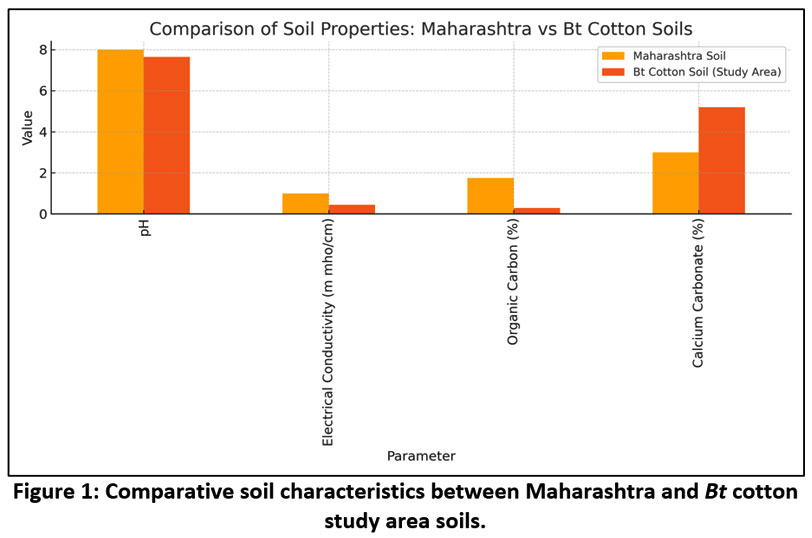 |
Figure 1: Comparative soil characteristics between Maharashtra and Bt cotton study area soils.
|
Discussion
Organic carbon content across the study sites was consistently lower (0.30%) than the state average (1.5-2.0%), reflecting declining soil organic matter due to intensive monocropping and low organic input use. Similar findings were reported by Angir 19, who observed significant depletion of carbon and nitrogen stocks under Bt cotton systems. The observed CaCO₃ content (5.20%) was within optimal limits, indicating adequate buffering capacity to maintain soil pH.
Conclusion
This study demonstrates that Bt cotton cultivation, whether irrigated or non-irrigated, exerts minimal influence on soil pH, EC, and CaCO₃ levels. However, persistently low level of organic carbon values highlights the urgent need for incorporating organic amendments, crop rotation, and residue recycling. Long-term monitoring of soil biological indicators such as microbial biomass, its irrigation and enzyme activity is recommended to complement the current physicochemical assessments.
Acknowledgement
The author is sincerely thankful to the farmers of Nandurbar, Dhule, and Jalgaon districts for their cooperation during sample collection. Special thanks to Prof. Dr. Vipul J. Somani for valuable guidance and to the management of NTVS’s G.T. Patil Arts, Commerce and Science College, Nandurbar, for continuous support throughout the study.
Funding Sources
The author(s) received no financial support for the research, authorship, and/or publication of this article.
Conflict of Interest
The authors do not have any conflict of interest.
Data Availability Statement
This statement does not apply to this article.
Ethics Statement
This research did not involve human participants, animal subjects, or any material that requires ethical approval.
Informed Consent Statement
This study did not involve human participants, and therefore, informed consent was not required.
Clinical Trial Registration
This research does not involve any clinical trials.
Permission to reproduce material from other sources
Not Applicable
Authors’ Contribution
Sandeep Marathe: Conceptualization, Methodology, Supervision, Writing – Original Draft, Resources.
Amanulla Khan: Data Collection, Data Curation, Formal Analysis, Validation, Visualization, Writing – Review & Editing, Literature Review.
References
- Kole C, Pandey S, Yasin JK, et al. Benefits, concerns, and sustainable alternatives to genetically modified crops from a global and Indian perspective. The Plant Genome. 2025;18(4):e70154. doi:10.1002/tpg2.70154
CrossRef - Kumar K, Gambhir G, Dass A, et al. Genetically modified crops: current status and future prospects. Planta. 2020;251(4):91. doi:10.1007/s00425-020-03372-8
CrossRef - Peshin R, Hansra BS, Singh K, et al. Long-term impact of Bt cotton: An empirical evidence from North India. Journal of Cleaner Production. 2021;312:127575. doi:10.1016/j.jclepro.2021.127575
CrossRef - Thangaraj A, Kaul R, Sharda S, Kaul T. Revolutionizing cotton cultivation: A comprehensive review of genome editing technologies and their impact on breeding and production. Biochemical and Biophysical Research Communications. 2025;742:151084. doi:10.1016/j.bbrc.2024.151084
CrossRef - Bhatt MK, Singh DK, Raverkar KP, et al. Effects of varied nutrient regimes on soil health and long-term productivity in a rice–wheat system: insights from a 29-year study in the mollisols of the Himalayan Tarai region. Front Sustain Food Syst. 2023;7:1206878. doi:10.3389/fsufs.2023.1206878
CrossRef - Zhong D, Sun R, Huo Z, Chen J, Dong S, Dong H. Long-Term Irrigation Deficits Impair Microbial Diversity and Soil Quality in Arid Maize Fields. Agronomy. 2025;15(6):1355. doi:10.3390/agronomy15061355
CrossRef - Das BS, Wani SP, Benbi DK, et al. Soil health and its relationship with food security and human health to meet the sustainable development goals in India. Soil Security. 2022;8:100071. doi:10.1016/j.soisec.2022.100071
CrossRef - Kumar R, Mandhana,. A Review of Soil Improvement in Problematic Black Cotton Soil by Using Dry Kota Stone Slurry and Fly Ash. AiBi Revista de Investigación, Administración e Ingeniería. Published online 2024:27-40. doi:10.15649/2346030X.3471
CrossRef - Liu J, Liang Y shan, Hu T, et al. Environmental fate of Bt proteins in soil: Transport, adsorption/desorption and degradation. Ecotoxicology and Environmental Safety. 2021;226:112805. doi:10.1016/j.ecoenv.2021.112805
CrossRef - Naranjo SE. Impacts of Bt Transgenic Cotton on Integrated Pest Management. J Agric Food Chem. 2011;59(11):5842-5851. doi:10.1021/jf102939c
CrossRef - Arroita M, Causapé J, Comín FA, et al. Irrigation agriculture affects organic matter decomposition in semi-arid terrestrial and aquatic ecosystems. Journal of Hazardous Materials. 2013;263:139-145. doi:10.1016/j.jhazmat.2013.06.049
CrossRef - Núñez A, Cotrufo MF, Schipanski M. Irrigation effects on the formation of soil organic matter from aboveground plant litter inputs in semiarid agricultural systems. Geoderma. 2022;416:115804. doi:10.1016/j.geoderma.2022.115804
CrossRef - Vitale GS, Scavo A, Zingale S, et al. Agronomic Strategies for Sustainable Cotton Production: A Systematic Literature Review. Agriculture. 2024;14(9):1597. doi:10.3390/agriculture14091597
CrossRef - Lv N, Liu Y, Guo T, et al. The influence of Bt cotton cultivation on the structure and functions of the soil bacterial community by soil metagenomics. Ecotoxicology and Environmental Safety. 2022;236:113452. doi:10.1016/j.ecoenv.2022.113452
CrossRef - Kaushal M, Wani SP. Plant-growth-promoting rhizobacteria: drought stress alleviators to ameliorate crop production in drylands. Ann Microbiol. 2016;66(1):35-42. doi:10.1007/s13213-015-1112-3
CrossRef - Renshu, Meenakshi, Sonia, Juneja P. Comprehensive Assessment of Soil Chemical and Physical Properties across India. In: Gaballa ProfAS, ed. Chemical and Materials Sciences: Research Findings Vol. 1. BP International; 2025:132-152. doi:10.9734/bpi/cmsrf/v1/4501
CrossRef - Singh RK, Singh P, Li HB, et al. Diversity of nitrogen-fixing rhizobacteria associated with sugarcane: a comprehensive study of plant-microbe interactions for growth enhancement in Saccharum spp. BMC Plant Biol. 2020;20(1):220. doi:10.1186/s12870-020-02400-9
CrossRef - Bremner JM, Jenkinson DS. Determination of organic carbon in soil: i. Oxidation by dichromate of organic matter in soil and plant materials. Journal of Soil Science. 1960;11(2):394-402. doi:10.1111/j.1365-2389.1960.tb01093.x
CrossRef - Laoufi H, Bachir H, Hadj-Miloud S, Clark K. Comparative Assessment of Three Methods for Soil Organic Matter Determination in Calcareous Soils, Eastern Algeria. Land. 2025;14(10):2030. doi:10.3390/land14102030
CrossRef - Wang YH, Gao J, Sun MF, et al. Impacts of soil salinity on Bt protein concentration in square of transgenic Bt cotton. Desneux N, ed. PLoS ONE. 2018;13(11):e0207013. doi:10.1371/journal.pone.0207013
CrossRef
 PlumX:
 Views: 1536 Views
  PDF Downloads:
285
PDF Downloads:
285 Accepted on: 30-01-2026
Second Review by: Dr. Thirunahari Ugandhar
Final Approval by: Dr. Wagih Ghannam